The alpha, twice a week
That was 4 min.
Get the best new moments in your inbox every Wednesday and Saturday. It's free.
Check your inbox
We sent a link to your address. Click it to finish signing up. Not there in a minute? Look in spam.
or
Sources · 4 min · Feb 11, 2026
OpenAI separates long-term research from product deadlines
 Fidji Simo
 says research leaders set the long-term direction, while product teams adapt when breakthroughs emerge.
In this episode
Full analysis- 42:21ChatGPT is starting with intent-based ads and firm limits8 min
- 1:09:57AI relationships need guardrails, not a blanket banPro pick 6 min
- 1:19:51OpenAI separates long-term research from product deadlines4 min
- 1:24:17Codex could let solo builders do work once done by teams3 min
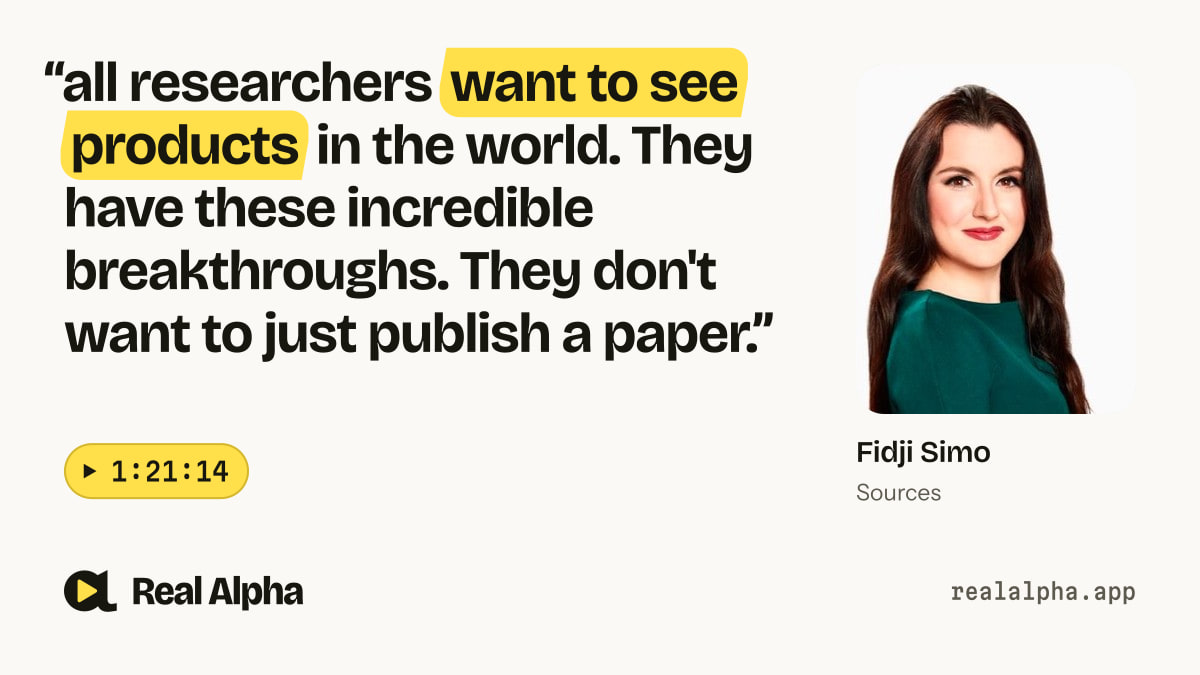
“all researchers want to see products in the world. They have these incredible breakthroughs. They don't want to just publish a paper.”
 Fidji Simoat 1:21:14 · Sources
Takeaways
- Research leaders set the long-term research direction.
- Researchers bring emerging breakthroughs to product teams.
- The Code Red affected ChatGPT teams, not long-term research.
About this segment
Fidji Simo says research leaders set the long-term direction, while product teams adapt when breakthroughs emerge. She says the Code Red did not affect long-term research teams.

Fidji Simo is CEO of Applications at OpenAI.
Led OpenAI's applications business after serving as Instacart's CEO, and now advises the company part-time.

Alex Heath, Host · Founder & host, Sources
Left The Verge to start Sources in 2025; it has made over $1M since, mostly from sponsors.
From “OpenAI's Fidji Simo on why ads are coming to ChatGPT”, Feb 11, 2026. Watch the full episode
Thanks. We'll look at and fix what's off.
Transcript
Transcribed by machine (Whisper) from the episode’s audio, so a word may be off here and there.
- 1:20:03
Right now, my understanding is you have all of the quote unquote normal company stuff, right? And Sam has research and compute. Correct. How does that work? Like how? I mean, obviously, you and he talk all the time, but like, how does that division actually play out internally? Because that seems like an unusual setup. yeah and for an unusual company right so i think it works for us but i think the thing that's really important to understand is like all our strengths come from being both a research and deployment company for me as a person in charge of deploying it's like i'm like a kid in a candy store having access to the best research lab in the world that can create these breakthrough technologies right so So I definitely could not, my org could not exist without the research lab.
- 1:20:55
Meanwhile, if you're in research, you want your breakthroughs to be experienced by people. So, you know, there is a little bit this narrative in press right now that there's tension between research and products. I think it's that opening eye is becoming big tech, right? That it's like people like you and ex-Facebook people coming in and the researchers are like, I don't want to actually have to focus on like shipping this stuff.
- 1:21:16
And like, I think that is the narrative. Yeah. That's the narrative, but that's so not the experience internally. Like, you know, Mark, who leads research, and I are tied at the hip. And what I can tell you is like, all researchers want to see products in the world. They have these incredible breakthroughs. They don't want to just publish a paper. They want to make sure that people use these discoveries, that companies use these discoveries.
- 1:21:37
So like researchers are pushing me on like, you know, how are we going to get this out? Like, why aren't we getting it in the hands of even more people? So there is definitely an appetite to get out there. And I think what Sam and Mark have done and Jacob so incredibly well is protect research to make sure that we can still invest in the very long term. So the thing that would be bad is if I was going to the research team and telling them I need these five things.
- 1:22:04
No GPUs for you. I need GPUs. Or like I didn't even think of that because I would never do that. But you get the GPUs, but like I need you to deliver these five things for the product. That's not how it works. The way it works is like, you know, Jakob and Mark set the research direction for the long run. And then, you know, after months of work, something incredible emerges. And I get a researcher pinging me being like, hey, I have something pretty cool.
- 1:22:30
How are you going to use it in chat? How are you going to use it for our enterprise products? And that's like the magic of the place. So we can do both the long-term research as well as, you know, continuing to innovate directly on our products. Is maybe some of this the code red and just the fact that resources were shifted to focus more on chat and it's more of a temporary thing? Do you think that could be where some of the narrative is coming from?
- 1:22:52
Maybe, but even when you look at the Code Red, that did not impact whatsoever the teams working on long-term research. They heard about the Code Red probably in a Slack channel and went back to their day and were not impacted at all. The teams that were impacted were the ChatGPT team or product research team that is working directly on chat. Those teams were impacted, but not the long-term research teams.
- 1:23:14
Are you out of that? Are we out of Code Red? We're still hoping to ship a new version of the chat model soon. And then we will exit the code red then. But, you know, even the code red, it's like it's a tool for us to accelerate execution. And I think that's a useful tool to marshal resources towards something.