The alpha, twice a week
That was 4 min.
Get the best new moments in your inbox every Wednesday and Saturday. It's free.
Check your inbox
We sent a link to your address. Click it to finish signing up. Not there in a minute? Look in spam.
or
Sourcery · 4 min · Nov 21, 2026
Orbital robots can free astronauts for higher-value work
 Ethan Barajas
 says station astronauts cost about $130,000 an hour to keep alive, while cargo handling takes 14 days per 60-day cycle.
In this episode
Full analysis- 2:15AI trained to perform care can learn the wrong lesson7 min
- 13:38AI's debut private-company list dwarfs a decade of cloud4 min
- 40:23AI could make expertise less central to human purpose2 min
- 22:03Orbital robots can free astronauts for higher-value work4 min
- 17:35AI inference could be far larger than its current real-world use2 min
- 35:58AI verification is the bottleneck to putting models to work3 min
- 29:33Venture investors should judge shocks on a 10-year horizon3 min
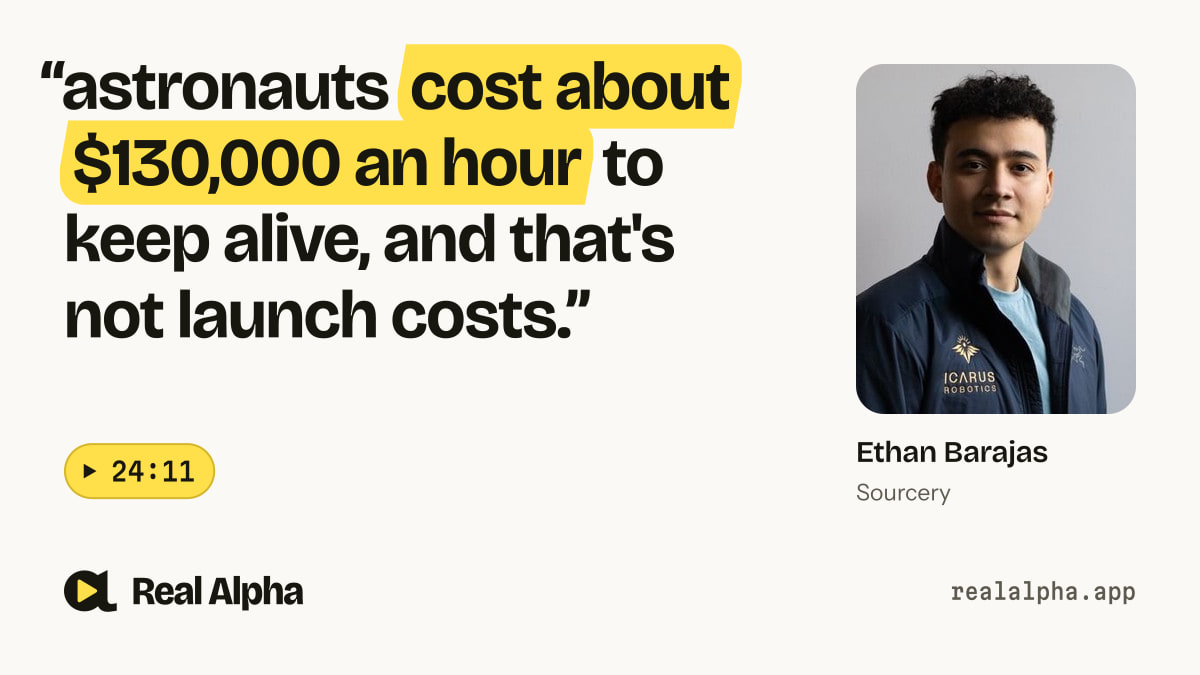
“astronauts cost about $130,000 an hour to keep alive, and that's not launch costs.”
 Ethan Barajasat 24:11 · Sourcery
Takeaways
- Keeping astronauts alive costs about $130,000 an hour, before launch costs.
- Cargo handling takes 14 days of each 60-day cycle.
- Robots could free astronauts for research and other specialized work.
About this segment
Ethan Barajas says station astronauts cost about $130,000 an hour to keep alive, while cargo handling takes 14 days per 60-day cycle. Icarus aims to move that work to robots so crews can focus on research.

Co-founder & CEO, Icarus Robotics
Builds dexterous robots to take routine labor off astronauts and expand the orbital economy.

Molly O'Shea, Host · Founder, Sourcery
Ex-Upfront Ventures investor; has interviewed Alex Karp and Palmer Luckey.
From “"It's So Over?" Emmett Shear, Brendan Foody, Byron Deeter & Nico Rosberg on Tech's Future”, Nov 21, 2026. Watch the full episode
Thanks. We'll look at and fix what's off.
Transcript
Transcribed by machine (Whisper) from the episode’s audio, so a word may be off here and there.
- 22:09
On-orbit robots for maintenance and logistics of large infrastructure. Our first robots launched the space station. We handed over in January to NASA, which will be very exciting. And then afterwards, they go outside the space station. All right. There's some major news. I don't know how to drop this one. I don't know how to let you know, but it looks like Jensen's no longer CEO of NVIDIA. They're one of your partners. How are you thinking through this? How does this affect the underlying ecosystem of tech companies?
- 22:38
Well, I mean, this week's been an interesting week. You see the NASDAQ drop, you see Anthropic come out at 1.4 instead of 2, and you know that's going to drop even worse. And then when you look at everybody with all of these rights agreements to compute and these new models and chips coming out, like, he was very much the voice of reason within that ecosystem. And now, without that voice of reason, what happens to the market?
- 23:00
What happens to these downstream players, the people putting these chips in robots, It's carrying out physical AI inside of really, really needed industries. And I think we're going to see a lot of negative downstream effects, and the Chinese really got what they wanted with this one. Damn. Yeah, so I guess what do you do? Yeah, I mean, so the big thing is you can't have too much reliance on one ecosystem anymore.
- 23:24
I think that's the big thing that we learned. Everybody can't be reliant on NVIDIA and only NVIDIA's chips and their models and Isaacson and things like that. You really need a diversification. and it points out that software is quite cheap now. Software, that moat, is not there as much as we thought, and the moat really comes from hardware and actual physical deployments. And so that's what you really need to focus on, bolstering your own models and the own things that you build internally, maybe on top of these, but you can't be entirely reliant on it.
- 23:51
And so that's something that we take to heart, where we're deploying our robots, we're sending them on orbit, we're working with NASA and all these companies to build off of a foundation of NASA. actually having your robots in environment working on physical tasks. So what do these robots replace, or what are you entering into the space economy that wasn't there before or could be more efficient? Yeah, I think one of the big things that people don't realize is space is like a lot of a maintenance game.
- 24:16
Like on the space station, astronauts cost about $130,000 an hour to keep alive, and that's not launch costs. You got like 50 people at any given time watching these guys do their work, and we send up about three and a half tons of cargo every 60 days. And so you have four guys that are worth $3.2 million a day moving cargo, right? And that takes 14 days just for them to move the cargo in and out of that vehicle on a 60-day duty cycle.
- 24:39
You want them developing the drugs that Varda is developing and bringing down for pharmaceutical markets. You want them doing semiconductors and fiber optics. And so we're bringing almost a very sexy forklift or an extra set of hands to take away those tasks from astronauts, but then at the same time build models based on zero G dynamics of robots operating in orbit and then that applies outside of the space station to maintenance and infrastructure maintenance and data centers now that they're regulated to hell down here terrestrially we're gonna see more and more volume sent on orbit and more and more maintenance needed whether it's satellites whether it's refueling whether it's large infrastructure and you need that intelligence layer and that robotics labor force to do that and that's exactly what we're building from first principles. So before we get to the hot takes,
- 25:25
and I'll just like preface that so you can think about it. Not that there's not many hot topics