The alpha, twice a week
That was 3 min.
Get the best new moments in your inbox every Wednesday and Saturday. It's free.
Check your inbox
We sent a link to your address. Click it to finish signing up. Not there in a minute? Look in spam.
or
MTS · 3 min · Nov 20, 2026
Organizational alignment is the AI bottleneck
 Arnab Bose
 argues that model intelligence is not the main constraint on enterprise AI.
The episode’s best minutes
Full analysis- 1:14Enterprise AI delivers gains when it coordinates full workflows3 min
- 3:46Organizational alignment is the AI bottleneck3 min
- 11:15Self-driving organizations could arrive by 2027Pro pick 4 min
- 2 more moments in the full episode
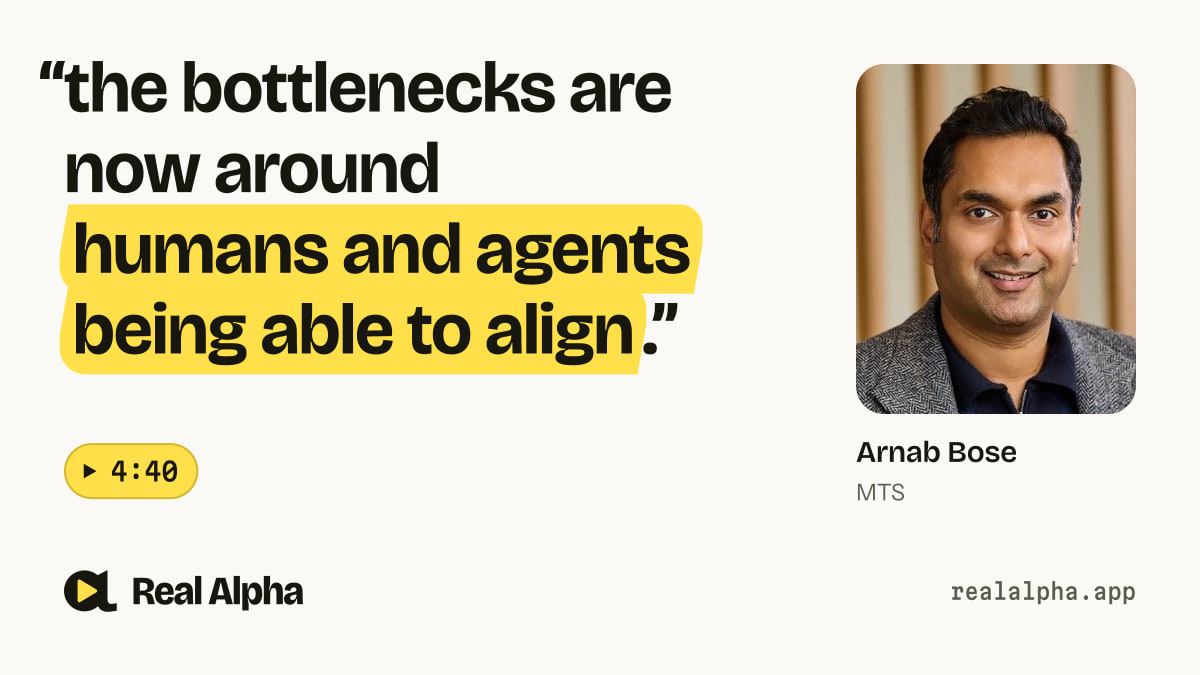
“the bottlenecks are now around humans and agents being able to align.”
 Arnab Boseat 4:40 · MTS
Takeaways
- The bottleneck is coordinating humans and agents.
- Agents need company-level context and quality standards.
- Work graphs can encode roles, responsibilities and workflows.
About this segment
Arnab Bose argues that model intelligence is not the main constraint on enterprise AI. Shared context, clear roles and aligned human-agent workflows are what let companies use it well.

Arnab Bose is chief product officer at Asana.
Built enterprise products reaching billions of users, and leads Asana’s product strategy with a focus on AI.

Theo Jaffee, Host · Co-founder & host, MTS
One of the first members of a16z's new media team; earlier hosted the Emergent Ventures-backed Theo Jaffee Podcast.

Sophia Dew, Host · Host, MTS
From “Self-Driving Enterprises Will Happen in 2027 | Arnab Bose”, Nov 20, 2026. Watch the full episode
Thanks. We'll look at and fix what's off.
Transcript
Transcribed by machine (Whisper) from the episode’s audio, so a word may be off here and there.
- 3:52
Yeah, this is really interesting because it feels like most people are just thinking about model capabilities. and the next benchmark that I might solve. But a little bit about what you're sharing here is that it's not just about how smart a model is. Rather, it's everything around it. It's the workflows. It's how it's actually being integrated into production software that influences what it can do.
- 4:18
And so do you think how we're thinking about the frontier of intelligence as an industry is maybe slightly overhyped? I mean, the intelligence is insane and it's mind-blowing. So I don't think you should be sort of underwhelmed by it by any means. But maybe the place where we need to focus on as an industry is how do you unlock the impact of that intelligence for these real-world outcomes? And so in my opinion, the bottlenecks are now around humans and agents being able to align.
- 4:51
The bottlenecks are around who gets to set the right level of context for those agents. and how do you get human and agent workflows to work end-to-end. So when I think about product strategy for Asana, we've been building alignment and collaboration software for over a decade, and it's built on this very specific system of work that we call the pyramid of clarity, which is encoded in our data model, that's the work graph.
- 5:16
We've got a lot of investment in that to ensure there's sharing rules, you can codify these business-critical workflows for human beings to align. And what I've seen is that alignment system we've built for humans actually works very well for agents because that metadata about who does what by when and how is something that agents can use to repeatedly do good, high-quality work. And it's also a way where you can assign agents a real role and persona and control who gets to set the context for them, who gets to give them memories that they reuse, versus who are just users of the agents, because perhaps those employees are not subject matter experts in terms of setting that bar, in terms of setting what the brand should look like, in terms of setting what the quality bar should be for identifying that high-value garment and whatnot.
- 6:04
So big area of focus for me is how do I unlock human agent workflows at scale and how do I set the right context for enterprises?