The alpha, twice a week
That was 4 min.
Get the best new moments in your inbox every Wednesday and Saturday. It's free.
Check your inbox
We sent a link to your address. Click it to finish signing up. Not there in a minute? Look in spam.
or
MTS · 4 min · Nov 20, 2026
Self-driving organizations could arrive by 2027
 Arnab Bose
 expects self-driving organizations to emerge by 2027, with AI accelerating end-to-end work while people move to higher-level goals and decisions.
The episode’s best minutes
Full analysis- 1:14Enterprise AI delivers gains when it coordinates full workflows3 min
- 3:46Organizational alignment is the AI bottleneck3 min
- 11:15Self-driving organizations could arrive by 2027Pro pick 4 min
- 2 more moments in the full episode
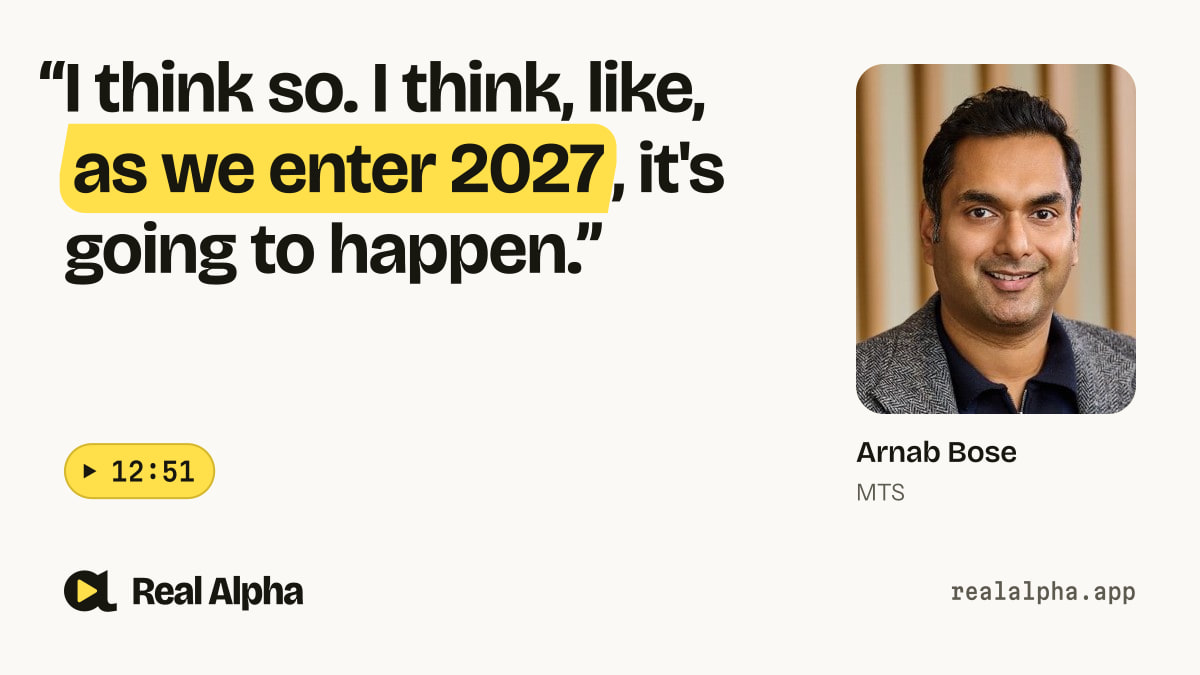
“I think so. I think, like, as we enter 2027, it's going to happen.”
 Arnab Boseat 12:51 · MTS
Takeaways Pro pick
- Bose predicts self-driving organizations as early as 2027.
- Automation can reveal the next bottleneck for a business.
- People still set goals and decide where to invest resources.
One of Pro's picks, open to you here. Try Pro free for 7 days
One of Pro's picks. The rest of the summary and the 3 takeaways are in Real Alpha Pro; the video, the quote and the transcript stay free.
Read it with Pro, 7 days freeAbout this segment
Arnab Bose expects self-driving organizations to emerge by 2027, with AI accelerating end-to-end work while people move to higher-level goals and decisions. He says even large enterprises could adopt the model.

Arnab Bose is chief product officer at Asana.
Built enterprise products reaching billions of users, and leads Asana’s product strategy with a focus on AI.

Theo Jaffee, Host · Co-founder & host, MTS
One of the first members of a16z's new media team; earlier hosted the Emergent Ventures-backed Theo Jaffee Podcast.

Sophia Dew, Host · Host, MTS
From “Self-Driving Enterprises Will Happen in 2027 | Arnab Bose”, Nov 20, 2026. Watch the full episode
Answers “Which jobs will AI replace, and which are safe?” See all 241 answers
Answers “What will AI look like in the next few years?” See all 395 answers
Thanks. We'll look at and fix what's off.
Transcript
Transcribed by machine (Whisper) from the episode’s audio, so a word may be off here and there.
- 11:22
might want to talk to, to then doing the follow-up, understanding the product needs, maybe improving some areas of the product and getting them to pay and sign a contract for that. So let's pretend in this hypothetical world, these end-to-end workflows get really good. Are we close to a future of a fully AI-driven business? Yeah, so one of the papers that I read before I joined Asana, the CEO at the time had written this for the company. He had a vision of building a self-driving organization, which we're all very invested in, and we're excited about bringing to reality.
- 11:58
and what we mean by self-driving is we'd love to elevate human beings and the human team members to more and more higher level outcomes and input and taste making. And so I don't think the answer really is that it's a fully automated company because some of these jobs to be done as they get automated, what will happen is the people working with them will get elevated to think about the next level of outcome, the next bottleneck, the next optimization, the next differentiation. And I think you'll start seeing an abundance of output and outcomes from that end-to-end process. That's at least our thinking and our rationale. Because what we're seeing is, yes, you can make a particular process go faster because you've identified a bottleneck and you're using AI, but that will just reveal the next step of growth for you as a company, as a business, and that's pretty exciting.
- 12:50
But in theory, can't you then apply it again and again and again? And so are we close to self-driving organizations? I think so. I think, like, as we enter 2027, it's going to happen. Yeah. What will that look like? What will that look like? I think it's pretty hard to imagine. There's just, like, a constant improvement. But my sort of ideal would be you could set goals that are hyper-ambitious, that break the ceiling of what was previously possible, and then push yourself and your team and you'll probably see them materialize much faster than you can ever imagine. And that's the kind of reality we'll start living and going forward. All right. If we were to just make that really clear and concrete, can you give me an example of how you envision a self-driving organization in 2027 playing out? Like what does that actually look
- 13:44
like? Are you picturing maybe a small indie hobbyist, one person entrepreneur building a a self-driving organization, or do you see a giant enterprise like FedEx, at that scale, building self-driving organizations? I think it would be possible for a giant enterprise like FedEx to build a self-driving organization. And I would say, as Asana, I'm a leader at Asana, I would want Asana to be a self-driving organization.
- 14:08
We would want to be in a world where any individual in my R&D team could come up with a big, hairy, audacious goal, they could set it, and it's maybe a budget decision we'd have to make. There's still taste-making over there, Like, okay, how much do you want to spend on R&D, token costs, sales and marketing for that initiative? And how much conviction do you have on the goal? That is an interesting place of human alignment.
- 14:32
If you have enough conviction on setting resources against a goal and you believe the KR, the key result is achievable. Yeah. Yep. Okay, what does this look like in terms of the makeup of the company?