The alpha, twice a week
That was 4 min.
Get the best new moments in your inbox every Wednesday and Saturday. It's free.
Check your inbox
We sent a link to your address. Click it to finish signing up. Not there in a minute? Look in spam.
or
Possible · 4 min · Nov 18, 2026
Pacing AI means steering, not simply slowing down
 Reid Hoffman
 argues that pacing AI means steering its development, not just slowing it.
In this episode
Full analysis- 15:07AI can compress early drug discovery from years to weeks5 min
- 9:56AI adoption depends on helping workers through job disruptionPro pick 5 min
- 4:57Data center deals should deliver local benefits4 min
- 1:02Pacing AI means steering, not simply slowing down4 min
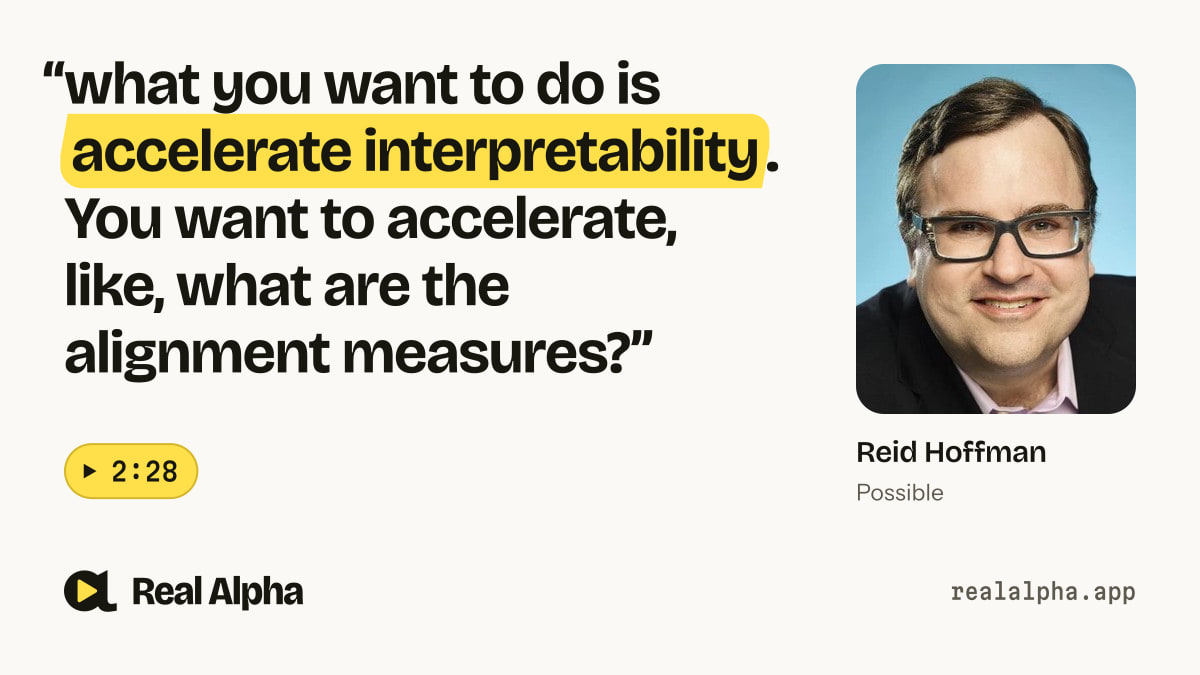
“what you want to do is accelerate interpretability. You want to accelerate, like, what are the alignment measures?”
 Reid Hoffmanat 2:28 · Possible
Takeaways
- Treat pacing as steering rather than pausing.
- Accelerate interpretability and alignment measures.
- Use early systems to learn which safeguards matter.
About this segment
Reid Hoffman argues that pacing AI means steering its development, not just slowing it. He says to advance interpretability and alignment work alongside recursive self-improvement, then use early systems to identify safeguards.

Reid Hoffman, Host
Co-founder, Manas AI
Co-founded LinkedIn; one of OpenAI's first investors; Greylock partner.
- AF
Aria Finger, Host
From “Live at Masters of Scale: AI pacing and data centers | Reid Hoffman”, Nov 18, 2026. Watch the full episode
Thanks. We'll look at and fix what's off.
Transcript
Transcribed by machine (Whisper) from the episode’s audio, so a word may be off here and there.
- 1:07
We're on the clock, so let's go. We're going to talk about speeding up or slowing down. On September 12th, Anthropics' Dario Amodei published, We Must Pace the Frontier. He called for slower advances so safety could catch up. But this week, he argued that Anthropics should stay at the frontier to make the industry safer. Both Dario and Sam say pacing is needed, but we have to stay at the frontier. Can we keep those two commitments together in practice? So I could just say yes and beat the clock. And look, more substantive is part of what pacing is. Pacing is not pausing. Pacing is not even necessarily slowing down, although there's a little bit of an implicature about a choice between as fast as possible and slower. And as you know, the actual metaphor in this that I like to use versus acceleration, deacceleration is steering.
- 1:59
And so, for example, one of the things that's most common in the discourse right now, especially in Silicon Valley, is what are we doing with recursive self-improvement? And part of the anxiety is if we say, hey, just improve yourself as much as you can. We don't know how to guarantee the alignment of that as it's happening. And so he's like, well, should you pace? Should you slow down? Should you pause? All reasonable, rational questions. But actually, I think the actual The answer of that, and as part of steering, is, well, what you want to do is accelerate interpretability.
- 2:34
You want to accelerate, like, what are the alignment measures? And part of the reason why it's not pause, for example, and pacing is better, is that, well, we've got to see what, like, you have to start doing some of the RSI, the recursive self-improvement, in order to know and see what, you know, kind of, what are the alignment measures? What is really important? Now, part of the thing I think the hugging face thing was so valuable on was here is, oh, a set of concerns that people had talked about theoretically demonstrated on like a thing that, you know, condolences, apologies, the hugging face don't really matter.
- 3:17
right the the these these these these agents yes really interesting swarm behavior yes interesting self-sacrifice yes yes interesting following following stuff yes hacking the tool set that is used to kind of get out and get to the web and you know there's probably other you know agentic frameworks we discovered other things australian government other ways of of doing this but like in the ones that don't really matter we now know what kind of alignment stuff is really important. So you say, well, okay, we're building recursive self-improvement AI. Well, let's make sure that we have a harder cutoff from the internet, right? Like as opposed to the, oh, you just put it in the data center and, you know, we put it in a virtual box, but with like 3,000 tools of which probably 2,900 of them are hackable by something that's smart. You go, no, no, when
- 4:07
we do this one, we're going to do this one with a, no, no, we've literally actually gone, okay, this is the physical this is the connection and you know as a kind of a as an instance and that's the kind of thing that is the stuff which you're doing and you say well that tangibly gets to pacing as a uh as a as a phenomena because like for example you said like like here is a rational question for recursive self-improvement alignment question look how much compute should you put into to the AI that you're using for interpretability, management, alignment, et cetera, in parallel with the AI that you are doing to recursively self-improve.
- 4:49
And that will create a certain pacing, but it's a pacing that's oriented towards steering. And part of steering, of course, is as all of the, you know, Dario, Sam, and all of these other leaders. It is important that we build the future.