The alpha, twice a week
That was 4 min.
Get the best new moments in your inbox every Wednesday and Saturday. It's free.
Check your inbox
We sent a link to your address. Click it to finish signing up. Not there in a minute? Look in spam.
or
The Information's TITV · 4 min · Oct 16, 2026
Palo Alto uses a harness to measure AI-assisted development
 Meerah Rajavel
 routes most AI work through a harness that traces requirements to production and measures quality, security, speed and efficiency.
In this episode
Full analysis- 29:53CoreWeave’s debt is layered around customer contracts6 min
- 58:29Michael objects to giving AI models authority over commandersPro pick 2 min
- 1:09:59Michael favors American open-source AI but flags China risksPro pick 4 min
- 11:29Palo Alto uses a harness to measure AI-assisted development4 min
- 41:10Power access favors experienced data center operators3 min
- 18:33Modal sees software as its advantage over neoclouds3 min
- 47:58Pentagon AI use grew from 80,000 to 1.7 million3 min
- 1:20:33Pentagon financing targets supply-chain gaps3 min
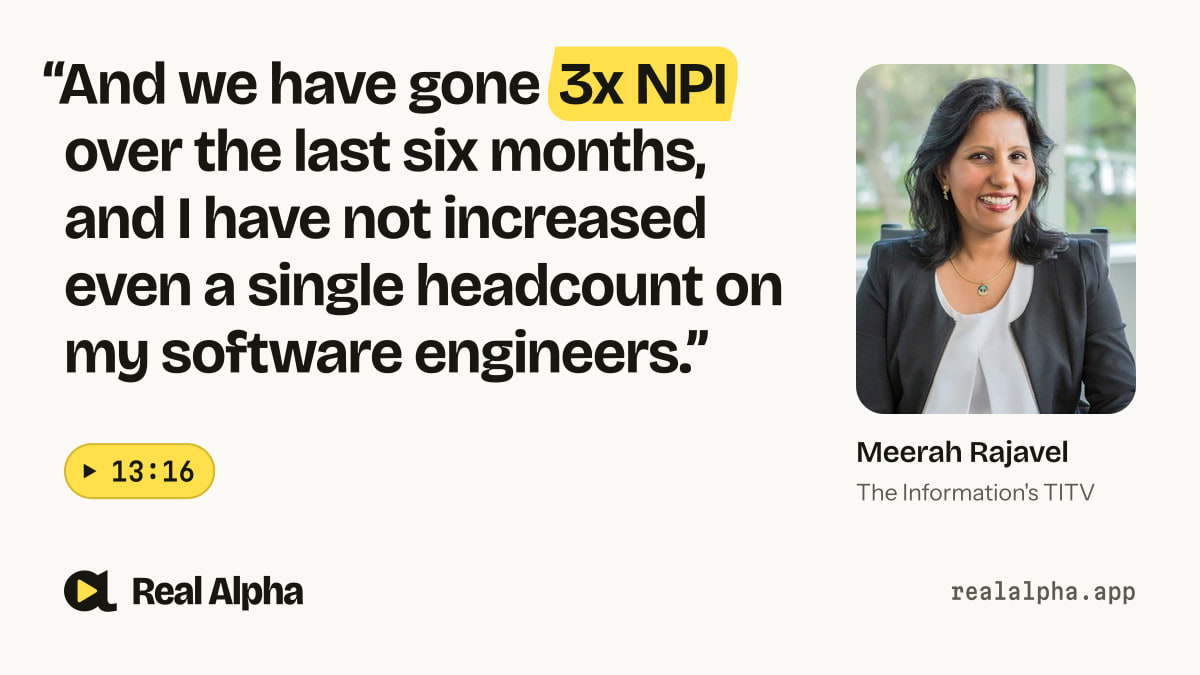
“And we have gone 3x NPI over the last six months, and I have not increased even a single headcount on my software engineers.”
 Meerah Rajavelat 13:16 · The Information's TITV
Takeaways
- Route AI work through a harness linking requirements to production releases.
- Track code quality, security, release velocity and efficiency.
- New product introductions grew 3x in six months without more engineers.
About this segment
Meerah Rajavel routes most AI work through a harness that traces requirements to production and measures quality, security, speed and efficiency. Her team tripled new product introductions without adding software engineers.

Senior vice president & chief information officer, Palo Alto Networks
Leads Palo Alto Networks’ global IT strategy, scaling technology and delivering solutions for its worldwide teams.

Akash Pasricha, Host · Host, TITV
Led The Information's Pro subscription and co-wrote its flagship newsletter, The Briefing.
From “The Pentagon’s CTO Explains the Anthropic Rift and Superintelligence Task Force”, Oct 16, 2026. Watch the full episode
Answers “Is AI paying off for companies?” See all 54 answers
Thanks. We'll look at and fix what's off.
Transcript
Transcribed by machine (Whisper) from the episode’s audio, so a word may be off here and there.
- 11:33
This is something we've talked about, productivity being one of the most difficult things to measure. How do you prevent that? Do you have to, do employees have to say that, you know, I used, This is AI generated, this is non-AI generated. Like, what's your method? Absolutely. Great question, right? I mean, this has been a ramp. I mean, the last, I would say, three, six months, we have actually put a lot of focus on our SDLC harness.
- 11:59
And the harness is the way people can come into it. And that's the way we are watching where the spend is. When somebody is outside, we can see, like, for example, in IT, I have a harness that actually connects to both our first-party applications as well as third-party applications. Anybody using AI has to use through the harness. I also know if they're outside the harness where the spend is and we nudge them back into the harness because when I put them in the harness, I'm not just talking about coding.
- 12:28
I'm tracing from PRD all the way to what they're releasing in production, right? Today, I would say in some technologies, it's a little harder to trace it, but I'm able to get the visibility for over 85, 90% of the work that's happening. So I look at it as three things. One, what is the quality of code they're producing? How secure it is? Two, what is the velocity of outcomes that we are generating or release outcomes?
- 12:56
Three, how efficiently we produce that work? For a simple example, I mean, the market is heating up, security is heating up. We are actually, you know, doing a lot of M&A and the new product introduction for Palo Alto has gone skyrocketing. I mean, for me as a CIO and my organization is responsible for NPI, every single innovation that comes to the business. And we have gone 3x NPI over the last six months, and I have not increased even a single headcount on my software engineers.
- 13:30
But are they good product? Like, this is the question. Are they good product in a sense? Help me understand the sense of, like, is AI producing good code? Yeah, yeah, no, no. I mean, I guess what I'm saying, so product launches are one thing, but have the products meet the goals that you have set. Yeah, yes, yes, yes. Because it is human in the loop, Akash, right? I mean, I don't believe in autonomous agents yet.
- 13:56
We are not at the place where, you know, having autonomy fully, especially when you're looking for outcomes and the bigger things. I always have the code is generated. There is always a human review before the release. And also there is actually a user testing before the release. This also brings us to what we are launching today with XDR1 because the XDR1 will give me the endpoint security guardrail.
- 14:19
So I can be a lot more taking higher risk on because I'll have a full visibility of how the AI, I mean, we already rolled it inside, by the way, but we'll have a full visibility of how the agent is behaving and how I can have the appropriate guardrails and kill switches to protect it if it's going wrong. And it's also connected to our, you know, SOC XIM solution, which has a way to respond in an autonomous fashion. To go back here and question, I think it really comes down to having the high risk or higher value things, putting human in the loop. And the second thing is really looking at it from the point of you have the right security guardrails. And if you need to go down the path of saying no, we have a quick way to respond to it.