The alpha, twice a week
That was 4 min.
Get the best new moments in your inbox every Wednesday and Saturday. It's free.
Check your inbox
We sent a link to your address. Click it to finish signing up. Not there in a minute? Look in spam.
or
Dwarkesh Podcast · 4 min · Nov 24, 2026
Partial automation can sharply accelerate AI research
 Dwarkesh Patel
He argues that human-in-the-loop research can accelerate before full automation.
The episode’s best minutes
Full episode- 44:08Evidence for AI research uplift is suggestive, not conclusivePro pick 5 min
- 49:12Partial automation can sharply accelerate AI researchPro pick 4 min
- 1:00:22AI colleagues could take on whole projects by next yearPro pick 3 min
- 5 more moments in the full episode
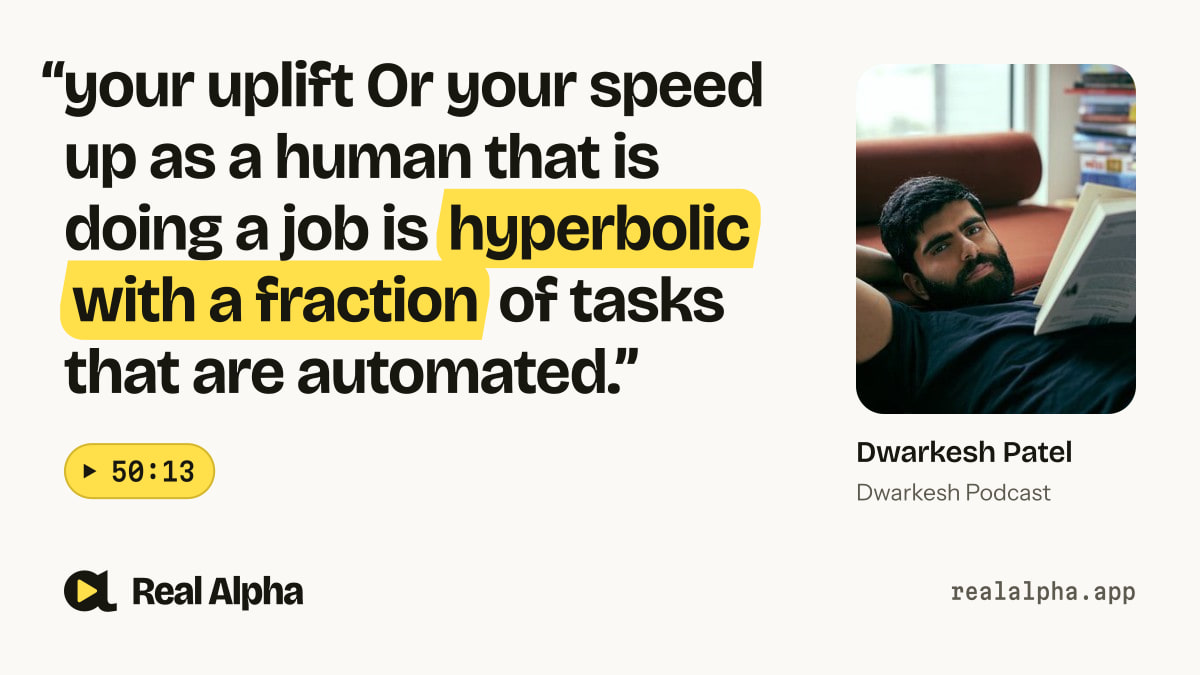
“your uplift Or your speed up as a human that is doing a job is hyperbolic with a fraction of tasks that are automated.”
 Dwarkesh Patelat 50:13 · Dwarkesh Podcast
Takeaways Pro pick
- Full automation is not required for major research uplift.
- The speedup grows as AI handles a larger share of the work.
- Researchers can target the tasks that still limit progress.
One of Pro's picks, open to you here. Try Pro free for 7 days
One of Pro's picks. The rest of the summary and the 3 takeaways are in Real Alpha Pro; the video, the quote and the transcript stay free.
Read it with Pro, 7 days freeAbout this segment
He argues that human-in-the-loop research can accelerate before full automation. As AI takes on more tasks, researchers can focus on the remaining bottlenecks.

Dwarkesh Patel, Host
Host, Dwarkesh Podcast
Co-wrote The Scaling Era, an oral history of AI; named to TIME100 AI.
From “Responding to objections to recursive self-improvement”, Nov 24, 2026. Watch the full episode
Answers “Is AI progress slowing down?” See all 75 answers
Thanks. We'll look at and fix what's off.
Transcript
From the transcript Dwarkesh Podcast publishes with the episode.
- 49:17
Okay, so there's this Twitter thread by Augustin LeBron, who I think you've actually had on the show in the past. And it's quite thorough. There's a particular point I want to go into. And I think it's worth saying ahead of time that he starts this whole thread by saying the essay actually updated him significantly in the direction of short timelines, RSI, etc.
- 49:36
You don't need to make me feel good. Okay, so I'll get to the point. So basically he says something like this. Even if I grant that AI use dramatically accelerates progress, that still does not imply recursive improvement. If even one piece of the feedback loop needs a human, then you definitionally don't have recursion. That's a high bar to pass when dealing with general frontier advancements. So I think that's correct.
- 49:57
And that is one of the main reasons that I think it's quite possible that we're looking into the 2030s before we get full automation of AI research and subsequently super intelligence, right? At the same time, the research that you have automated so far is speeding you up in the things that you have not yet automated. Now, an important thing to keep in mind is that your uplift Or your speed up as a human that is doing a job is hyperbolic with a fraction of tasks that are automated. Let me explain what I mean.
- 50:28
In computer science and in systems, there's this concept of Amdahl's Law, which basically says that when you paralyze a system or when something goes faster, you're bottlenecked by the slowest moving part. However, I think that is worth appreciating is that as the fraction that is going really fast increases, the amount faster the whole system is going is not even exponential, it's hyperbolic. So if an AI system can do the same task right now 50 times faster than a human can, we're going to get 50 times more work done in a week than a human can.
- 50:58
Suppose you only automate half the work, then the whole system with the human and the AI is going twice as fast. Now, suppose you automate 90 percent of the work, Then the whole system is going 8.5 times as fast. And suppose you automate 99% of the work, the whole system is going now 30 something times as fast. This is all to say that in a world where there's only a little bit, the AI researcher has to be equivalent of, Claude, keep trying harder.
- 51:25
I mean, of course, it'll be more substantive than that, right? But they're getting tremendous amounts of uplift and there's important parts of the puzzle that they're still doing while overseeing huge amounts of AI labor. That still leads to incredibly fast progress and that progress, the AI researchers will be gearing towards the parts that they haven't automated yet, right? They're not stupid. They realize that this is the part that I'm still having to do and this is the bottleneck to fully automating AI research and getting huge So that's the thing we got to focus on next.
- 51:52
It could be the case, I mean, there's many reasons this picture could be wrong. One is that the AIs and the humans are not able to work well together. And so you don't get this way, you don't get the humans just like slotting in in the hardest to animate tasks. I feel like we're already seeing with people using coding agents that in fact, people can work well together. By the way, this hyperbolic trend, I think helps explain why there's been such a mood shift on coding agents over the last year.
- 52:18
Karpathy came on the podcast, what is it, a little bit a year ago? Yeah. And he was like, these agents, they're actually making me less productive. He didn't say that, but he was like, I just want to use the cursor thing where it autocompletes. I don't want like crazy agents that are doing all this crazy stuff. It doesn't work. And now he's just updated very strongly in favor of like, this is a huge product to improve and people are not taking this seriously enough.
- 52:38
Many others have done this. DHH, which is the guy who made Ruby on Rails, had this similar evolution. The underlying trend is a hyperbolic increase in the uplift from a linear increase in the amount of tasks that are automated or the fraction of tasks that are automated.