The alpha, twice a week
That was 3 min.
Get the best new moments in your inbox every Wednesday and Saturday. It's free.
Check your inbox
We sent a link to your address. Click it to finish signing up. Not there in a minute? Look in spam.
or
Dwarkesh Podcast · 3 min · Nov 24, 2026
AI colleagues could take on whole projects by next year
 Dwarkesh Patel
He predicts that AI could soon act like a 24/7 colleague owning open-ended projects, while still lagging humans at high-quality work.
The episode’s best minutes
Full episode- 44:08Evidence for AI research uplift is suggestive, not conclusivePro pick 5 min
- 49:12Partial automation can sharply accelerate AI researchPro pick 4 min
- 1:00:22AI colleagues could take on whole projects by next yearPro pick 3 min
- 5 more moments in the full episode
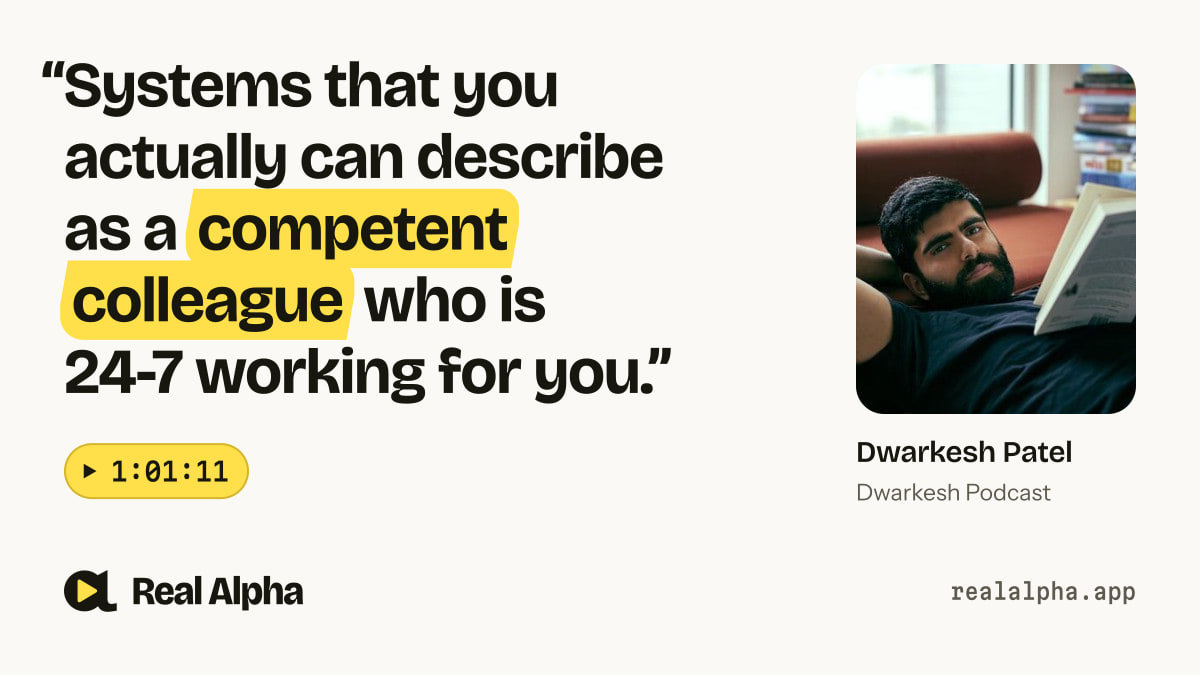
“Systems that you actually can describe as a competent colleague who is 24-7 working for you.”
 Dwarkesh Patelat 1:01:11 · Dwarkesh Podcast
Takeaways Pro pick
- AI agents may take responsibility for whole projects.
- Low cost could make AI teams practical before they reach expert quality.
- He expects the intelligence explosion around 2028–2029.
One of Pro's picks, open to you here. Try Pro free for 7 days
One of Pro's picks. The rest of the summary and the 3 takeaways are in Real Alpha Pro; the video, the quote and the transcript stay free.
Read it with Pro, 7 days freeAbout this segment
He predicts that AI could soon act like a 24/7 colleague owning open-ended projects, while still lagging humans at high-quality work. He expects an intelligence explosion later, around 2028–2029.

Dwarkesh Patel, Host
Host, Dwarkesh Podcast
Co-wrote The Scaling Era, an oral history of AI; named to TIME100 AI.
From “Responding to objections to recursive self-improvement”, Nov 24, 2026. Watch the full episode
Answers “When will we get AGI?” See all 40 answers
Answers “What will AI look like in the next few years?” See all 395 answers
Answers “Is AI progress slowing down?” See all 75 answers
Thanks. We'll look at and fix what's off.
Transcript
From the transcript Dwarkesh Podcast publishes with the episode.
- 1:00:27
So as I've gone through a bunch of these different objections to prep for this conversation, I had a few takeaways. It is incredibly important to make very clear, especially because we're talking about potentially insane worlds, what you actually think versus what you think is reasonable or possible. There's all these muddy concepts. And so I do wonder if it is worth you re-articulating here What you think is most likely to happen over the next couple of years or what you wouldn't be surprised.
- 1:01:02
You can phrase it however you want, but like, you know, just paint a picture for me. Like, what do the next couple of years look like?
- 1:01:12
I think by the end of next year, we'll have... Systems that you actually can describe as a competent colleague who is 24-7 working for you. I think current personal assistant type things like Muse or Duet or Dot are very weak versions of what we will see over the next year where it really does feel like there is somebody on Slack who's, you can just hand off assignments and very open ended assignments.
- 1:01:39
Not just a specific well -scoped task but they're owning whole projects And a key factor that is going to be different about this world than what it What it is like to hire a human now, is that AI systems are so cheap in comparison to humans. That you don't just go hire 100 people for a task or something and then go shed the entire team and then go hire five people for this other task. And so I think you should imagine that in the future, because AI systems are cheaper, it'll be more like hiring a department of very competent people to own a particular project for you.
- 1:02:14
Maybe in more concrete terms, I would expect that the AIs by the end of next year will be worse than my human video editors. But I could like passively have a podcast where I don't personally video edit, no human video edits. And the AIs, just like the AIs doing the work, we could like actually run a podcast that way. Yeah, interesting.
- 1:02:36
Just like AIs can already do a lot of things that humans can do now, but just sort of at like a very mediocre, passable level. But it's like if you want to do it at a really high bar, if you have a high bar, you're still going to hire humans. That's sort of your argument here.
- 1:02:48
Like some parts of software are like this today. Yeah. And I think that will happen for a wider range of knowledge work tasks. Yeah. I don't think we'll see the intelligence explosion next year. Okay. I expect that will happen, you know... From 2028 to 2029 basically. And so we will see the publicly deployed systems will continue getting better in this way. The internal systems, because AI companies will be specifically trying to make their systems especially good at RSI, especially good at doing ML research.
- 1:03:23
They will just have like, the way that software is way ahead of video editing right now, ML research will be way ahead of video editing in the future. And I'm really concerned about that, obviously.