The alpha, twice a week
That was 3 min.
Get the best new moments in your inbox every Wednesday and Saturday. It's free.
Check your inbox
We sent a link to your address. Click it to finish signing up. Not there in a minute? Look in spam.
or
Sourcery · 3 min · Nov 10, 2026
Partner payment failures pushed Mercor to own expert payouts
 Brendan Foody
After a partner's public payout failures flooded Mercor with support tickets, it took direct responsibility for paying experts.
In this episode
Full analysis- 43:35Enterprise AI adoption follows inference spending6 min
- 12:09Scalable interviews help find rare high-quality experts3 min
- 5:30Mercor sells training environments, not just expert access3 min
- 36:55AI companies need different moats at each layer4 min
- 2:19Partner payment failures pushed Mercor to own expert payouts3 min
- 28:28DeepTune filled Mercor's gap in simulated work apps3 min
- 19:53Seed-stage customer failures shaped Foody's operating cadence4 min
- 15:28Mercor treats frontier research as a signal for wider adoption3 min
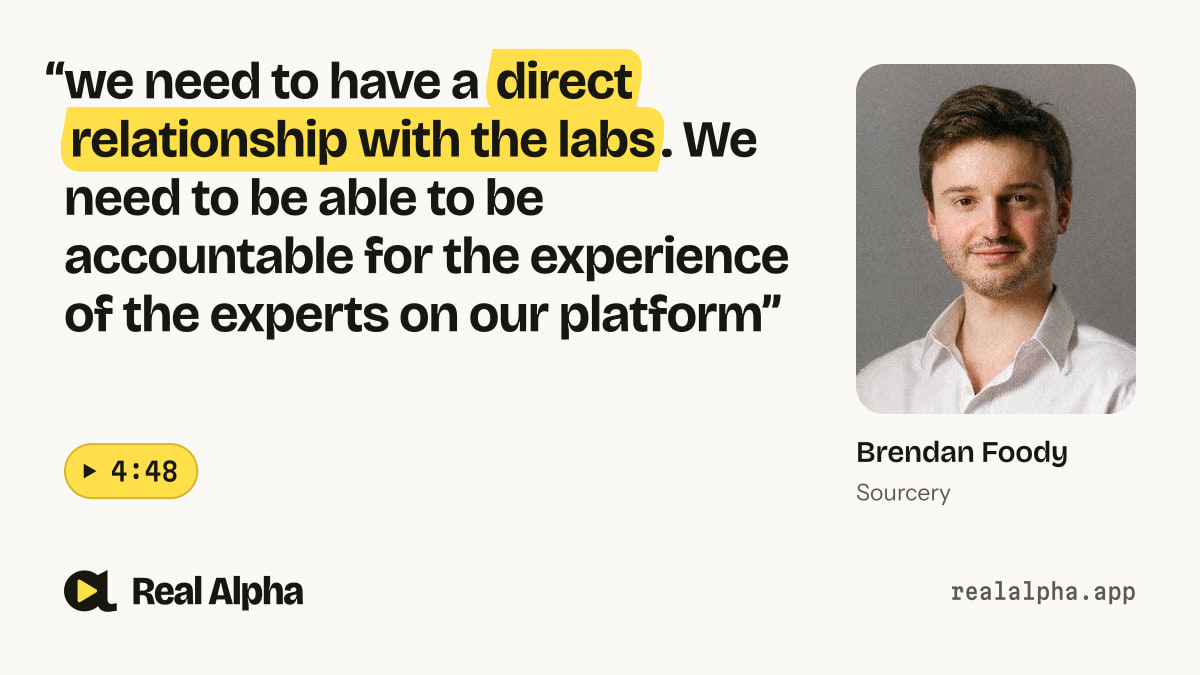
“we need to have a direct relationship with the labs. We need to be able to be accountable for the experience of the experts on our platform”
 Brendan Foodyat 4:48 · Sourcery
Takeaways
- A partner's missed payments generated support tickets from over 1,000 workers.
- Mercor decided to work directly with labs and own payment reliability.
- The company has paid out nearly $1 billion historically.
About this segment
After a partner's public payout failures flooded Mercor with support tickets, it took direct responsibility for paying experts. Brendan Foody says it has since paid nearly $1 billion without major issues.

Brendan Foody is co-founder and CEO of Mercor.
Co-founded Mercor, a labor marketplace supplying AI companies with expert data, paying tens of millions weekly.

Molly O'Shea, Host · Founder, Sourcery
Ex-Upfront Ventures investor; has interviewed Alex Karp and Palmer Luckey.
From “Mercor Raises $750M at $20B Valuation | CEO Brendan Foody”, Nov 10, 2026. Watch the full episode
Thanks. We'll look at and fix what's off.
Transcript
Transcribed by machine (Whisper) from the episode’s audio, so a word may be off here and there.
- 2:26
down how Mercore is operationally structured. So I know you want to talk about reinforcement learning environments a bit, also known as RL environments. So if you break that down, how the products of Mercore work, how does it all fit in? Yeah. So there's broadly three main products that we have to produce a given data type. The first product is what we built initially, our talent platform, where we have over 5 million people actively looking for work, pay out over $4 million a day. 70% of the people come from referrals. So there's a lot of network effects associated with how we can mobilize software engineers, doctors, lawyers, etc. for any specific type of data that we want to create in the economy. From there, we onboard those experts to Studio, our data platform, where they have an AI copilot and all of the Agenda QC and automated
- 3:21
capabilities for how they would create an RL environment, populating all the context that mirrors what they would do in their job, all the tasks, all the verifiers, etc. And then the third platform is our AI project manager, where we basically automate all of the manual work associated with how we would manage all the experts on these projects. So similar to how we We would have project managers setting KPIs for people, saying who's doing a good job, who's doing a bad job, giving them feedback.
- 3:52
We now have agents that are autonomously running these projects, hiring people, determining the data quality and all that. ultimately being accountable to the customer outcomes. So you're doing $5 million in payouts a day? Yeah, not well over that, yeah. How does that work? It uses Stripe Connect as the back end. I love how you go right into the infrastructure answer. The team is spectacular. I mean, it's been incredible because one of the things we realized early on is we were working with another player in the space that was having a lot of payout issues very publicly where we were providing talent to them.
- 4:35
And we got flooded with support tickets that we'd hired over 1,000 people for them, people often in third world countries. And they were not getting paid and struggling to put food on the table for their families as literally we were receiving many support tickets about that. And so really, that was one of the large catalysts for we need to have a direct relationship with the labs. We need to be able to be accountable for the experience of the experts on our platform and making sure that they get paid on time. And we need to over invest in how do we have a world class payments team that never makes mistakes and always make sure that people are paid out.
- 5:14
And so to date, we've, you know, paid out just about a billion dollars historically, which is on a pretty steep ramp. And we haven't had any major issues or of that sort. And so it's been an incredible process of how we scale the payments team.