The alpha, twice a week
That was 4 min.
Get the best new moments in your inbox every Wednesday and Saturday. It's free.
Check your inbox
We sent a link to your address. Click it to finish signing up. Not there in a minute? Look in spam.
or
Sourcery · 4 min · Nov 10, 2026
Seed-stage customer failures shaped Foody's operating cadence
 Brendan Foody
Many early customers were seed-stage startups, so their failures repeatedly disrupted Mercor.
In this episode
Full analysis- 43:35Enterprise AI adoption follows inference spending6 min
- 12:09Scalable interviews help find rare high-quality experts3 min
- 5:30Mercor sells training environments, not just expert access3 min
- 36:55AI companies need different moats at each layer4 min
- 2:19Partner payment failures pushed Mercor to own expert payouts3 min
- 28:28DeepTune filled Mercor's gap in simulated work apps3 min
- 19:53Seed-stage customer failures shaped Foody's operating cadence4 min
- 15:28Mercor treats frontier research as a signal for wider adoption3 min
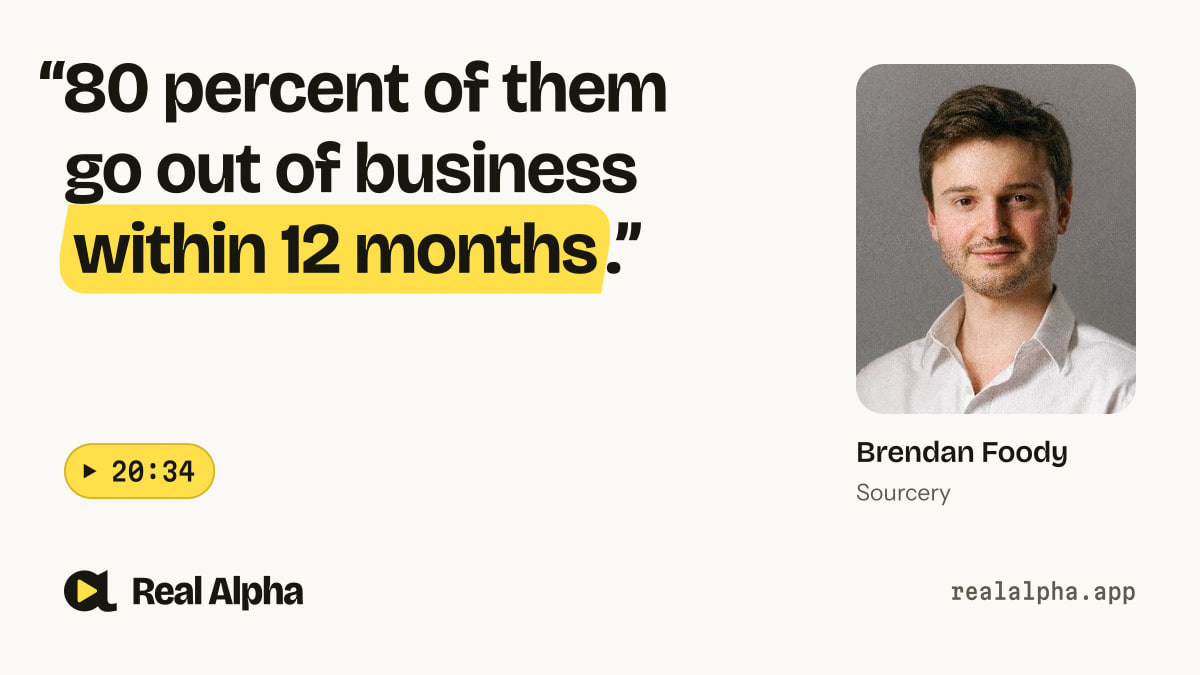
“80 percent of them go out of business within 12 months.”
 Brendan Foodyat 20:34 · Sourcery
Takeaways
- Foody says 80% of early seed-stage customers failed within a year.
- In rough patches, he rallies the team; in good times, he surfaces problems.
- He tracks customer and expert outcomes rather than weekly revenue graphs.
About this segment
Many early customers were seed-stage startups, so their failures repeatedly disrupted Mercor. Brendan Foody says he adjusts his message to the team's situation and focuses attention on customer and expert value over weekly revenue.

Brendan Foody is co-founder and CEO of Mercor.
Co-founded Mercor, a labor marketplace supplying AI companies with expert data, paying tens of millions weekly.

Molly O'Shea, Host · Founder, Sourcery
Ex-Upfront Ventures investor; has interviewed Alex Karp and Palmer Luckey.
From “Mercor Raises $750M at $20B Valuation | CEO Brendan Foody”, Nov 10, 2026. Watch the full episode
Thanks. We'll look at and fix what's off.
Transcript
Transcribed by machine (Whisper) from the episode’s audio, so a word may be off here and there.
- 20:00
about how do we build a legendary company that solves this problem of how do humans fit into the economy over the next decade? What were the biggest challenges that you had to overcome? There's been so many. I mean, I think that a lot of people who haven't actually founded companies don't know the feeling of just getting punched in the face over and over again. And, you know, We've had so many cases where we've lost our seed stage customers early on because the initial business for the first roughly year and a half was all seed stage companies.
- 20:39
And so, you know, 80 percent of them go out of business within 12 months. And it was sort of fighting that constant tension. Some of them became large companies like Cognition. um but that was definitely always a little bit painful um there have been uh cases like the security incident there's been cases where uh we lose a early member of the team like there's so many things where you just get punched in the face and i think founders gain an appreciation that like chaos is the norm and you just have to get used to uh chewing glass and staring to the best as elon says because ultimately it's the impact on the other side of that five to ten year journey that is motivating and makes it all worth it how do you manage that for your team it's really interesting like we i think we so i saw you at the upfront summit not too long ago and i was
- 21:43
interviewing Alfred Lin on stage and something that he's talked about a couple of times, even through our interviews, is they like to be shock absorbers for their founders and their companies. So do you like to be a shock absorber for your employees? How do you help direct them and let them know what's going on? I agree with this. I think what Alfred was saying is super accurate that when everyone feels like they're on top of the world, that's when you need to be cracking down on what are all the things going wrong. And when things are not going well and it's one of the rough patches, that's when you want to be the cheerleader that's telling everyone how good a job they're doing and helping to rally the company. I think that that is certainly super important. The other thing that relates to this is just driving the long-term orientation.
- 22:32
like even on our executive team someone like uh put up like a weekly revenue graph and i was like no we i don't want the company like looking at this right it's like the company should be looking at how happy are our customers how happy are our experts um how well utilized our experts all these different things that like actually drive creating value in the world um and how that compounds Because I think that that is one of, as I've learned and been fortunate to get insights from people who've been at a lot of the legendary companies early on, this long-term orientation is one of the most important characteristics of the people and the companies that accomplish extraordinary things.
- 23:20
Who are some people that you look up to? Well, I do think Elon is the greatest entrepreneur by results. I wish he didn't get into politics so much, but I think luckily he's out of it.