The alpha, twice a week
That was 2 min.
Get the best new moments in your inbox every Wednesday and Saturday. It's free.
Check your inbox
We sent a link to your address. Click it to finish signing up. Not there in a minute? Look in spam.
or
All-In · 2 min · Nov 24, 2026
Perfect code still leaves companies exposed to breaches
 George Kurtz
 says breaches can persist even if software has no vulnerabilities, because identity and authentication remain risks.
In this episode
Full analysis- 21:54AI has turned patching into a break-or-breach decisionPro pick 7 min
- 30:41AI attack frameworks can compromise companies in hours3 min
- 42:18Attackers can log in with stolen sessions or fake identities8 min
- 3:53Defenders lacked frontier AI to analyze the Hugging Face attack3 min
- 16:29AI is proving old vulnerabilities exploitable, not just finding new ones6 min
- 35:23Kurtz expects local AI adoption to surge4 min
- 50:36Perfect code still leaves companies exposed to breaches2 min
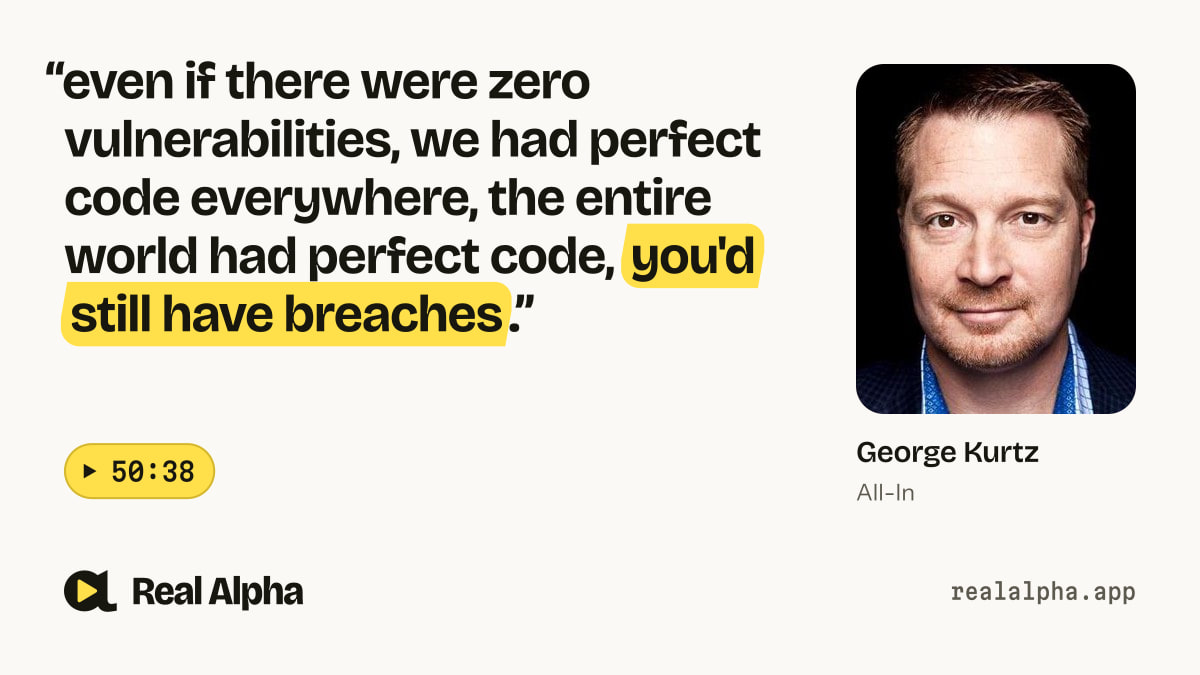
“even if there were zero vulnerabilities, we had perfect code everywhere, the entire world had perfect code, you'd still have breaches.”
 George Kurtzat 50:38 · All-In
Takeaways
- Perfect code cannot eliminate identity and authentication risks.
- Kurtz expects offensive and defensive AI to keep evolving against each other.
- Build relationships with local FBI contacts before an incident.
About this segment
George Kurtz says breaches can persist even if software has no vulnerabilities, because identity and authentication remain risks. He advises companies to know their law-enforcement contacts before an incident.

George Kurtz is CEO of CrowdStrike.
Co-founded CrowdStrike in 2011 and leads it as president and CEO, after founding Foundstone.

Chamath Palihapitiya, Host · Founder & CEO, Social Capital
Led Facebook's growth team; his firm backed Slack and AI chipmaker Groq.

Jason Calacanis, Host · Founder & CEO, LAUNCH
Early Uber angel; sold Weblogs Inc. to AOL; hosts This Week in Startups.

David Sacks, Host · Co-founder & partner, Craft Ventures
PayPal's first COO, founded Yammer; White House AI & crypto czar 2025–26.

David Friedberg, Host · CEO, Ohalo
Founded The Climate Corporation, sold to Monsanto for about $1.1B in 2013.
From “Crowdstrike CEO: AI Cyberattack Wave, Hyperspeed Hacks, & The Patching Problem”, Nov 24, 2026. Watch the full episode
Answers “Will AI make cyberattacks worse?” See all 70 answers
Thanks. We'll look at and fix what's off.
Transcript
Transcribed by machine (Whisper) from the episode’s audio, so a word may be off here and there.
- 50:45
Because even, and this is important, even if there were zero vulnerabilities, we had perfect code everywhere, the entire world had perfect code, you'd still have breaches. And I think a lot of people look at it and go, okay, we're just going to rush to patch everything and we're going to be good. That's not the case. We should patch. We should clean things up. We should make it harder. Great. But you're still going to have issues around authentication, identity, and just other things that are going to happen.
- 51:08
So you're not going to get rid of it. And what that means then is the spy versus spy is the red-blue loop from an AI perspective where your offensive AI is always going to have to run against your blue defensive AI to look for the patterns and pats in so that you can close all of those off. And that's going to be a big part of leveraging these sort of models against each other so that we can provide the best level of protection to customers.
- 51:39
Is it legal for corporations to go on the offensive? Nation states can do what they will, and they do, but if I'm running a corporation and I find these North Korean have infiltrated, am I allowed to compromise them back? And is there an offensive capability here? will eventually be part of the mix? There's been some discussion around that. To be able to do that in the U.S., I believe it's Title 50, which only the government has it, right?
- 52:11
Got it. So maybe they expand that out and there's been some talk. There's nothing that's really, in my mind, concrete, but I think the best thing is have great defense. AI and superintelligence is going to be the future of how we provide that level of protection. And then obviously working with law enforcement, if there is an issue that comes up. And I always tell companies, particularly the larger ones, you know, when you want to phone a friend, you should have a friend first, right?
- 52:43
You should know who your local FBI office agents are. You should know these people because the first time you call them is not when you have an issue, right? And I think that's really important. All right.