The alpha, twice a week
That was 3 min.
Get the best new moments in your inbox every Wednesday and Saturday. It's free.
Check your inbox
We sent a link to your address. Click it to finish signing up. Not there in a minute? Look in spam.
or
Sourcery · 3 min · Nov 9, 2026
Perfect reliability can mean you are not pushing far enough
 Will Marshall
Planet tests satellites against launch shocks and thermal extremes, with telescope optics requiring micron-scale stability.
The episode’s best minutes
Full analysis- 8:39Consumer electronics made satellite miniaturization 1,000x cheaper3 min
- 27:31Perfect reliability can mean you are not pushing far enough3 min
- 33:04AI can make satellite imagery searchable in plain languagePro pick 4 min
- 3 more moments in the full episode
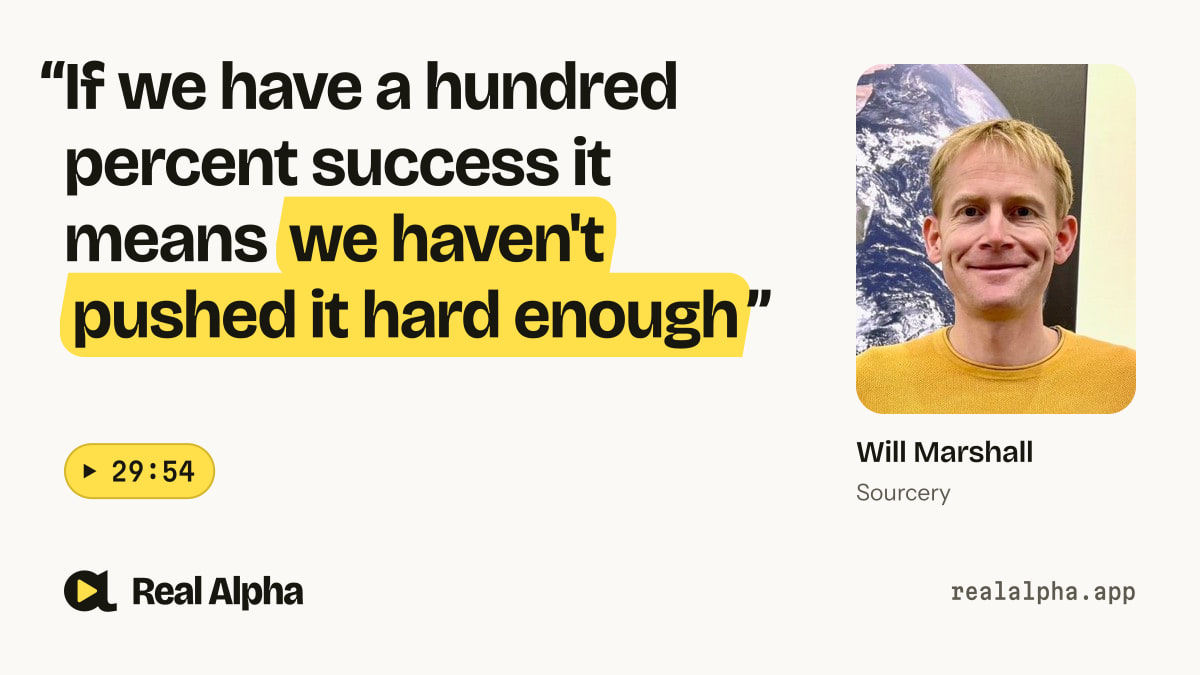
“If we have a hundred percent success it means we haven't pushed it hard enough”
 Will Marshallat 29:54 · Sourcery
Takeaways
- A rocket-stage separation can expose a satellite to roughly 200 G.
- Telescope optics can lose focus with movement of a fraction of a micron.
- Marshall sees perfect utility across the fleet as a possible sign of caution.
About this segment
Planet tests satellites against launch shocks and thermal extremes, with telescope optics requiring micron-scale stability. Will Marshall says a 100% useful fleet may mean the company is not pushing designs far enough.

Will Marshall is cofounder and CEO of Planet Labs.
Co-founded Planet and leads its Earth-imaging satellite network, after developing low-cost spacecraft at NASA/USRA.

Molly O'Shea, Host · Founder, Sourcery
Ex-Upfront Ventures investor; has interviewed Alex Karp and Palmer Luckey.
From “Inside Planet Labs (NYSE: $PL): Satellites, Planet AI & Area 51”, Nov 9, 2026. Watch the full episode
Thanks. We'll look at and fix what's off.
Transcript
Transcribed by machine (Whisper) from the episode’s audio, so a word may be off here and there.
- 27:43
So here, we have some of our testing facilities. So here, this is a system that tests the shock when two stages of the rocket separate. So basically, we put our satellite here, we bring this up, and we let this hammer... It smacked down and it gives this 200G-ish shock load and it's... What? Why isn't this in a sound barrier room? Well, I guess people put earplugs in. Okay. They're the earplugs. You haven't got any but they're up there.
- 28:14
And then this is a vibration table. So this vibrates to simulate the launch environment. So we put our satellite on there, vibrate the shit out of it and hopefully nothing falls apart. What have been the biggest failures? well we've had telescopes break okay we have to redesign it we've had like what is the most delicate part of your satellite well it's probably the telescope yeah exactly so it's because there again just think about this like the optics of that mustn't move by more than a fraction of a wavelength the wavelength is of order less than a micron so a thousandth of a millimeter so the telescope to components the main optics must move by more than a thousandth of a millimeter otherwise it's out of focus well that's really annoying because that's a very small distance and again even when it's in
- 29:06
space normally if you just made the telescope out of aluminium like this it would expand and contract so much that the telescope wouldn't work when it's too hot or too cold because it would be totally out of focus so we have to design it out of special materials compensate for that expansion and contraction because of the thermal loads. So that's the kind of thing that's really difficult and I can actually show you where we test that thermal loads.
- 29:30
How many satellites do you go up end up having errors? Like what has been the... Error rate? So firstly of all 700 satellites if the launch worked and delivered us into orbit our satellites have turned on and worked. We have had some that are out of focus, we have had a few problems where a solar panel didn't deploy, a reaction wheel stopped working early, things like this, but generally we've got utility out of a hundred percent of our satellites which I actually think is a problem and I keep on telling folks, well because it means we're not pushing the envelope enough. If we have a hundred percent success it means we haven't pushed it hard enough and maybe we should have gotten a latest sensor or something that would improve it yeah so we want to push the the barriers thanks for your help all right what's this we got a little vacuum