The alpha, twice a week
That was 7 min.
Get the best new moments in your inbox every Wednesday and Saturday. It's free.
Check your inbox
We sent a link to your address. Click it to finish signing up. Not there in a minute? Look in spam.
or
Prof G Markets · 7 min · Feb 27, 2026
Prediction markets can improve forecasts when trading is informed
 Tarek Mansour
 distinguishes open exchanges from house-banked gambling and argues markets can price important future events.
The episode’s best minutes
Full analysis- 22:00Prediction markets can improve forecasts when trading is informed7 min
- 29:55Insider trading can destroy trust even when it improves pricesPro pick 6 min
- 35:43Prediction markets can hedge risks insurers struggle to price3 min
- 2 more moments in the full episode
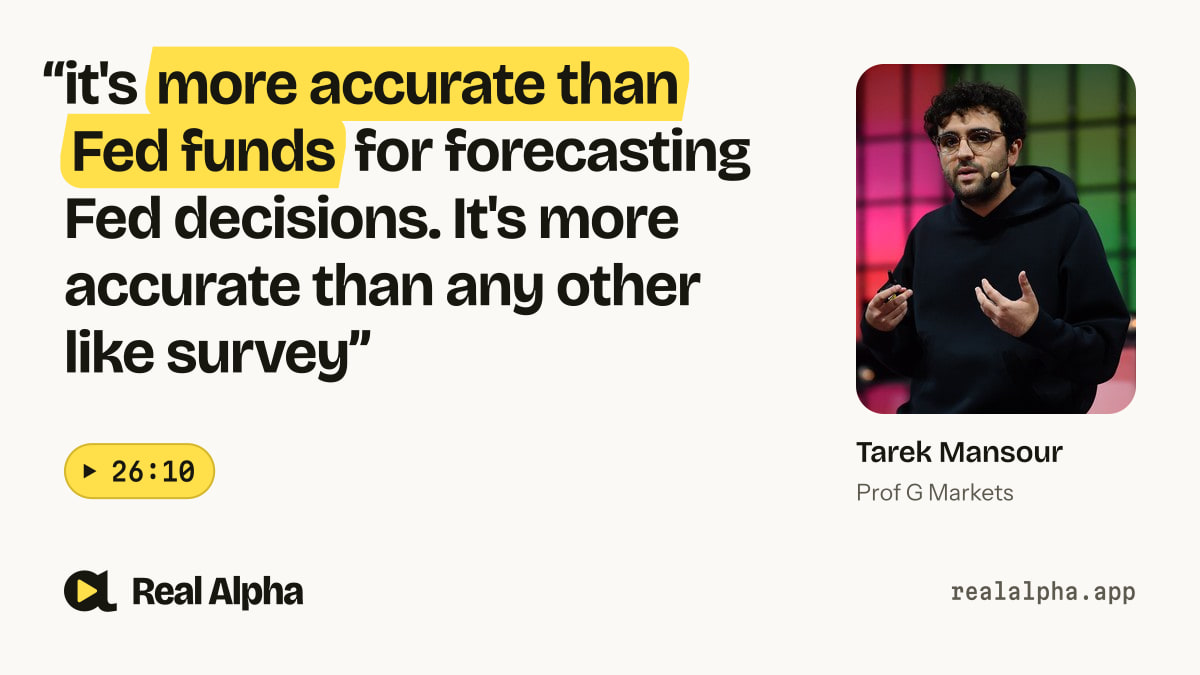
“it's more accurate than Fed funds for forecasting Fed decisions. It's more accurate than any other like survey”
 Tarek Mansourat 26:10 · Prof G Markets
Takeaways
- Open marketplaces let participants compete on price.
- Prediction markets can provide real-time distributions of outcomes.
- More accurate forecasts could improve resource allocation and asset pricing.
About this segment
Tarek Mansour distinguishes open exchanges from house-banked gambling and argues markets can price important future events. He says they can outperform surveys and improve decisions about the economy and assets.

Tarek Mansour is cofounder and CEO of Kalshi.
Built Kalshi, the federally regulated exchange for event contracts, with co-founder Luana Lopes Lara.

Scott Galloway, Host

Ed Elson, Host
From “Prediction Markets vs. Gambling: Where’s the Line? | Prof G Markets”, Feb 27, 2026. Watch the full episode
Thanks. We'll look at and fix what's off.
Transcript
Transcribed by machine (Whisper) from the episode’s audio, so a word may be off here and there.
- 22:10
is there a natural underlying instrument that you know where it's it's helpful to price or forecast the thing because some people in society care about it whether socially or economically or other and you know number two is the mechanics and i think that's the most important thing when we talk about addiction all the issues the mechanics is this you know to me gambling is the negative incentives right it's the incentive where i'm walking into a casino know and that business is essentially like structured against me like it's rigged against me it's basically going to incentivize all bad behaviors that we're talking about because that's how they make money whereas an open and open marketplace like a marketplace where I'm a marketplace I'm a neutral fair exchange where I provide the rules I provide the guardrails I
- 23:02
provide the technology I provide the structure but then people are engaging with each other and they're figuring out the pricing, you could be a price taker ad or you could be a price maker and then you're figuring out how to beat others. That has historically fell under a definition of an exchange, a marketplace, whether a stock market, a commodity market, et cetera. And that same principle was drawn in 1905 by the Supreme Court for grain futures.
- 23:25
And then they delineated like there's the bucket shop. So if you go and trade directly or bet directly against like a company on grain futures, that's like bucket shop laws. It's going to go state by state. And if you do it in an open, fair marketplace and the Chicago Board of Trade and now CME, that's considered like a federally regulated financial market. market. And then the same thing happened with the election market for Kalshi. And then, you know, what we're seeing kind of play out in sports. Also exists, by the way, insurance. You know, you have state-regulated insurance, which is like one insurance company is the one that gives you the price and you just take it how it is, versus hedging, which is on CME. If you go and want to offload some risk in an open and fair marketplace where anyone can compete on the price,
- 24:05
that's also like open and fair game. So that's kind of like where, you know, we, I think, draw the line. And to me, all prediction markets very squarely fit under kind of number one and number two. I mentioned the Gatorade at the halftime show. What color is the Gatorade going to be? Which is something that you can bet on on gambling apps. You say that's not something that we provide on Kalshi, which I didn't know that. I assumed that that was kind of fair game.
- 24:33
that raises an interesting question of where does that fall on the line why does betting on the color of the gatorade not work for you guys well i think it's kind of the pillar number one is like is this like a natural like thing a risk or an occurrence that like okay trading on brexit like if you're have a market on whether brexit is going to happen or not that has extrinsic consequences to a lot of people, government, businesses, people.
- 25:05
Pricing that thing is relevant. People care, right? Like pricing, whether this is a 20% chance or it's a 60% chance, that's a very important thing. That can be basically traced back to asset prices. That can be traced back to how we price the S&P, to how we price the FTSE. That's a very important thing to have. That has extrinsic consequences outside of the speculative activity that is going to happen on people trading on whether Brexit is going to happen or not, right?
- 25:29
The Gatorade is a harder kind of argument because the odds are, I think it's, I would assume it's 50-50, right? Or coin toss is the same, like a similar sort of setup. So this is where like, when you go back and if you all take a step back, you know, on kind of like this sort of, what is the purpose? And maybe we didn't talk enough about this so far, like about prediction markets. Like, why is it so important?
- 25:48
Well, I, you know, I'll say like, what they do is they apply a market-based mechanism to questions, to these key, to a lot of questions about the future. Some of which may be existential to humanity, some of which less existential. And you have to build a marketplace of diverse range of participants and diverse range of sort of opinions and all of that. But I think to me, it's like what this does.
- 26:09
And I don't know if you have seen there's a Fed paper last week that has kind of in some ways confirmed a lot of stuff. I was saying over the last few years, and the Fed paper was saying basically, cash fills a lot of holes. One, it's more accurate than Fed funds for forecasting Fed decisions. It's more accurate than any other like survey, like the Bloomberg Economist survey for forecasting CPI or inflation prints.
- 26:29
But it also gives us a full distribution of outcomes and it does it in real time. It gives us like a much better understanding of basically the economy or a better understanding of the economy. And what excites me about what we're building is like over time, if you get a very liquid marketplace about all these kind of different questions, you will basically just have a better light about our future, which enables better decisions, better resource allocation, and then better also like better asset pricing for all the kind of assets that we're currently pricing.
- 26:58
So there's a paper from Kevin Hassett about this idea of as society gets increasingly more complex and you used to be agriculture-based economy. So as long as you understand the agriculture, you understand where we're heading. Then we added, you know, industrials, then we got into a service-based economy and now information economy, all these different, now AI is happening. As you add more and more complexity to society, it argues that we need infinite number of markets.
- 27:24
You in some ways need prediction markets to price all these different aspects and facets of society so that you can actually price like the core asset prices like homes and S&P and the rates and the big sort of ticket items that we currently price. And maybe to make that like example very concrete, like, you know, you might, did you read the AI paper that some people are calling it a Doomerism AI paper from, what was it called?
- 27:54
Citrini. Citrini, yes. And what we're doing is we're launching a market this afternoon on like whether the Citrini outcome is going to happen. Because in the Citrini paper, like someone put out an opinion and it actually tanked a bunch of stocks. The market actually reacted to this. And, you know, I want to release that market to price that specific outcome, like price these, like the outcomes that people are talking about when it comes to AI and get a better understanding of AI.
- 28:16
Because if you have these markets getting us better prices about these things, those will end up basically helping us price the bigger things, like the S&P and the stocks. And those are things that basically excite me about what we're building.