The alpha, twice a week
That was 4 min.
Get the best new moments in your inbox every Wednesday and Saturday. It's free.
Check your inbox
We sent a link to your address. Click it to finish signing up. Not there in a minute? Look in spam.
or
This Past Weekend w/ Theo Von · 4 min · Nov 3, 2026
Princeton Review charged more in Asian-heavy neighborhoods
 Lindsay Owens
A ProPublica report found Princeton Review offers were 1.8 times as likely to be higher in Asian-heavy ZIP codes.
In this episode
Full analysis- 24:22Instacart tested how much shoppers would pay for groceries8 min
- 1:07:01Retailers use personal data to vary prices and monetize loyaltyPro pick 7 min
- 1:29:06AI shopping assistants can ignore requests for the cheapest option7 min
- 1:37:31Princeton Review charged more in Asian-heavy neighborhoods4 min
- 1:15:00Incognito mode narrowed StubHub fee gaps in one test4 min
- 40:55The Savannah Bananas use lotteries instead of dynamic pricing6 min
- 14:12Lobbyists can weaken bills through delay and loopholes4 min
- 1:41:32Owens proposes 12 baseline rights for shoppers3 min
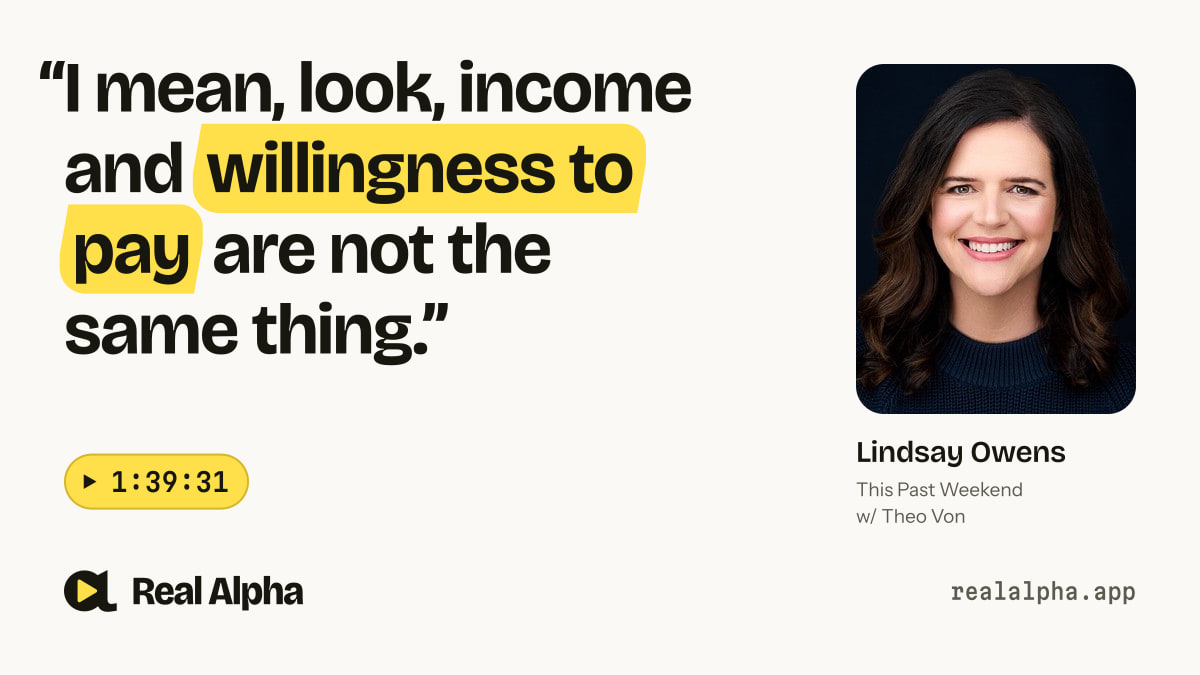
“I mean, look, income and willingness to pay are not the same thing.”
 Lindsay Owensat 1:39:31 · This Past Weekend w/ Theo Von
Takeaways
- Asian-heavy ZIP codes were more likely to get higher test-prep offers.
- The reported SAT-prep price gap approached $2,000.
- Need and urgency can matter more than income.
About this segment
A ProPublica report found Princeton Review offers were 1.8 times as likely to be higher in Asian-heavy ZIP codes. Lindsay Owens says pricing can target urgency, not just income.

Lindsay Owens is a consumer protection expert and author of Gouged.
Exposed corporate pricing power and profiteering, shaping debate on inflation, affordability and consumer protection.

Theo Von, Host · Host, This Past Weekend w/ Theo Von
From “Corporate Watchdog: You’re Being Experimented On Every Time You Shop | Lindsay Owens #693”, Nov 3, 2026. Watch the full episode
Thanks. We'll look at and fix what's off.
Transcript
Transcribed by machine (Whisper) from the episode’s audio, so a word may be off here and there.
- 1:37:36
There was a story that they had SAT tests. They, like the Princeton Review was charging more for SAT tutoring or for testing. I'm not sure which one it was in Asian heavy zip codes. Is that true? That's exactly right. Oh. So Princeton Review, like if you logged on from an IP address that was in an area of the country that had more Asian Americans, they were charging you more for the same test prep package than other individuals in a less like predominantly Asian neighborhood.
- 1:38:08
And this has been going on for a while. This is 2015 Asian families living in the U S are, are almost twice as likely to be charged higher prices for college test prep. The Princeton review, according to a new study from ProPublica or ProPublica, the Princeton review determines pricing based on a potential customer zip code As ProPublica notes, there is nearly a $2,000 difference in the highest and lowest prices for the Princeton Review premier SAT prep course.
- 1:38:35
When it comes to getting the highest prices, living in a zip code with a high median income or a large Asian population seem to make the greatest difference, according to ProPublica Reporters by Julian Angwin. Wow. Customers in areas with a high density of ASEAN residents were 1.8 times as likely to be offered higher prices regardless of income. Dang, bro. Asian's getting jacked over that. Bro, we need Asian people to get upset about this.
- 1:39:06
High income zip codes were twice as likely to be charged a more expensive price. Because, you know, part of me is like, yeah, charge rich people more. I don't care. But it's not fair if you're charging somebody that's Asian is because you think they're good at something. And some Asians these days, bro, some of these second, third degree Asians or whatever they're called, they're not, some of them are not even that good at stuff like they used to be. Like the premier Asians used to have shit popping, dude. There's Asian dudes now that can't even read that good. I mean, look, income and willingness to pay are not the same thing. Yeah. Right. Like that's the key here.
- 1:39:42
Like you think it's just going to be the rich who get soaked, but actually it's the people who want it the most, or the people who are the most desperate, or the people who need something most urgently. Like, the problem with surveillance pricing is, you know, when companies are collecting this data on you, they get better and better at figuring out how desperate you are. I mean, this is why I'm so worried about surveillance pricing and AI assistance. Because let's say, you know, there was an example, the Facebook whistleblower had this crazy example where it turned out that Facebook, when you deleted selfies, so let's say you're like a teenage girl, you're insecure about how you look, you know, you delete a lot of selfies because you're like, oh, this is a bad picture of me. They were pushing you beauty products.
- 1:40:23
Wow. Right? And so there's all sorts of ways in which companies are really exploiting insecurity, exploiting desperation. I mean, this is like an Asian immigrant family who just wants their kid to go to college. And so they're willing to pay, you know, an extra $1,500 for six weeks of test prep, right? And companies figured that out. They're like, oh, these Asian moms are, you know, really hoping their kids get into college.
- 1:40:48
So we're going to bilk them for all they're worth. That's gross. You know, these teenage girls are really insecure, so we're going to see them as, like, shooting fish in a barrel and push them expensive beauty products.