The alpha, twice a week
That was 2 min.
Get the best new moments in your inbox every Wednesday and Saturday. It's free.
Check your inbox
We sent a link to your address. Click it to finish signing up. Not there in a minute? Look in spam.
or
Inside Blackstone · 2 min · Nov 3, 2026
Ramp tracks organizational friction and resets its meetings
 Eric Glyman
 tracks how long ideas take to become purchases or shipped features and checks meeting load.
In this episode
Full analysis- 10:30AI-intensive companies are growing and hiring faster5 min
- 15:42Token spend needs its own controls3 min
- 22:08Ramp hires for standout ability rather than a full checklist3 min
- 5:38Ramp tied its card business to customer savings3 min
- 8:07Ramp tracks organizational friction and resets its meetings2 min
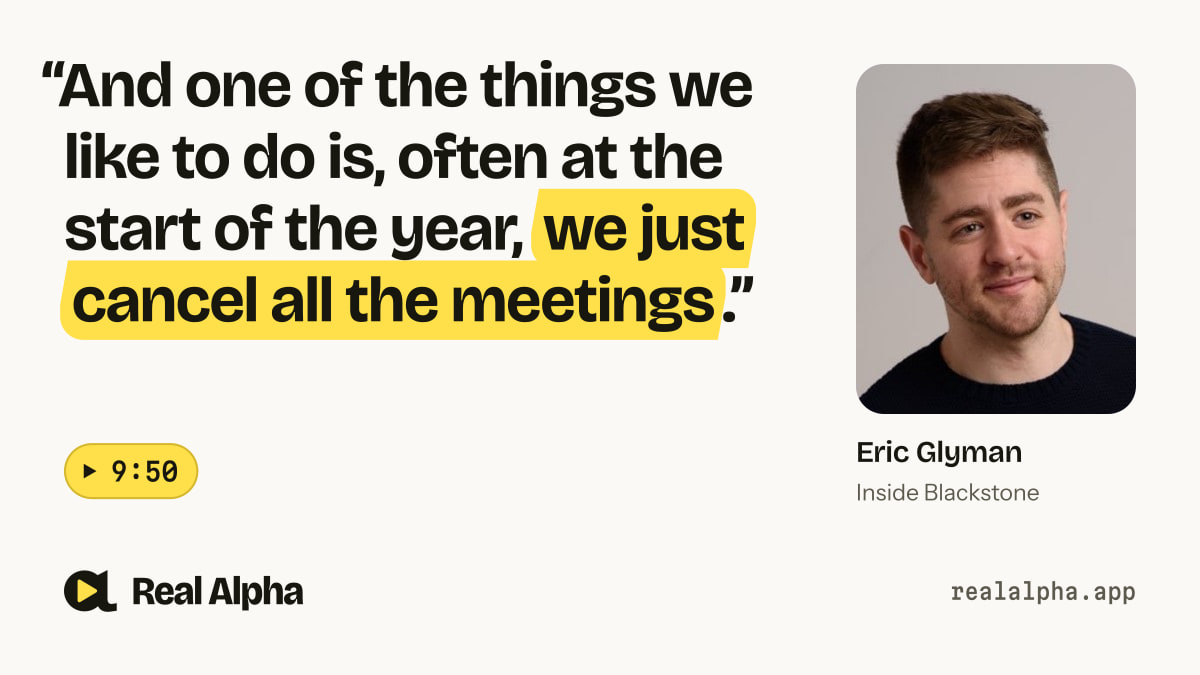
“And one of the things we like to do is, often at the start of the year, we just cancel all the meetings.”
 Eric Glymanat 9:50 · Inside Blackstone
Takeaways
- Track how long it takes employees to buy useful software.
- Check decision counts, shipped work and recurring-meeting time.
- Cancel meetings in January and add back only what's needed.
About this segment
Eric Glyman tracks how long ideas take to become purchases or shipped features and checks meeting load. Ramp cancels meetings each January, then restores only what teams need.

Eric Glyman is cofounder and co-CEO of Ramp.
Co-founded Ramp, now used by 85,000 businesses and building AI tools to automate finance and manage company spend.
- CA
Christine Anderson, Host · Global Head of Corporate Affairs, Blackstone
From “Ramp Co-Founder and Co-CEO Eric Glyman on AI Adoption, Jobs, and Token Spend”, Nov 3, 2026. Watch the full episode
Thanks. We'll look at and fix what's off.
Transcript
From the transcript Inside Blackstone publishes with the episode.
- 8:13
Definitely. It forces you to really understand why you're investing where you're investing. Not just how fast you're going but how durable that growth is. I think one of the most famous F1 drivers had said, on a sunny day it's hard to pass cars, when it's raining, you can pass 20. I think back to when Ramp, we were late to this industry in, you know, many, many respects. And during that time in 2022 and ‘ 23, we raised more money even at a lower price, took a down round.
- 8:42
We hired more people and we invested in technologies that kept saving people more. And so that allowed us to pull ahead when others were declining. So really course corrected and focused more on the technology you we're building and the team. That's right. That's incredible. Where have you changed where you're spending your time? I feel like my job is to answer the question of how do we create the conditions for my team to do their lives work.
- 9:06
I think in lots of organizations they're filled with unbelievably talented people, who, something about the organization is just, there’s, it creates conflict. People aren't getting the best out of each other and so I'm constantly going in trying to debug, understand how we can speed things up, get to decisions faster. Any tricks for how you do that? I try to look at metrics, how fast does it take to do things?
- 9:28
And so, often a simple metric I'll go in with companies is, let's say it's a 24- year- old, and they have a bright idea. If they want to go buy a new piece of software, how long does it take? Does it take like an hour? Does it take a day? Does it take three months? How many decisions are we making? How many lines of code or new features are we actually shipping? I'll even look at to the percentage of time that my team is in a recurring meeting.
- 9:55
And one of the things we like to do is, often at the start of the year, we just cancel all the meetings. And if it's important, add it back, no problem. What can start happening to people is their calendar is happening to them and you lose kind of, so much of what makes people brilliant. Ramp cancels all its meetings in January? Yes. Yeah. Fascinating. It's a jubilee day. The team is cheering probably in the background. Go ahead. That's amazing.