The alpha, twice a week
That was 3 min.
Get the best new moments in your inbox every Wednesday and Saturday. It's free.
Check your inbox
We sent a link to your address. Click it to finish signing up. Not there in a minute? Look in spam.
or
Sourcery · 3 min · Feb 7, 2026
Rao expects coordination costs to rise beyond 80 to 100 people
 Naveen Rao
 says the company prioritizes truth-seeking, fast access to information and a flat structure.
In this episode
Full analysis- 15:15Biology pushed Rao toward a new computing substrate7 min
- 35:31Power limits make AI’s largest buildout plans unrealistic3 min
- 57:16Unconventional designs for silicon, not a literal brain copy3 min
- 31:58Rao estimates about $1.5 billion to reach a first product3 min
- 1:01:58Data movement remains a major energy cost in digital systems3 min
- 1:06:10Rao treats recurrent state transitions as computation2 min
- 38:30Rao expects coordination costs to rise beyond 80 to 100 people3 min
- 41:21Sequoia looks for a standout founder strength, not every box2 min
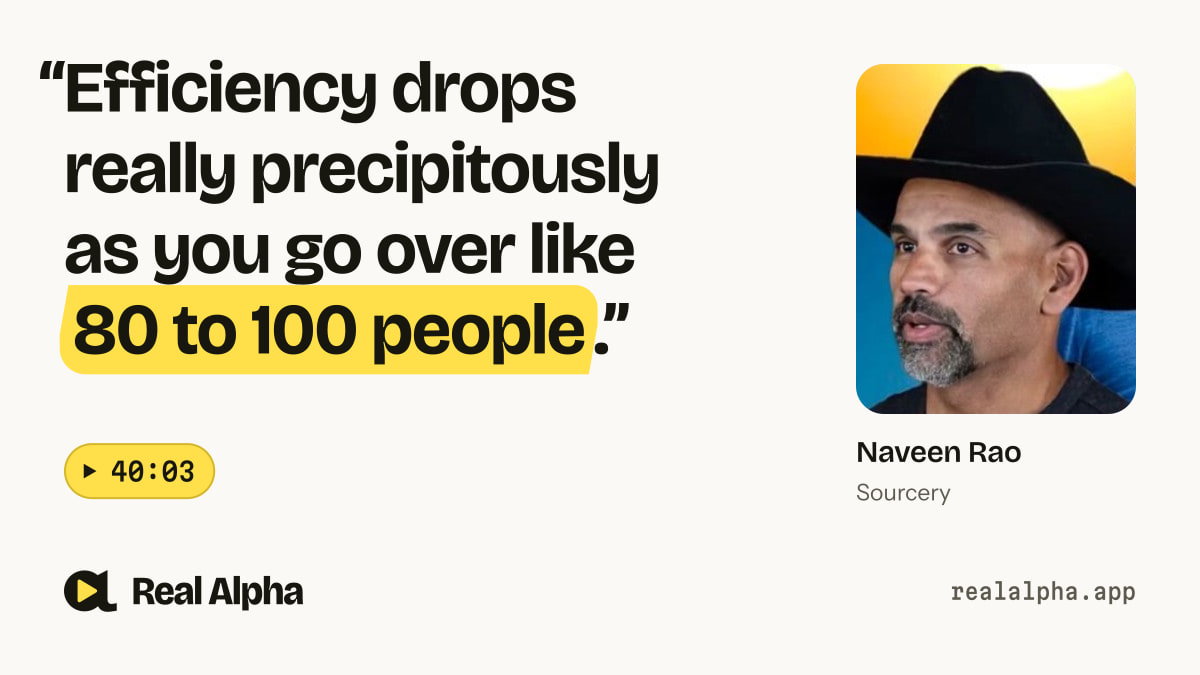
“Efficiency drops really precipitously as you go over like 80 to 100 people.”
 Naveen Raoat 40:03 · Sourcery
Takeaways
- He uses 80–100 people as a point where efficiency drops.
- He favors the cheapest experiment that answers the question.
- He wants teams to stay flat and go to original sources.
About this segment
Naveen Rao says the company prioritizes truth-seeking, fast access to information and a flat structure. He says efficiency drops sharply as teams grow beyond roughly 80–100 people.

CEO & Co-Founder, Unconventional AI
Co-founder and CEO of Unconventional AI; founded and sold Nervana Systems to Intel and MosaicML to Databricks.
- PB
Peter Barrett, Host · General Partner, Playground Global

Molly O'Shea, Host · Founder, Sourcery
Ex-Upfront Ventures investor; has interviewed Alex Karp and Palmer Luckey.
From “Inside the $4.5B Startup Building Brain-Inspired Chips for AI”, Feb 7, 2026. Watch the full episode
Thanks. We'll look at and fix what's off.
Transcript
Transcribed by machine (Whisper) from the episode’s audio, so a word may be off here and there.
- 38:37
What are your principles as a founder and a leader? Well, it's interesting because I think as a founder, you change some of these things depending on the company to some degree. Of course, truth-seeking, we don't want to have these ideas of, I'm just going to defend my idea because it's mine and I don't care if it's true. I mean, you have to have people at the beginning of a company who set the stage and are really, truly about solving the problem.
- 39:07
Actually, I've seen this impedance mismatch happen when those people go into a big company because in big companies, the incentives are very different many times. It's not about solving the problem. It's about getting promoted or something like that. And so oftentimes when you get these very mission-driven people in those scenarios, it causes problems. So I think being mission-driven, going after the problem and caring about it, that's an important thing. I think that's job one.
- 39:28
um i think um trying to find the the quickest way to get information is sort of a cultural cultural um i don't know attribute you need to have like you know think try to think efficiently even if you've raised a bunch of money it doesn't matter right it has to be about do i need to do all these experiments what's the cheapest way to get there that i still think even at any scale will only help you so i think that's an important attribute I think going after the original source of information, you know, like we want to keep our organization as flat as possible. Efficiency drops really precipitously as you go over like 80 to 100 people. That's what I've seen over and over again. What's that number called 150 people? It's a particular number.
- 40:22
Not MapCal, no. Some people that have been cortex. Yeah, but there's a word for the number. It's something number. I forget the name now. But anyway, yeah, over 150 people basically. Dunbar's, that's it. Yeah, there you go. Thank you, ChatGPT. I had to phone in a friend there. Yeah, so Dunbar's number, right? Like when you break that, you start to see these massive inefficiencies because coordination starts to take over. So I think keeping things flat, going to the source of information is very important. And, you know, always just being i want to be humbled by the people that i hire i want everybody to feel that way and we will just keep getting better at the after the 20th hire i probably would never have been hired at the company you know what i mean that's kind of my goal so i think having these
- 41:09
sort of attributes in everybody's mind uh just makes the company better and it's it's hard to keep that going it's just you see it over and over again but we're in a research mode for a while so i think we can we can adhere to these principles for a number of years so i think those are kind of the high-level ideas that I like to keep. Konstantin, what are your principles?