The alpha, twice a week
That was 3 min.
Get the best new moments in your inbox every Wednesday and Saturday. It's free.
Check your inbox
We sent a link to your address. Click it to finish signing up. Not there in a minute? Look in spam.
or
Big Technology Podcast · 3 min · May 7, 2025
Reasoning models improve most on problems with verifiable answers
 Gary Marcus
 says test-time compute helps most in domains like math and programming, where synthetic answers can be checked.
The episode’s best minutes
Full analysis- 1:17Scaling stopped delivering the gains investors expected6 min
- 9:18Reasoning models improve most on problems with verifiable answersPro pick 3 min
- 48:35Neurosymbolic AI combines learning with explicit reasoning3 min
- 5 more moments in the full episode
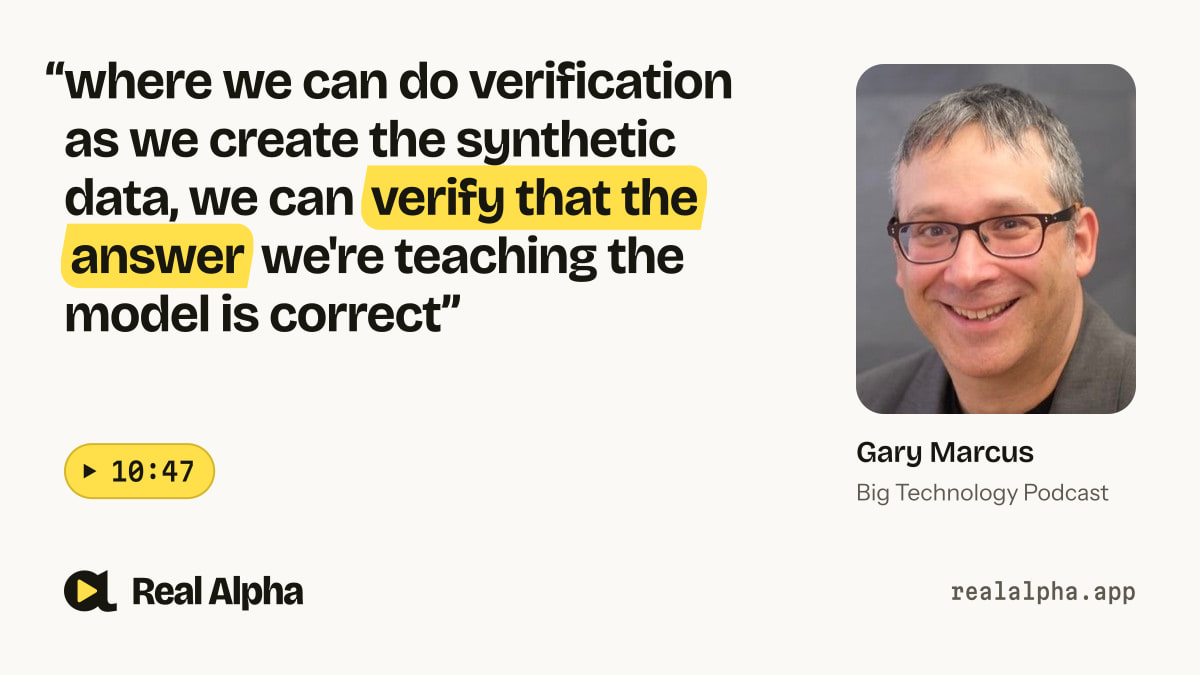
“where we can do verification as we create the synthetic data, we can verify that the answer we're teaching the model is correct”
 Gary Marcusat 10:47 · Big Technology Podcast
Takeaways Pro pick
- Verifiable synthetic data can improve performance on specific tasks.
- Reasoning-model gains are not consistent across all problems.
- Marcus sees human-reasoning patterns, not deep abstraction.
One of Pro's picks, open to you here. Try Pro free for 7 days
One of Pro's picks. The rest of the summary and the 3 takeaways are in Real Alpha Pro; the video, the quote and the transcript stay free.
Read it with Pro, 7 days freeAbout this segment
Gary Marcus says test-time compute helps most in domains like math and programming, where synthetic answers can be checked. That narrow strength does not mean the models reason reliably across the board.

Gary Marcus is a cognitive scientist, author, and longtime AI skeptic.
Founded Geometric Intelligence, acquired by Uber, and researches human language development and cognitive neuroscience.

Alex Kantrowitz, Host · Founder, Big Technology
Former BuzzFeed News senior tech reporter and author of Always Day One.
From “Are We at the End of Ai Progress? — With Gary Marcus”, May 7, 2025. Watch the full episode
Thanks. We'll look at and fix what's off.
Transcript
Transcribed by machine (Whisper) from the episode’s audio, so a word may be off here and there.
- 9:22
true that you can build a model that will do better if you put more compute on it but it's only true to some degree so um and i'll get to whether it's actually reasoning or not but it turns out that on some problems you can generate a lot of data in advance and for those problems adding more test time compute seems helpful. There was a paper this weekend that's calling some of this into question. By the way, just to explain to folks, test time is when the model is giving an answer.
- 9:55
That's what test time is. That's right. So you have these models now, like 03 and 04, that will sometimes take like 30 seconds or five minutes or whatever to answer a question. And sometimes it's absurd because you ask it like, what's 37 times 11? And it takes 30 seconds. You're like, my calculator could have done it faster. But we'll put aside that absurdity. In some cases, it seems like time will spend, sometimes not.
- 10:19
But if you look carefully, the best results for these models are almost always on the same things, which are math and programming. And so when you look at math and programming, you're looking at domains where it's possible to generate what we call synthetic data and to generate synthetic data that you know are correct. So for example, on multiplication, you can train the model on a bunch of multiplication problems and you can figure out the answer in advance.
- 10:45
You can train the model what it is that it should predict. And so on these problems, in what I would call closed domains, where we can do verification as we create the synthetic data, we can verify that the answer we're teaching the model is correct, the models do better. But if you go back and you look at the O3, sorry, the O1 paper, even then you could already see that the gains were there and not across the board they reported that on some problems o1 was not better than gpt4 it's only on other problems these cut and dry problems with the synthetic data uh that you actually got better performance. And I've now seen like 10 models and always seems to be that way.
- 11:28
We're still waiting for all the empirical data to come in, but it looks to me like it's a narrow trick that works in some cases. The amazing thing about GPT-4 is that it was just better than GPT-3 on almost anything you could imagine. And GPT-3, the amazing thing is it was better than GPT-2 on almost anything you can imagine. Models like O1 are not systematically better than GPT-4. They're better in certain use cases, especially ones where you can create data in advance.
- 11:55
Now, the reason I wouldn't call them reasoning models, though you're right that many people do, is what I think they're doing is basically copying patterns of human reasoning. They're getting data about how humans reason certain things. But the depth of reasoning there is not that great. They still make lots of stupid mistakes all the time. I don't think they have the abstractions that we think, for example, a logician has when they're reasoning.
- 12:17
So it has the appearance of reasoning, but it's really just mimicry. And there's limits to how far that mimicry goes. I'll give you just one more example. Is O3 apparently hallucinates more than the models that came before it. Which is stunning. Like, how does that happen?