The alpha, twice a week
That was 6 min.
Get the best new moments in your inbox every Wednesday and Saturday. It's free.
Check your inbox
We sent a link to your address. Click it to finish signing up. Not there in a minute? Look in spam.
or
Big Technology Podcast · 6 min · May 7, 2025
Scaling stopped delivering the gains investors expected
 Gary Marcus
 argues that scaling once produced striking improvements but recent, much larger training runs have fallen short of predictions.
The episode’s best minutes
Full analysis- 1:17Scaling stopped delivering the gains investors expected6 min
- 9:18Reasoning models improve most on problems with verifiable answersPro pick 3 min
- 48:35Neurosymbolic AI combines learning with explicit reasoning3 min
- 5 more moments in the full episode
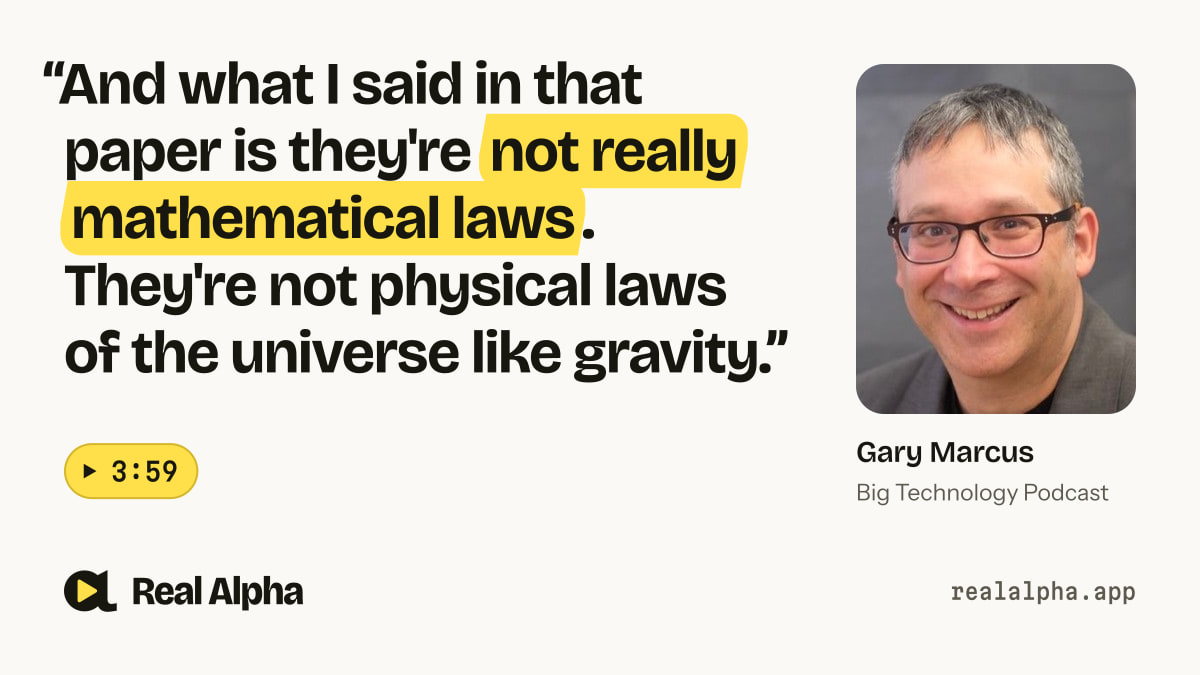
“And what I said in that paper is they're not really mathematical laws. They're not physical laws of the universe like gravity.”
 Gary Marcusat 3:59 · Big Technology Podcast
Takeaways
- Scaling curves were empirical patterns, not laws of nature.
- GPT-5-sized gains did not follow from much larger training runs.
- More compute still helps, but the returns have diminished.
About this segment
Gary Marcus argues that scaling once produced striking improvements but recent, much larger training runs have fallen short of predictions. The gap matters because huge AI investments were justified by those projections.

Gary Marcus is a cognitive scientist, author, and longtime AI skeptic.
Founded Geometric Intelligence, acquired by Uber, and researches human language development and cognitive neuroscience.

Alex Kantrowitz, Host · Founder, Big Technology
Former BuzzFeed News senior tech reporter and author of Always Day One.
From “Are We at the End of Ai Progress? — With Gary Marcus”, May 7, 2025. Watch the full episode
Answers “Is AI progress slowing down?” See all 75 answers
Thanks. We'll look at and fix what's off.
Transcript
Transcribed by machine (Whisper) from the episode’s audio, so a word may be off here and there.
- 1:22
things get, right? That is the big question with AI today. Well, I mean, I have to laugh because I wrote a paper in 2022 called Deep Learning is Hitting a Wall. And the whole point of that paper is that scaling was going to run out, that we were going to hit diminishing returns. And everybody in the field went after me. A lot of the people you mentioned, I mean, Lacoon did, Elon Musk went after me by name, Altman did. And they all, like Altman said, give me the strength of a mediocre deep learning skeptic. So people were really pissed when I said that deep learning was going to run out. So it's amazing to me that a bunch of people have conceded that these scaling laws are not working the way they used to be. And they're also doing a bit of backpedaling. I think that that Mark Chen interview, I can't quite remember the details, but I think it was a version
- 2:05
of backpedaling and redefining things. So if you go back to 2022, there were these papers by Jared Kaplan and others at OpenAI. And they said, look, we can just mathematically predict how good a model is going to be from how much data there is. And then there were the so-called chinchilla scaling laws. And everybody was super excited. And basically, people invested half a trillion dollars, assuming that these things were true.
- 2:30
You know, they made arguments to their investors or whatever. They said, if we put in this much data, we're going to get here. And they all thought that here in particular was going to mean AGI eventually. And what happened last year is everybody was disappointed by their results. So we got one more iteration of scaling after 2002, after 2022, that worked really well. And we call that GPT-4 and all of these models that are sort of like that.
- 2:56
So I wrote that paper around GPT-3. We got another iteration of scaling. So three was scaling compared to two. It was much better. Two was scaling compared to one. It was much better. So much better meant, sorry, much more data meant much better. But what is much better? Well, I mean, one way to think about it is you didn't need a magnifying glass to see the difference between GPT-2 and, we didn't call it GPT-1, but the original GPT, and you didn't need a magnifying glass for GPT-4 as opposed to GPT-3.
- 3:26
It was just obviously better. A lot of people thought is that we would pretty quickly see GPT-5, and a lot of people raced to build it. So OpenAI tried to build GPT-5, and they had a thing called Project Orion, and it actually failed. and eventually got released as GPT-4.5. So what they thought was going to be GPT-5 just didn't meet expectations. Now, they could slap any name on any model they want.
- 3:52
Lately, nobody understands how they're naming their models. But they haven't felt like any of the models that they've worked on since GPT-4 actually deserve the name GPT-5. And it didn't meet the performance that these so-called mathematical laws required. And what I said in that paper is they're not really mathematical laws. They're not physical laws of the universe like gravity. They're just generalizations that held for a little while. Like a baby may double in weight every couple of months early in its life. That doesn't mean that by the time you're 18 years old that you're going to be 30 years old.
- 4:22
thousand pounds and so we had this doubling for a while and then it stopped and we can talk about why but the reality is it's not really operative anymore so there's been efforts to kind of misdirect and shift direction so i think everybody in the industry quietly or otherwise acknowledged that hey we're not getting the returns that we thought anymore and nobody's been able to build a so-called GPT-5 level model.
- 4:48
That's a big deal, right? I'm a scientist, or I was originally a scientist. As a scientist, we have to pay attention to negative results as well as positive results. So when 30 people try the same experiment and it doesn't work, nature is telling you something. And everybody tried the experiment of building models that were 10x the size of GPT-4, hoping to get to something they could call GPT-5 that was like a quantum leap better than GPT-4.
- 5:14
They didn't get there. So now they're talking about scaling inference time compute. That's a different thing. So before we get there, I just want to talk to you about, I want to test your theory here. So it's not that scaling is over, right? I don't think anyone that we're talking about say scaling is over. Basically, what they're saying is if you want to make the model better, and I think that means more intelligent, more conversational, even more personable, you can still do it by scaling.
- 5:44
I think what they admit, the thing that they admit, though, is that it takes much more compute and much more data to get the same results that you would in the previous loops. So let's clarify two things. One is that what people talked about about scaling originally was a mathematically predictable relationship between performance and amount of data. You can go back and look at the Chinchilla paper, the Jared Kaplan paper, and lots of things that were posted on the internet.
- 6:11
There were papers that saying, or t-shirts saying scale is all you need. And you looked at that t-shirt and it had equations from the Jared Kaplan paper. And it said, you know, here's the exponent. You can fit the equation. If you have this much data, this is the performance you're going to get. And there were a bunch of papers, a bunch of models that actually seemed to fit that curve, but it was an exponential curve. And what's happening now is, yeah, you add more data, you get a little bit better, but you're not fitting that curve anymore. We've fallen off the curve. That's what it really means to say that scaling isn't working anymore.
- 6:42
is you don't, you know, if I drew a curve for you, it was going up and up and up really fast and it's not going up as a function of how much data you had or how much compute you had. So you added a bunch of compute and you got this much better performance. And this is how people justified running these experiments that cost a billion dollars is they're like, I know what I'm going to get for the billion dollars.
- 7:04
And then they ran the billion dollar experiments and they didn't get what they thought they would. Yeah, you get a little bit better, but that's what diminishing returns means. Diminishing returns means you're not getting the same bang for your buck as you used to. That's where we are now. So anytime you add a little piece of data, the model is going to do better on that piece of data. But the question is, does it generalize and give you significant gains across the board?
- 7:28
And we were seeing that, and we just aren't anymore.