The alpha, twice a week
That was 6 min.
Get the best new moments in your inbox every Wednesday and Saturday. It's free.
Check your inbox
We sent a link to your address. Click it to finish signing up. Not there in a minute? Look in spam.
or
Lightcone · 6 min · Nov 7, 2026
Replit is replacing some $10 million software projects for $250,000
 Amjad Masad
 describes companies replacing internal systems with Replit and explains why ambitious employees drive adoption.
The episode’s best minutes
Full analysis- 22:32Replit is replacing some $10 million software projects for $250,0006 min
- 1:53Replit automated the copy-paste loop between ChatGPT and codePro pick 4 min
- 14:44Replit’s infrastructure gave its agent a head start4 min
- 5 more moments in the full episode
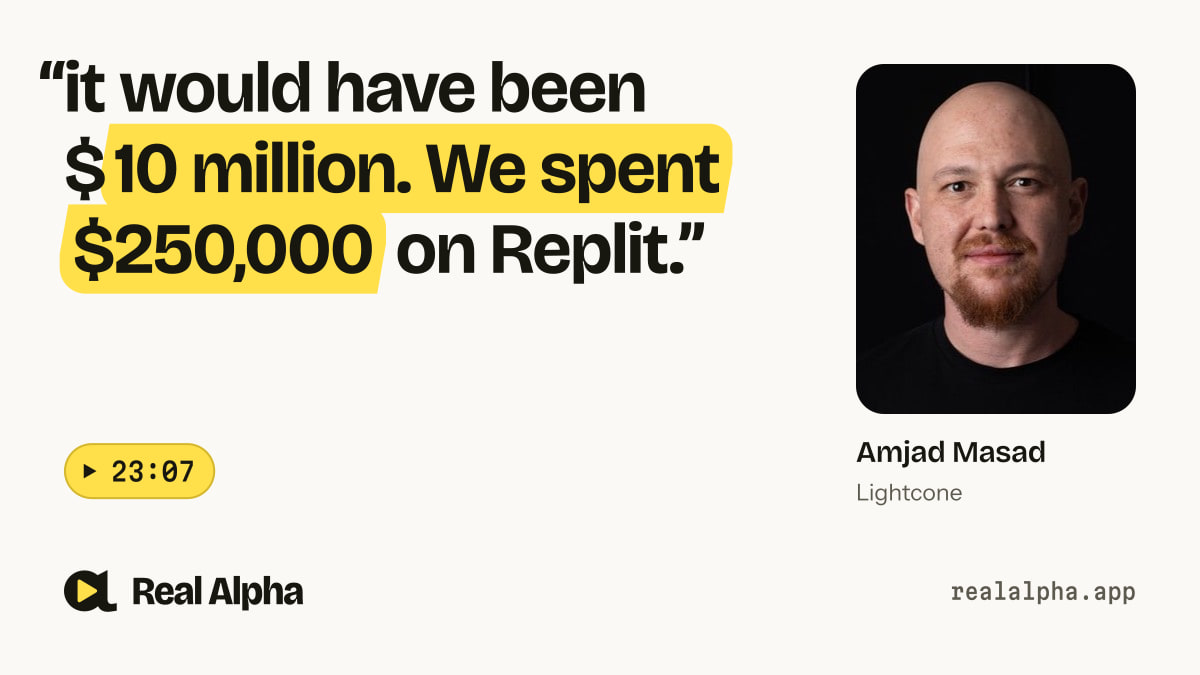
“it would have been $10 million. We spent $250,000 on Replit.”
 Amjad Masadat 23:07 · Lightcone
Takeaways
- Some projects once scoped at $10 million cost $250,000 with Replit.
- The biggest early impact is often in non-tech companies.
- One employee can deliver 100 times another employee’s ROI.
About this segment
Amjad Masad describes companies replacing internal systems with Replit and explains why ambitious employees drive adoption. He argues companies should measure AI by ROI, not equal token budgets.

Amjad Masad is co-founder and CEO of Replit.
Co-founded and leads Replit, a browser-based coding platform letting anyone write and deploy code.
- PG
Paul Graham, Host
From “How To Build The Future: Paul Graham & Amjad Masad”, Nov 7, 2026. Watch the full episode
Answers “Is AI paying off for companies?” See all 54 answers
Thanks. We'll look at and fix what's off.
Transcript
Transcribed by machine (Whisper) from the episode’s audio, so a word may be off here and there.
- 22:45
I mean, that's the case right now. Like we, you know, we go into big multinational corporations, banks, you know, things like that. and they have a lot of like SaaS software they pay $10 million for or like old software and they find like a few Vibe coders inside the company that have adopted Replit and they're going and like replacing all these different systems. And it starts with internal stuff.
- 23:13
It starts with internal stuff, yes. And, you know, previously they would tell us that, you know, we've actually scoped this project out and it would have been $10 million. We spent $250,000 on Replit. And so it's happening all over the place. And I think really the outsourcing industry is sort of dead at this point. So is it mostly not very technical companies that you're talking to? Like companies that don't specialize in technology?
- 23:37
They wouldn't call themselves tech companies, right? We have a lot of tech companies as customers. I think that that's not where we have the biggest impact. Because I think they can fish for their own. But the sort of the banks, the, you know, the manufacturing or ordering companies, they need something like Replit otherwise. They'll shoot themselves in the foot. And really it's driven mostly by people internally who like are sort of ambitious, like some guy who's in charge of sales and wants to write some tool for his sales department.
- 24:12
Yes, so, you know, this created a bit of a, you know, identity question inside Replit. It was like, well, like the enterprise, like that, that's like not part of our mission. But what I tell my team is that those are like entrepreneurial people, those are like ambitious people, like, you know ambitious people building businesses this feels like very core what we do those are people within companies do exactly yeah and and even if the companies aren't scrappy the people are the people are and they tend to get promoted a lot of people who bring rapplin to their organization will get promoted and because they're having great impact so and also because especially now all these companies are thinking we got to use ai i keep reading how ai has taken over the world we ought to be using AI with our who within our company understands
- 24:58
anything about AI who's using it and here's the person using Replit to make stuff yes they're gonna be the ones that they trust exactly so so it's it's a continuation of that but it is there's a bit of them like what do you call it like schlep there's a schlep blindness yeah just schleps just like there's a lot of like boring work to like be enterprise ready oh that you have to do yeah well you have practice doing that kind of stuff it's just like systems programming right is it like systems programming yeah a little bit i mean a lot of it is also just like giving admins and it a lot of like controls over what people could do and like setting budgets and you know oh they want to have rules yeah yeah rules yeah well it's sort of like sandboxing for humans yeah it's like the principal actor problem right like you know the end users are
- 25:56
They're not actually decision makers for the buyer, like for who buys software, which is why I think most of history of tech industry, enterprise software has sucked. But now I think people have a lot more say on what they want to use and therefore products that are really good are winning in the enterprise. But that problem still exists where sometimes IT and security will like force you to make the product worse for the users.
- 26:24
Do you think the answer is give them what they want? Like they want to do stupid things, let them do the stupid things. Or do you think the answer is secretly you're working on behalf of the ambitious, scrappy people in the company and you secretly want to give them a way to get around the bureaucrats? Yeah, that's a tough one. So, for example, you take a real thing. I disagree with like rationing tokens.
- 26:49
So the way companies are kind of approaching this is saying everyone gets, you know, $100 of tokens a month. What they should care about is ROI. ROI, exactly. And what we see from our customers is there's a power law of ROI inside companies. So one person could drive 100x the next person. I bet there is. Absolutely. There always isn't software. And especially with agents, it becomes, it used to be 10x, now it's 100x, it's 1,000x.
- 27:19
Yeah. You want to control token spend. So what you need is to help the companies see where good stuff is happening. Yes. And I think there is some invention we could do there to help with that. So in the short term, I think you kind of have to do what they're asking for. Because that's how you get in. That's how you get in. And then you want to invent something better and then show them the way. So there's more stuff to build.
- 27:46
There's more stuff to build. This could be very valuable stuff. Wouldn't this be valuable stuff? Because when you think about what you're doing when you're trying to figure out which of the projects that people are using tokens for are the most valuable, you're fixing the biggest problem inside big companies. This is why big companies are the way they are. They can't figure out the value. You have stuff done by individual people, right?
- 28:07
So if you build something that makes makes them even 10% better at that, you're fixing like the whole fundamental problem with big companies, right? Yeah, and I think that's a lot more than just vibe coding.