The alpha, twice a week
That was 4 min.
Get the best new moments in your inbox every Wednesday and Saturday. It's free.
Check your inbox
We sent a link to your address. Click it to finish signing up. Not there in a minute? Look in spam.
or
Lightcone · 4 min · Nov 7, 2026
Replit’s infrastructure gave its agent a head start
 Amjad Masad
 says enterprise customers value Replit’s security and reliability, backed by years of systems work.
The episode’s best minutes
Full analysis- 22:32Replit is replacing some $10 million software projects for $250,0006 min
- 1:53Replit automated the copy-paste loop between ChatGPT and codePro pick 4 min
- 14:44Replit’s infrastructure gave its agent a head start4 min
- 5 more moments in the full episode
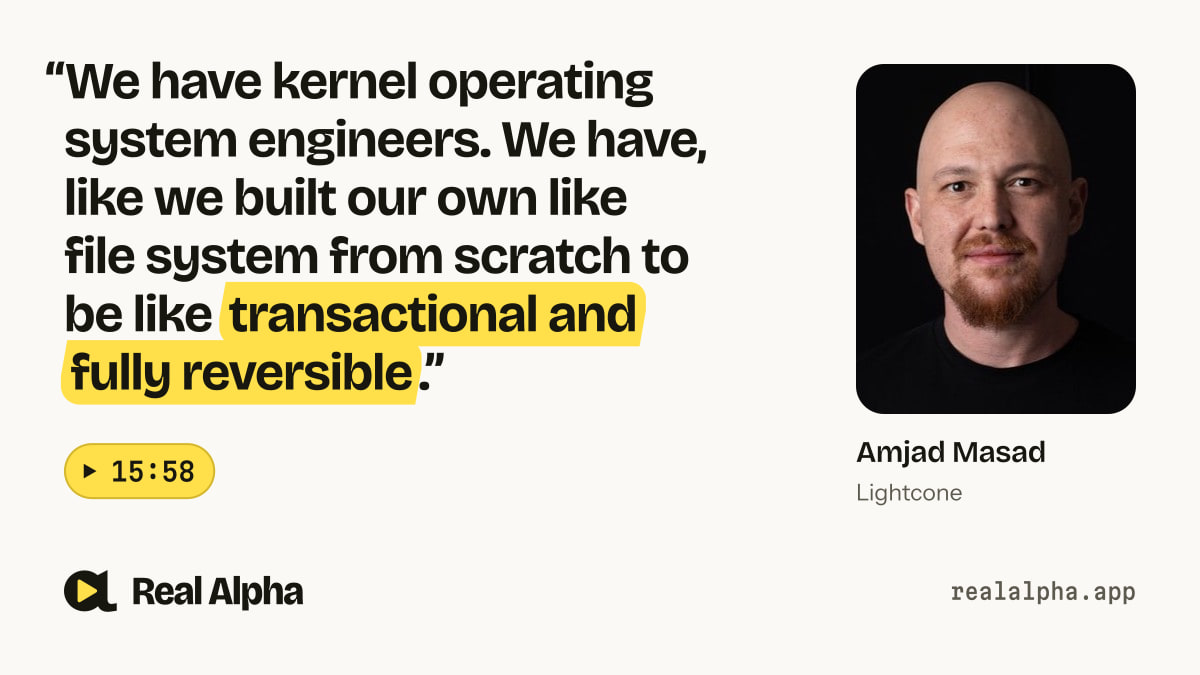
“We have kernel operating system engineers. We have, like we built our own like file system from scratch to be like transactional and fully reversible.”
 Amjad Masadat 15:58 · Lightcone
Takeaways
- Enterprise buyers care deeply about reliability and security.
- Replit built its own transactional, reversible file system.
- The agent could use infrastructure designed for collaboration.
About this segment
Amjad Masad says enterprise customers value Replit’s security and reliability, backed by years of systems work. Its collaborative IDE also let the agent fit in as another user.

Amjad Masad is co-founder and CEO of Replit.
Co-founded and leads Replit, a browser-based coding platform letting anyone write and deploy code.
- PG
Paul Graham, Host
From “How To Build The Future: Paul Graham & Amjad Masad”, Nov 7, 2026. Watch the full episode
Thanks. We'll look at and fix what's off.
Transcript
Transcribed by machine (Whisper) from the episode’s audio, so a word may be off here and there.
- 14:57
they don't have to do it yeah yes do you think that will be the thing that helps helps you prevail over competitors because that is one difference the depth of stuff that you've built and the depth of understanding you have of how to deploy programs online yeah so that is helping us win enterprise in our category because they are a lot more sensitive to reliability security all of that stuff it's really hard to get consumers to care about security for example a lot of our competitors competitors are like do really reckless things um with regards to to like building apps that are on secure and so on.
- 15:40
Because if you have agents writing all this code, who knows what it's doing? Yes. Yeah. And so we put a lot of guardrails, which makes our products sometimes slower, sometimes more expensive. But enterprises really like that. And so these newly arrived opportunists don't have the same sort of depth of infrastructure. It's like Replit's like, Like this iceberg, right? Where there's this visible bit above the water that's like, look, you just tell it in English what to do, right?
- 16:06
And it writes your code and then underneath there's all this stuff for deployment and sandboxing and stuff. We have kernel operating system engineers. We have, like we built our own like file system from scratch to be like transactional and fully reversible. I remember hearing all these stories back in the days before Vibe Coding, that's what all the updates from you would be up about. We made our whole new file system.
- 16:29
I hope somebody appreciates it. Yeah. When you want to make coding collaborative, you had to invent a lot of core primitives. So that's an interesting question. Did the stuff that you did in version one of Replit, where it's just online programming and it's collaborative, did the stuff that you did to make it collaborative also help with Vibe Coding? 100%. I mean, it's sort of surreal how plug-and-play it was.
- 16:58
So when you put an agent into a REPL, as we call it. It's like you're collaborating with the agent. Yes. So the agent is another user. So the initial version was basically the agent was just another user on the same system. And you had everything else built. Just ready for it. Yeah. And even you and the agent could work on the same project and it will just work. So it's no wonder you discovered Vibe Coding first, because you were perfectly positioned.
- 17:25
You had all the other ingredients, right? Yeah, I mean, this surreal thing, even the way the company was organized was so perfect. So we had the infrastructure team that handles code execution team, right? This is like sandboxing team, whatever. And then we had the deployment and cloud services team, just like you can spin up databases and deploy VMs and whatever. And then we had the team that was building the glue between the sort of infrastructure and the IDE.
- 17:59
And then we had the IDE team. And so where does AI fit into all of that? So we ended up creating a new agent team and we put it in the middle. And all these people are building now for the agent. So the infrastructure team is exposing tools for the agents. The IDE team, instead of like building IDE for humans, now they're building edit tools for the agents. Really? What sort of IDE do agents even need?
- 18:24
I thought they just generated code. Well, initially in 24, editing code was actually a hard problem.