The alpha, twice a week
That was 3 min.
Get the best new moments in your inbox every Wednesday and Saturday. It's free.
Check your inbox
We sent a link to your address. Click it to finish signing up. Not there in a minute? Look in spam.
or
Big Take · 3 min · Nov 6, 2026
Richter uses time away to judge sketches more objectively
 Max Richter
He saves rough ideas and returns to them later, when he can see them with fresh perspective.
In this episode
Full analysis- 31:30Richter says AI music needs royalties for its source artists7 min
- 28:14Richter stripped back his music to speak directly to listeners3 min
- 18:14A Richter track gave Hamnet its final scenePro pick 3 min
- 11:19A failed first album freed Richter to write about the Iraq War3 min
- 14:50Richter uses time away to judge sketches more objectively3 min
- 23:00Music became a refuge after Richter's difficult childhood4 min
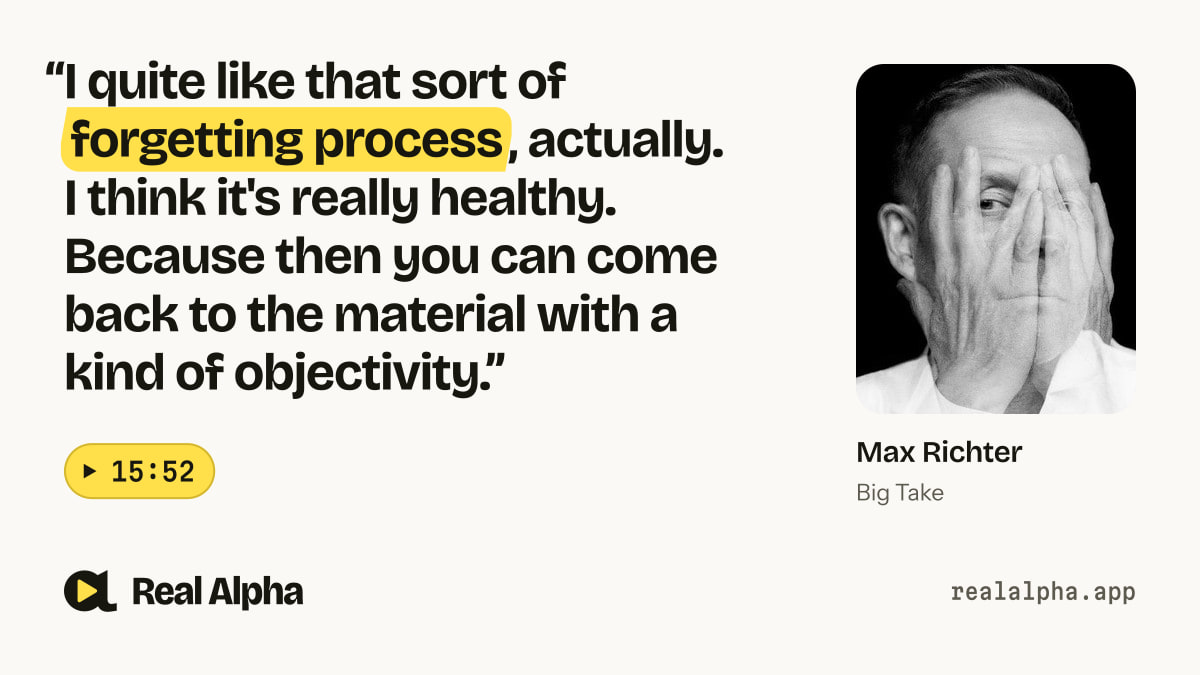
“I quite like that sort of forgetting process, actually. I think it's really healthy. Because then you can come back to the material with a kind of objectivity.”
 Max Richterat 15:52 · Big Take
Takeaways
- He keeps rough ideas rather than deciding immediately whether they work.
- Time away helps him assess material more objectively.
- Some pieces arrive complete; others emerge through experiments.
About this segment
He saves rough ideas and returns to them later, when he can see them with fresh perspective. Some pieces arrive fully formed; others emerge through sustained experiments.

Max Richter is a classical composer.
Composed music for over 50 film and TV projects and acclaimed albums including The Blue Notebooks and SLEEP.

Mishal Husain, Host · Host, The Mishal Husain Show
From “Composer Max Richter on AI, Artist Pay and Music’s Future | The Mishal Husain Show”, Nov 6, 2026. Watch the full episode
Thanks. We'll look at and fix what's off.
Transcript
From the transcript Big Take publishes with the episode.
- 15:02
How long does it usually take you to compose a piece of music? Does it start with the piano?
- 15:09
Often. I mean, the piano is my instrument. So as well as sort of performing, it's also my sketch pad. So I work at the piano. I work on a piece of paper on a table or with a computer or whatever.
- 15:22
Yeah, you'll sit there, keep experimenting, keep honing, and will you only write the notes on the page once you're sure of them, or are you even experimenting on the page?
- 15:32
There's quite a lot of scribbling. There's a scribbling phase, and it's a lot of composting, honestly. Things which are sort of, you know, I'll write something and it'll be like, I don't really know what that is. And then months later you sort of pick it up, and there's a kind of iterative composting process that goes on.
- 15:51
So things will come back then from the Richter composting. Definitely. Months, even years later? Definitely, yeah, sure. I mean, is there an actual.
- 16:00
Drawer where you'll put the scribble papers? Yeah, there are piles of paper all over the studio. And I quite like that sort of forgetting process, actually. I think it's really healthy. Because then you can come back to the material with a kind of objectivity.
- 16:13
But then you know it works... When it works at the first moment of a scribble, or do you sometimes remember the piece from ages ago and pull it up?
- 16:25
There's sort of no rule about that, really. Sometimes a thing will just land, almost like an email landing in your inbox, just fully formed, you know, and you think, oh, well, you know, and you just sort of write it out, basically. Other times it can take a while and it can be difficult and can be quite a sort of a wrestling process. And you have to be like a sort of little dog with a bone, you know, just sort of not let go and sort of just keep sort of working away at it. Honestly, I see the whole thing as a kind of set of experiments. And eventually things just kind of something will catch fire. Something will turn into an object which feels like it has a kind of gravitational field of its own, which has a sort of a character. It's a bit like novelists talk about this, don't they? They'll be writing something and then
- 17:11
suddenly the characters start to do things which they're not expecting. And it's that sort of feeling of intentionality that the material can have.