The alpha, twice a week
That was 4 min.
Get the best new moments in your inbox every Wednesday and Saturday. It's free.
Check your inbox
We sent a link to your address. Click it to finish signing up. Not there in a minute? Look in spam.
or
No Priors · 4 min · Feb 20, 2025
Robot design should match what the product can do
 Kyle Vogt
 argues that humanlike designs can set expectations a robot cannot yet meet.
The episode’s best minutes
Full analysis- 10:03Home robots can return time lost to choresPro pick 5 min
- 21:13Robot design should match what the product can doPro pick 4 min
- 33:56Small teams can still take on ambitious company goals3 min
- 5 more moments in the full episode
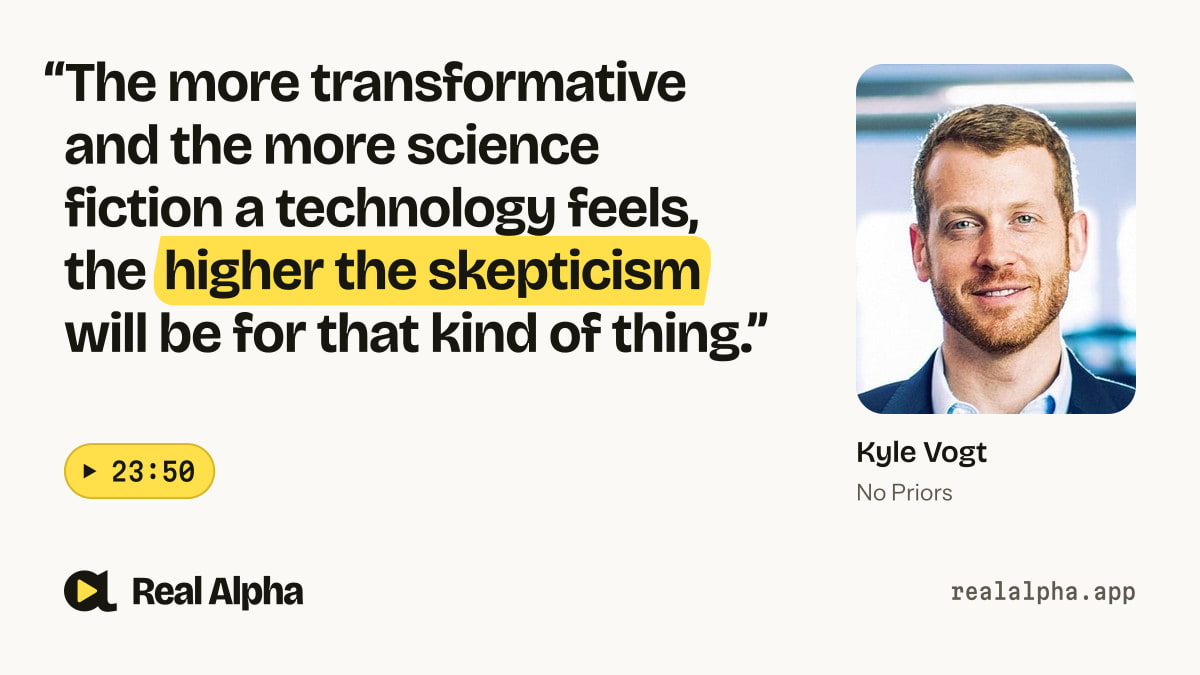
“The more transformative and the more science fiction a technology feels, the higher the skepticism will be for that kind of thing.”
 Kyle Vogtat 23:50 · No Priors
Takeaways Pro pick
- A more humanlike robot raises users’ expectations.
- Design should avoid promising more capability than the product has.
- One ride cut self-driving skepticism from 75–80% to 20–30%.
One of Pro's picks, open to you here. Try Pro free for 7 days
One of Pro's picks. The rest of the summary and the 3 takeaways are in Real Alpha Pro; the video, the quote and the transcript stay free.
Read it with Pro, 7 days freeAbout this segment
Kyle Vogt argues that humanlike designs can set expectations a robot cannot yet meet. He says firsthand use and trusted recommendations are more persuasive than specs or conventional marketing.

Kyle Vogt is cofounder of Twitch and Cruise, and CEO of The Bot Company.
Co-founded Cruise, a self-driving car company GM acquired, and now leads The Bot Company's household robots.


From “No Priors Ep. 102 | With The Bot Company CEO Kyle Vogt”, Feb 20, 2025. Watch the full episode
Thanks. We'll look at and fix what's off.
Transcript
Transcribed by machine (Whisper) from the episode’s audio, so a word may be off here and there.
- 21:19
consumers and you know make it interpreted in different ways by the customer you know to start with the analogy and the self-driving car uh industry was interesting because we named our cars every car had a name and people would personify it when it came up and you know a car in itself doesn't look like a creature it looks like a car something that you drive but once it starts moving on its own your brain plays some tricks on you and starts like treating it like it's an entity or a creature of some kind and so you can try to pretend that that doesn't exist And then you have this weird cognitive dissonance where you're saying it's a machine, but it seems like it has its own, you know, consciousness or life force in some way.
- 21:54
Or you can lean into it and acknowledge that and find a way to integrate it in the right way. The challenge, I think, with anthropomorphism, like I said, that word, right? You're just showing off now. Yeah, seriously. That was the hard part of the bot company. yeah yeah um yeah but too much anthropomorphism can see i screwed up there can it can imply like a set of uh human-like behaviors that uh don't exist in that product and i think rodney brooks wrote an essay about this basically saying with robots in particular the appearance of them sets the expectation for what that product will do and so if you make something I think that's interesting.
- 22:30
that looks exactly like a human. And in fact, the more human-like you make it, the higher the expectations I think the average person will have for that machine. It looks like me, it walks like me, it has a face and talks like me. So, you know, it must be capable of doing all the things that I can do. And today, 2025, I think it would be a leap of faith for any company to sell a humanoid robot or something like that and imply that it can do all of these things because we're still, I think, many years out from that, at least from meeting those expectations. And so I think that there's a lot of thought that can go into the design of a robot, the form of a robot and other things to try to match the expectations that you have for a robot when you see it to what it can actually do or even go the other direction instead of
- 23:12
over promising by showing a humanoid. Maybe you can do something in the other direction and surprise people with how much it can it can do. And that's that's kind of how I think about it personally. I'd like to surprise and delight customers rather than set them up for disappointment. Maybe on this front of just consumer acceptance and expectations, are there like lessons that transfer from self-driving to home robots? One thing I saw in self-driving, which I guess you could say it's intuitive, but it was still very striking, was that most people on the whole were very skeptical of self-driving cars. I guess like 75, 80 percent of people are like, I've never, you know, I'm never going to trust one of those things. That dropped to like 20 or 30 percent after one ride. Amazing. And so it's one of those things where it's like you just simply do not
- 23:55
believe it. The more transformative and the more science fiction a technology feels, the higher the skepticism will be for that kind of thing. And so I think anytime you're doing something new, whether it's self-driving or a home robot, which let's be honest, that sounds like sci-fi. I'd love to have that, but like, you know, can this be real is the question. And I think there will be a barrier. There'll always be skepticism and people say this is impossible or it's never going to scale or whatever it is. Maybe the introduction with any new technology. What I would say looking back is the most powerful thing to overcome that, which is people using the product, like people using the product and telling other people about the product and saying, no, no, no, I wrote in this thing or I tried this thing and it's real. You got to try it. And so I think leaning into
- 24:34
too much sort of classical marketing and trying to like tell people like what this thing will do or how, what its specs are and all that is very different than like hearing from someone you trust that I have this thing in my home, one of your most intimate spaces and it's working and it's like, and I love it. And so that's, that's kind of how I think about it for something like this where it's just hard to go straight at people who are skeptical and just don't believe that a sci-fi thing can exist and try to convince them through any other medium other than just trying it themselves.
- 25:00
timeline for that? Like you mentioned in passing like a pretty important claim that said like maybe