The alpha, twice a week
That was 3 min.
Get the best new moments in your inbox every Wednesday and Saturday. It's free.
Check your inbox
We sent a link to your address. Click it to finish signing up. Not there in a minute? Look in spam.
or
No Priors · 3 min · Feb 20, 2025
Small teams can still take on ambitious company goals
 Kyle Vogt
After Cruise, Kyle Vogt says he won’t sell another company and wants to avoid management layers that create bureaucracy.
The episode’s best minutes
Full analysis- 10:03Home robots can return time lost to choresPro pick 5 min
- 21:13Robot design should match what the product can doPro pick 4 min
- 33:56Small teams can still take on ambitious company goals3 min
- 5 more moments in the full episode
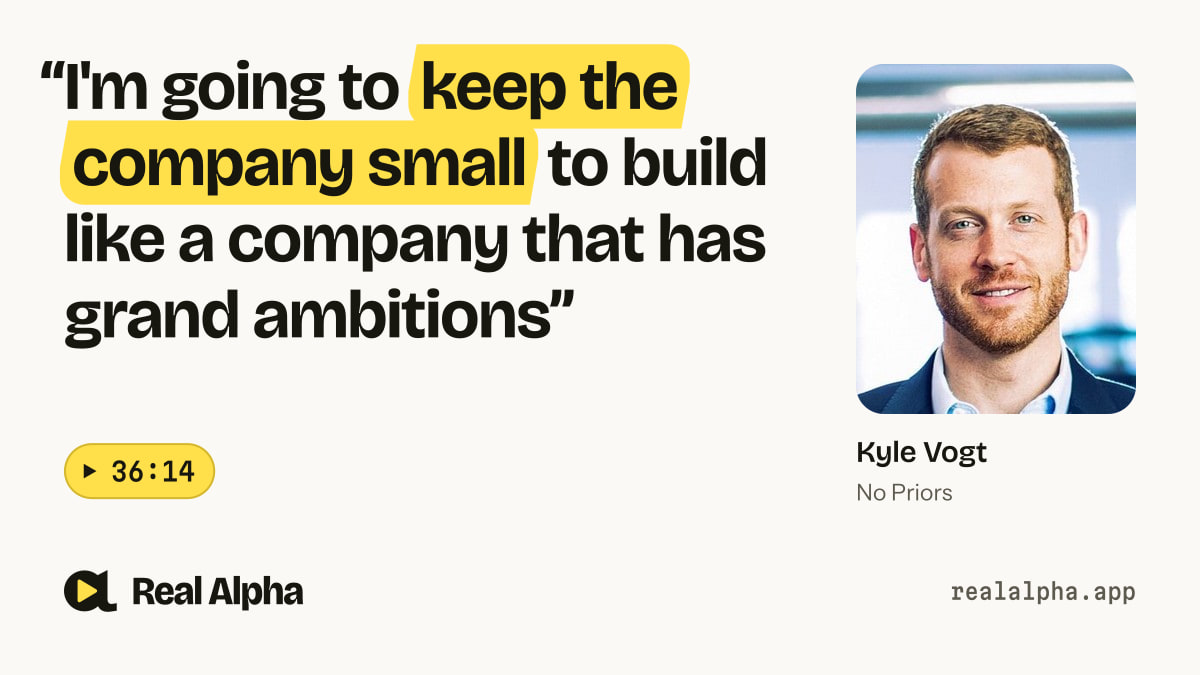
“I'm going to keep the company small to build like a company that has grand ambitions”
 Kyle Vogtat 36:14 · No Priors
Takeaways
- Selling means giving up a company you may still care about.
- Keep teams small and make every hire count.
- Coding assistants help engineers take on work beyond their specialties.
About this segment
After Cruise, Kyle Vogt says he won’t sell another company and wants to avoid management layers that create bureaucracy. Better coding tools, he argues, let a small team tackle a wider range of work.

Kyle Vogt is cofounder of Twitch and Cruise, and CEO of The Bot Company.
Co-founded Cruise, a self-driving car company GM acquired, and now leads The Bot Company's household robots.


From “No Priors Ep. 102 | With The Bot Company CEO Kyle Vogt”, Feb 20, 2025. Watch the full episode
Answers “Which jobs will AI replace, and which are safe?” See all 132 answers
Answers “Will AI replace software engineers?” See all 40 answers
Thanks. We'll look at and fix what's off.
Transcript
Transcribed by machine (Whisper) from the episode’s audio, so a word may be off here and there.
- 34:02
Yeah, I learned a lot. You know, big companies that have their have their, you know, core business in another domain doing an acquisition that's not in that domain, selling cars to people who buy pickup trucks and SUVs in the Midwest versus robo taxis and urban environments. These are not compatible things. And when push comes to shove, they're going to pick that one over the other. And we got completely decimated by GM's like lack of, you know, priority and then completely abandoning crews.
- 34:25
So I guess lessons learned plenty. First is I'm never going to sell another company again, ever. And so like, you know, maybe it will IPO or something like that, but it'll never be an acquisition in my life again. The reality is like, if I'm working on something today, I'm working on it because I think it's important and I care about it. And the day you sell the company is the day that you have to let that go.
- 34:42
And so, you know, if I'm, by definition, if this is something I care about, I'm not going to let it go. So the second thing is like team size. I, along with many other people, I think who started companies around the same time, fell victim to the Silicon Valley dogma of traditional engineering management for Silicon Valley companies. And so that's like higher. the VPs first and then they hire the directors and then they hire the senior managers who hire the managers. And there can't be a ratio of more than eight to one for fan outs. And you do performance review cycles and all these things that creates bureaucracy and structure, creates like communication gaps between the people actually doing the work and the people making the decisions. And so the solution, of course, is just to keep companies very small, like have
- 35:21
fewer employees, make every seat count, get the absolute best person in every role in every seat and just never grow the company to be so large that it sort of like crumbles under all the structure and bureaucracy and politics that seep in. These are natural things that happen to large groups of people when they are organized together in companies. Traditionally, that would mean you have to limp the scope of what you want to do.
- 35:40
If you want to keep your company small, you have to have small ambitions. Like it needs a large company to do large things. I think now that is not true. I think with coding assistants that continue to get better, things like deep research, like I found that nearly every job function can be partially automated. And I think that trend is going to continue. And as someone who spends like a lot of time programming, I felt my ability to take on things where I would have had to hire a team of people or like a specialist in iOS development or a specialist in like, you know, low-level Rust programming for motor drivers.
- 36:10
If you have a couple of good engineers, they can adapt and do all those things when sitting next to an LLM and some good coding tools. So I think it actually is viable to do what I want to do, which is like lesson learned. I'm going to keep the company small to build like a company that has grand ambitions, but a very tiny team. And that's what we're going to try to do. It's pretty amazing. I think you've had a really amazing career arc overall, right?