The alpha, twice a week
That was 4 min.
Get the best new moments in your inbox every Wednesday and Saturday. It's free.
Check your inbox
We sent a link to your address. Click it to finish signing up. Not there in a minute? Look in spam.
or
Newcomer Pod · 4 min · Nov 5, 2026
Robotics has a new learning breakthrough and a huge market
 Aydin Senkut
 says robots can now learn from observation, and cites 190 million low-skilled jobs in the US, Western Europe and Japan.
The episode’s best minutes
Full analysis- 17:40Robotics has a new learning breakthrough and a huge market4 min
- 12:55AI biology needs scalable experiments to test its discoveries5 min
- 42:58Underlying business growth matters more than bubble talk5 min
- 5 more moments in the full episode
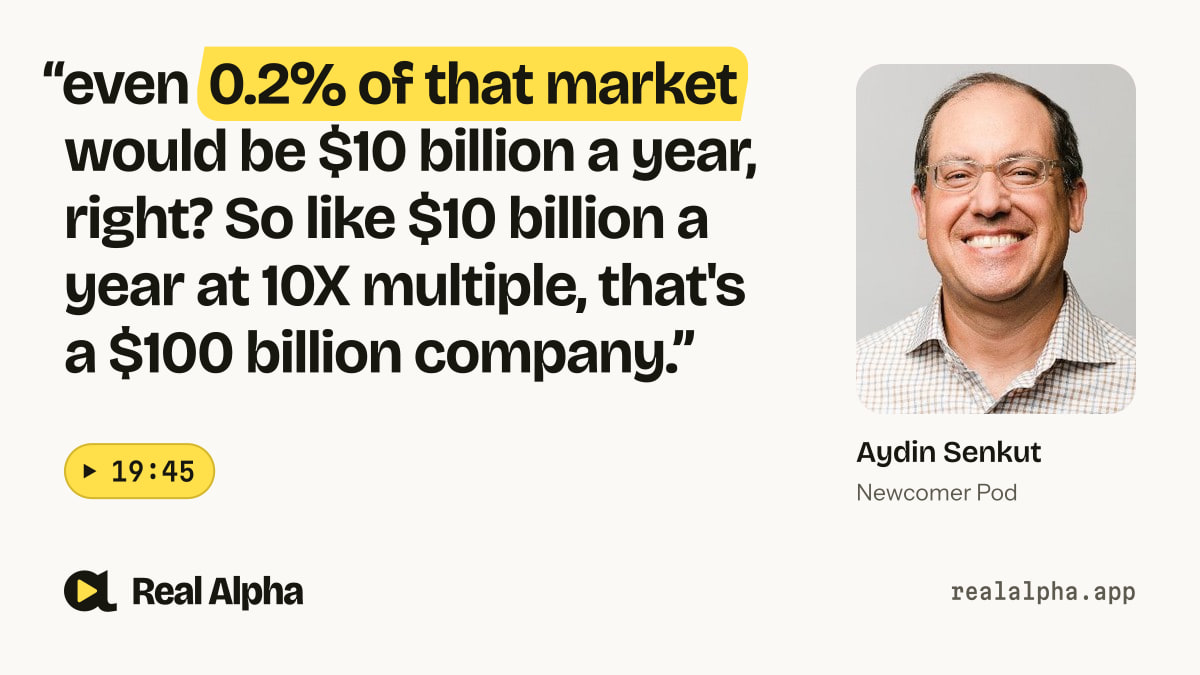
“even 0.2% of that market would be $10 billion a year, right? So like $10 billion a year at 10X multiple, that's a $100 billion company.”
 Aydin Senkutat 19:45 · Newcomer Pod
Takeaways
- Robotics investments failed when robots could not learn like humans.
- Senkut estimates 190 million low-skilled jobs in three regions.
- He sees opportunities in robot data, parts, energy and deployment.
About this segment
Aydin Senkut says robots can now learn from observation, and cites 190 million low-skilled jobs in the US, Western Europe and Japan. Even a small share of that market could support a very large company.

Aydin Senkut is founder of Felicis and former Google product manager.
Founded Felicis, a Menlo Park VC firm; former Google first product manager now backing AI and infrastructure companies.
- EN
Eric Newcomer, Host · Newcomer
From “Aydin Senkut on Why AI Is Fueling a Robotics Boom”, Nov 5, 2026. Watch the full episode
Thanks. We'll look at and fix what's off.
Transcript
Transcribed by machine (Whisper) from the episode’s audio, so a word may be off here and there.
- 17:45
environment and how we basically verify that these things actually work on our third bucket I mean a newcomer we surveyed venture capitalists a couple weeks ago and asked you know the hottest category we weren't paying attention to and overwhelmingly they said robotics. So there's clearly this immersion list, that survey. There's a lot of points that robotics is hot. You're in the venture capital business. We're going to talk in a second about building a fund. You need to make returns off these investments. Even if you say, okay, robotics, clearly there's something there. What's your analysis of what part of robotics is going to actually generate a huge return to investors?
- 18:21
So the one thing that I will say, we've been investing in robotics for almost 15 years. Up until a year and a half ago or two years ago, everything we invested in robotics was an absolute abject failure. Like not even partial failure, like abject failure. Because what happened is we never had a moment where robots learn things the way humans do. You know, like you can't just basically program a robot only to take a step or to lift the glass and all of that.
- 18:49
and more importantly like we you know learn things by looking observing whatever there was some way that our brain has evolved to essentially pick things up really fast and you see like the babies like it's amazing how they learn for the first time we have a way of making that happen in robotics so it's infinitely scalable so this is a very important moment the reason why I'm calling that out is it's easy to say something is hyped or exciting but the more interesting question is why why and why now and so that's a really important reason um and then the next thing is when you think about i just did this simple calculation that just u.s western europe japan alone 190 million low-skilled jobs by the way these are only jobs humans are willing to do and there might be like another billion jobs that we didn't even
- 19:34
imagine because humans would never do something like that and so when you basically think about that as like i don't know like to pick your number 10 000 a year 20 000 a year we're talking the market is so gigantic that for one of our robotics investments, I made this calculation that even 0.2% of that market would be $10 billion a year, right? So like $10 billion a year at 10X multiple, that's a $100 billion company.
- 19:57
So this is not a VC pipe dream of I'm- optimistic this company is going to do great and to me the other big thing was the validation of some of the worst most critical companies the question is can you have robots in the field in the toughest environments and have those companies say these are good enough that i'm going to deploy them and we are just starting to see that that to me is a very important validation we're not talking about household robots we're talking mission critical the the biggest most critical companies in the world so the combination of all these things i'm super excited by the way this doesn't even get to the bottom of like, hey, if we're going to build that many robots, where are all the parts going to come from? Manufacturing industry is going to go through a hundred exchange.
- 20:38
All of these robots will need actuators and energy and other stuff. We're going to need, if you thought inference market is big enough, just wait until like these robots like come along and with agents, it's going to be like an incredible explosion of demand. So that's why I'm super excited. And one of the other like interesting approaches we have at Felices is people look at a wave and like it's this company and we're like wait no like this wave has like six seven different ways it's going to play out the robots themselves will be great there's going to be data providers for the robots there's going to be like ai and inference for it there's going to be manufacturing wave all these robots will need parts there's energy that needs to come there is robot deployment there were like maybe 10 areas not just the robots themselves but like between
- 21:22
the models and all of that i just think like we are not even like top of the tip of the iceberg