The alpha, twice a week
That was 5 min.
Get the best new moments in your inbox every Wednesday and Saturday. It's free.
Check your inbox
We sent a link to your address. Click it to finish signing up. Not there in a minute? Look in spam.
or
Newcomer Pod · 5 min · Nov 5, 2026
Underlying business growth matters more than bubble talk
 Aydin Senkut
 says he focuses on company performance rather than whether the market is in a bubble, using Supabase’s growth as an example.
The episode’s best minutes
Full analysis- 17:40Robotics has a new learning breakthrough and a huge market4 min
- 12:55AI biology needs scalable experiments to test its discoveries5 min
- 42:58Underlying business growth matters more than bubble talk5 min
- 5 more moments in the full episode
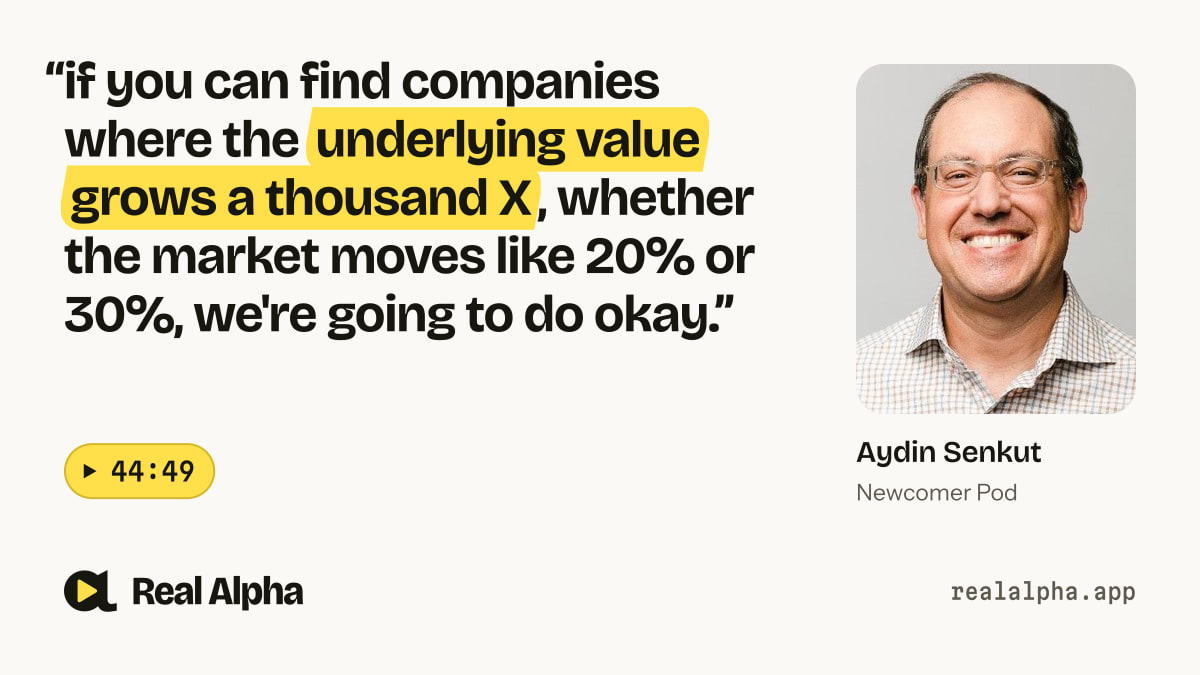
“if you can find companies where the underlying value grows a thousand X, whether the market moves like 20% or 30%, we're going to do okay.”
 Aydin Senkutat 44:49 · Newcomer Pod
Takeaways
- Market multiples can change while a company’s underlying value grows.
- Supabase revenue grew a thousandfold after Felicis invested.
- Strategic assets, talent and gatekeeping roles can attract acquirers.
About this segment
Aydin Senkut says he focuses on company performance rather than whether the market is in a bubble, using Supabase’s growth as an example. He also explains why strategic assets can hold value even before traction catches up.

Aydin Senkut is founder of Felicis and former Google product manager.
Founded Felicis, a Menlo Park VC firm; former Google first product manager now backing AI and infrastructure companies.
- EN
Eric Newcomer, Host · Newcomer
From “Aydin Senkut on Why AI Is Fueling a Robotics Boom”, Nov 5, 2026. Watch the full episode
Thanks. We'll look at and fix what's off.
Transcript
Transcribed by machine (Whisper) from the episode’s audio, so a word may be off here and there.
- 43:02
read on the bubble moment? Or like, how much do you feel like this is a, we used to have to talk about like.com, but 2021 was such a crazy period. Now I think we just look back at 2021. Does 2026 feel like 2021 to you? You know, I spent like not even a second thinking about bubbles. Like all I care about is the underlying business value. Like a great example is we've invested super base uh it was right after the covet like bubble like valuations crash and for three years nothing happened to that company and people are like you guys are idiots you pay too high of a price like what's going to happen to that company and i think what happens is if you basically let the market affect your decisions you're never going to like have the bravery to find the right things underlying super base had like insane growth they grew revenues thousand x since we
- 43:53
invested. What really mattered to me is that the underlying business performance was growing And more importantly, we had a thesis that that was going to follow hyper demand for a back-end platform that takes advantage of like crypto needed back-end, then all the AI apps needed back-end and people look around and there was no like friendly back-end and Superbase became that. It's become key to a lot of these like vibe-coded apps.
- 44:19
So where I'm going with this is you can now look at it and say like, just make a generalist comment and say, oh my God, there's a bubble. Like, what does that even mean? Like the only thing that matters is we have a job and that is are you picking the best companies as in not the best companies like whether there is a bubble or not you just look at the underlying performance and all that's changed with the bubble is that you have performance and like i can tell you that's worth 1x the revenue or 10x the revenue or 100x the revenue the multiple can change but the underlying value of the company doesn't change and the way that i think about it is if you can find companies where the underlying value grows a thousand X, whether the market moves like 20% or 30%, we're going to do okay. You know what I mean? Even if the market takes a 50% hit,
- 45:04
which I don't want for anyone, our job is to say, you know what, there is something in our book that has grown so much that even with that hit, you know, at some point, like we're going to be able to monetize it. And even with the biggest setbacks and crashes in the market and bubble bursting, guess what happened a couple years later? The market comes back roaring even stronger. You know what I mean? So we're not just going to say, oh my God, it's a bubble. We're slowing down. We're going to stop. And that's by the way, when people lose the biggest opportunities.
- 45:33
Because in this business, you cannot take pauses and you cannot stop. You cannot look at the market and say, oh my God, this is just crazy. Our job is to find the very best companies, even in that environment. How do you price with that philosophy? It's sort of like, what do I think sort of other investors are going to pay you? What tends to be sort of your valuation philosophy? I mean, I don't really think as much as what the other investors are going to pay, is that I basically think about what will be the terminal value of the company.
- 46:02
And more than the investors themselves, the question that we ask is, how can this company be so important that it is an independent company? And today, like that lens is like, you have to be at a billion to 10 billion revenues. and by the way you can't wait eight to ten years to get there you got to get there in three to five years um but the other thing is if you find the right zip codes like let me give you an example if you find anything in like the overall like ai infrastructure and chip industry like you have multiple trillion dollar companies and we have this like interesting like theorem that any company will easily spend up to one to two percent of their market cap to acquire a company The question is, for a $5 trillion company, that's $100 billion.
- 46:44
For a $5 billion company, that's like $100 million. So if you're in the right zip code, and even when things don't go right, but you build something so critical, there is going to be an acquire for a very large amount. Well, that's a theme in venture capital recently has been these acquisitions where deals were, you know, it's like poolside, hugging face companies where people didn't even necessarily think they were going to go the distance and they've had these amazing acquisitions.
- 47:10
So the acquisitions is a sort of defense of some of these companies. And I think this is a really good eye opener because we talk about business traction and you can argue like, hey, these companies maybe didn't have a significant of a business traction. but we were in poolside like but what they have done is they built a critical asset strategic asset it's like we're in new york there are certain like areas of new york like even if you wanted office or home like you just can't get it you know what i mean like something that is very rare strategic asset or you become a gatekeeper like shopify was a gatekeeper in commerce adyan was a gatekeeper in payments superbay is the gatekeeper for like infrastructure for all the ai apps so if you have like a strategic role and you become the home of a very important
- 47:52
community right like that was hugging face and for poolside they took their model open sourced it and have like some other really great assets And they found great talent, even that has value. So even if the business performance has not ensued yet, there is still great value in the company. And I'm glad that it is being monetized.