The alpha, twice a week
That was 2 min.
Get the best new moments in your inbox every Wednesday and Saturday. It's free.
Check your inbox
We sent a link to your address. Click it to finish signing up. Not there in a minute? Look in spam.
or
The Joe Rogan Experience · 2 min · Jul 2, 2025
Routine computer jobs may face automation before blue-collar work
 Amjad Masad
 argues that repetitive desk work may be more exposed to near-term AI than many physical jobs.
In this episode
Full analysis- 1:41:15AI coding lets employees build tools for a fraction of the cost3 min
- 2:05:03AI self-play works best when success can be objectively tested5 min
- 1:35:50Direct posts outperformed a $30,000 PR placement2 min
- 1:51:07Routine computer jobs may face automation before blue-collar work2 min
- 1:56:47China's manufacturing edge comes from expertise and long-term planning2 min
- 2:43:31A student hacker was tasked with securing the system he breached8 min
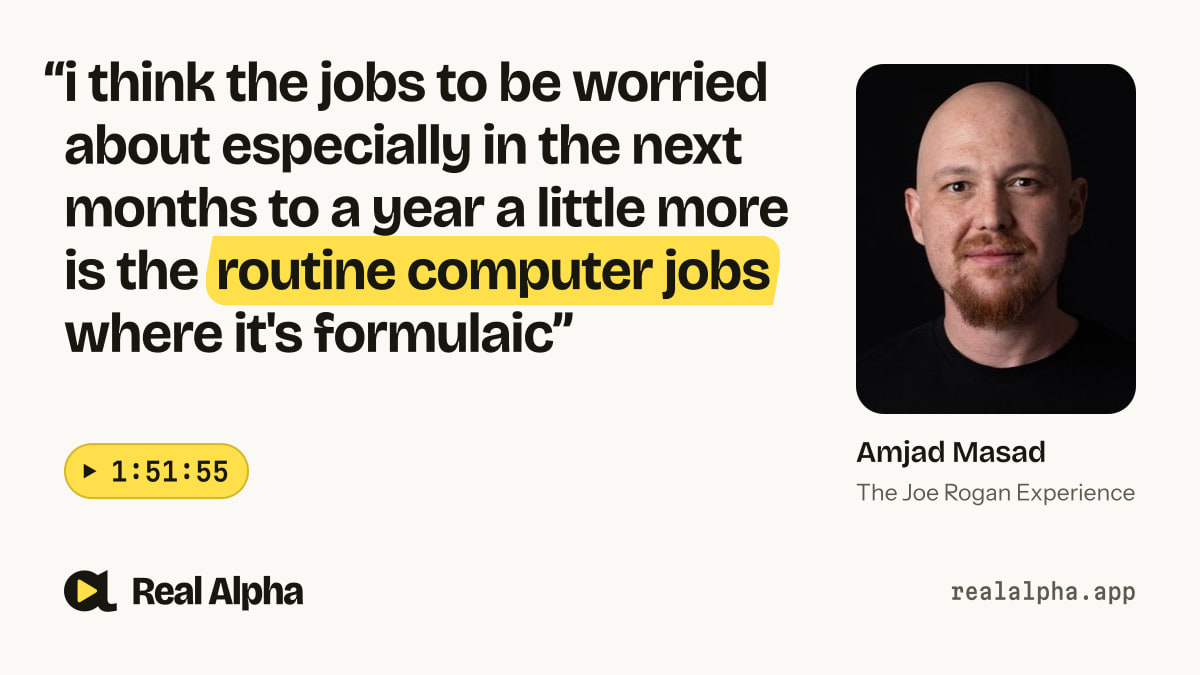
“i think the jobs to be worried about especially in the next months to a year a little more is the routine computer jobs where it's formulaic”
 Amjad Masadat 1:51:55 · The Joe Rogan Experience
Takeaways
- Predictable computer work may be exposed over the next months to a year.
- He sees routine software QA as an early target.
- Data abundance makes desk tasks easier to train for than robotics.
About this segment
Amjad Masad argues that repetitive desk work may be more exposed to near-term AI than many physical jobs. He points to computer-based tasks with predictable steps and abundant training data.

Amjad Masad is founder and CEO of Replit.
Co-founded and leads Replit, a browser-based coding platform letting anyone write and deploy code.

Joe Rogan, Host · Host, The Joe Rogan Experience
From “Joe Rogan Experience #2344 - Amjad Masad”, Jul 2, 2025. Watch the full episode
Answers “Which jobs will AI replace, and which are safe?” See all 132 answers
Answers “What will AI look like in the next few years?” See all 169 answers
Thanks. We'll look at and fix what's off.
Transcript
Transcribed by machine (Whisper) from the episode’s audio, so a word may be off here and there.
- 1:51:11
Well, I actually think that more white-collar jobs are going away. I think so too. Yeah, so then blue-collar, which is what was the – like go back 10 years ago and we thought, okay, self-driving cars, robots and manufacturing. And that turned out to be a lot harder than actually, like, more desk jobs because we have a lot more data, for one. We have a lot more data on people sitting in front of a computer and doing Excel and writing things on the Internet.
- 1:51:49
And so we're able to train these what we call large language models. and those are really good at like using a computer like a human uses a computer right and so i think the jobs to be worried about especially in the next months to a year a little more is the routine computer jobs where it's formulaic you know you go you have a task like quality assurance jobs right software quality assurance it's like you get you get you have to constantly test the same feature of like some large software company, Microsoft or whatever.
- 1:52:25
You're sitting there and you're performing the same thing again and again every day and if there's a bug you kind of report it back to the software engineers and that is I think really in the bullseye of what AI is going to be able to do over the next month. And do it much more efficiently. much more efficiently much faster yeah yeah those people have to be really worried um drivers you know professional drivers like people who drive trucks right things along those lines that's going away that's definitely going away yeah and that's a that's an enormous part of our society it's millions of jobs right you know i was watching a video on this coal mining factory in china that's