The alpha, twice a week
That was 4 min.
Get the best new moments in your inbox every Wednesday and Saturday. It's free.
Check your inbox
We sent a link to your address. Click it to finish signing up. Not there in a minute? Look in spam.
or
The Information's TITV · 4 min · Nov 9, 2026
Runway expects robotics to become its largest market
 Alejandro Matamala Ortiz
 says Runway's video models can serve filmmakers and train robots, with interactive environments as a third use.
In this episode
Full analysis- 12:13AI data centers need to make nearby communities partners3 min
- 16:13Personal AI agents may build affinity through memory and personalityPro pick 5 min
- 36:23Microsoft measures AI by business outcomes, not one ROI metric3 min
- 2:46Jensen Huang's relationship raises questions about NVIDIA succession8 min
- 28:26Runway expects robotics to become its largest market4 min
- 40:29Microsoft is scaling AI through department-wide agents4 min
- 22:59Bing Gordon says Xbox sits outside Microsoft's core model3 min
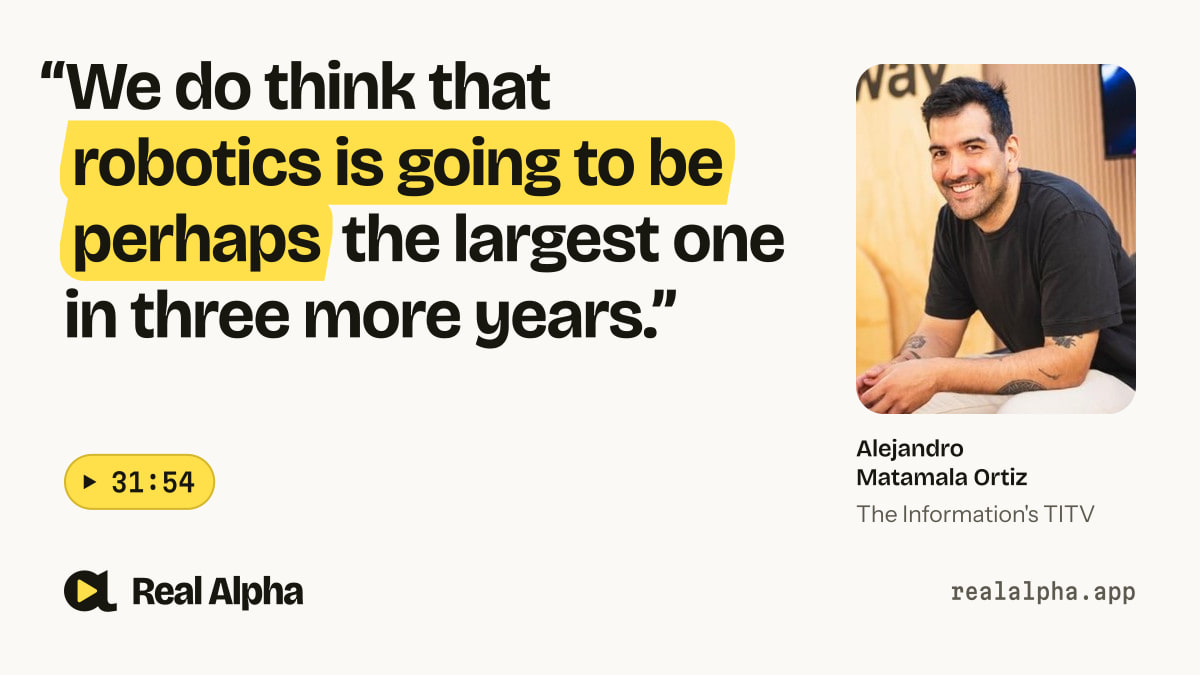
“We do think that robotics is going to be perhaps the largest one in three more years.”
 Alejandro Matamala Ortizat 31:54 · The Information's TITV
Takeaways
- Runway's models can generate video for audiences or train robots.
- Ortiz groups media, robotics, and interactive experiences as target markets.
- He forecasts robotics may be Runway's largest market in three years.
About this segment
Alejandro Matamala Ortiz says Runway's video models can serve filmmakers and train robots, with interactive environments as a third use. He expects robotics could become the company's largest market within three years.

Co-founder & chief innovation officer, Runway
Co-founded Runway and leads Runway Labs, exploring new applications for generative video and world models.

Akash Pasricha, Host · Host, TITV
Led The Information's Pro subscription and co-wrote its flagship newsletter, The Briefing.
From “Nvidia Probes Jensen Huang; Inside Microsoft’s AI Payoff”, Nov 9, 2026. Watch the full episode
Answers “What will AI look like in the next few years?” See all 395 answers
Thanks. We'll look at and fix what's off.
Transcript
Transcribed by machine (Whisper) from the episode’s audio, so a word may be off here and there.
- 28:30
from now, because I think as I think about the history of the company, I mean, you know, I think I always sort of thought of you as the Hollywood focused AI video company. And then you kind of expanded into more of a platform play, you know, more of an aggregator model. You're here today to talk about world models and so i i see the aperture getting wider and wider where do you want to focus on three years from now what what should we know runway as yeah so when we started the company We started with this idea of allowing anyone in the world to create a feature film using AI.
- 29:05
That was meant for creatives, and that was a very crazy idea in 2018. I think the world moved on. I think we have more tools, we have more systems, we have an ecosystem of tools in which you can now create these kind of outputs. And we are still serving that industry, the creative industry. We're still working with Hollywood studios, with advertising agencies, with creative shops, and we're helping them tell the stories that they want to tell.
- 29:30
As we develop our tools and our models, we discovered or we learned that these models were going to be far more capable than we anticipated for. So instead of just using them for creating videos for things that people want to watch, these videos can be used to train robots to learn how they want to perform specific things in the physical world. So as an external eye, this might look like two different spaces, like the creative space and robotics.
- 29:59
but for us it's the same underlying technologies like we are creating models that produce videos and in some cases videos are good for people to watch in some other cases are good for machines to watch so we want to continue on that on that research effort and we want to simulate the world entirely not purely on the visual aspects and we we think there's three buckets in which we can apply this kind of research one is still in media and entertainment if we can create better scenes through world models we can use them for making better bigger more ambitious films we can also use it for robotics to train the next generation of robotics to learn how they will work in the physical world and the third baguette which is a little bit more experimental today is for gaming and real-time interactive immersive experiences or interfaces so you can use these modes to kind
- 30:51
of create game environments or other environments where you where you can use them for onboarding tasks, for training tasks, or for interfaces as we know them today. So you run Runway Labs, which is the innovation arm for Runway. So you work on research and initiatives in all three of those three buckets, is that right? Yeah, Runway Labs is kind of like a design studio within the company. So we have what I call a mini-mode because we do have access to these new capabilities that are coming from research way before than anyone else.
- 31:27
So what Labs is doing is turning these research capabilities into prototypes, into applications, into new media projects, and seeing how we can apply them into things that can go into production or maybe things that can inform our industries on how to use this model. Which one of those three is closest to being a profitable product for Runway? Media, entertainment, advertising is the core industry.
- 31:54
that we have been serving for the past seven, six years. We do think that robotics is going to be perhaps the largest one in three more years.