The alpha, twice a week
That was 5 min.
Get the best new moments in your inbox every Wednesday and Saturday. It's free.
Check your inbox
We sent a link to your address. Click it to finish signing up. Not there in a minute? Look in spam.
or
Sources · 5 min · Sep 22, 2026
Salesforce’s 1-1-1 model puts giving inside the business
 Marc Benioff
 says Salesforce puts 1% of equity, profit and time into giving, citing grants, volunteer hours and school support.
In this episode
Full analysis- 21:04Customer reality is a better guide than SaaS panicPro pick 5 min
- 29:30Salesforce saw Slack as an agent for business4 min
- 44:25AI will make computer interfaces dynamic and adaptive4 min
- 33:36Salesforce plans to offer six AI pricing models2 min
- 16:04A blocked OpenAI investment led Salesforce to Anthropic4 min
- 41:11AI agents now outnumber human readers at TIME3 min
- 12:10An attack on Hugging Face opened Salesforce acquisition talks4 min
- 7:18Salesforce’s 1-1-1 model puts giving inside the business5 min
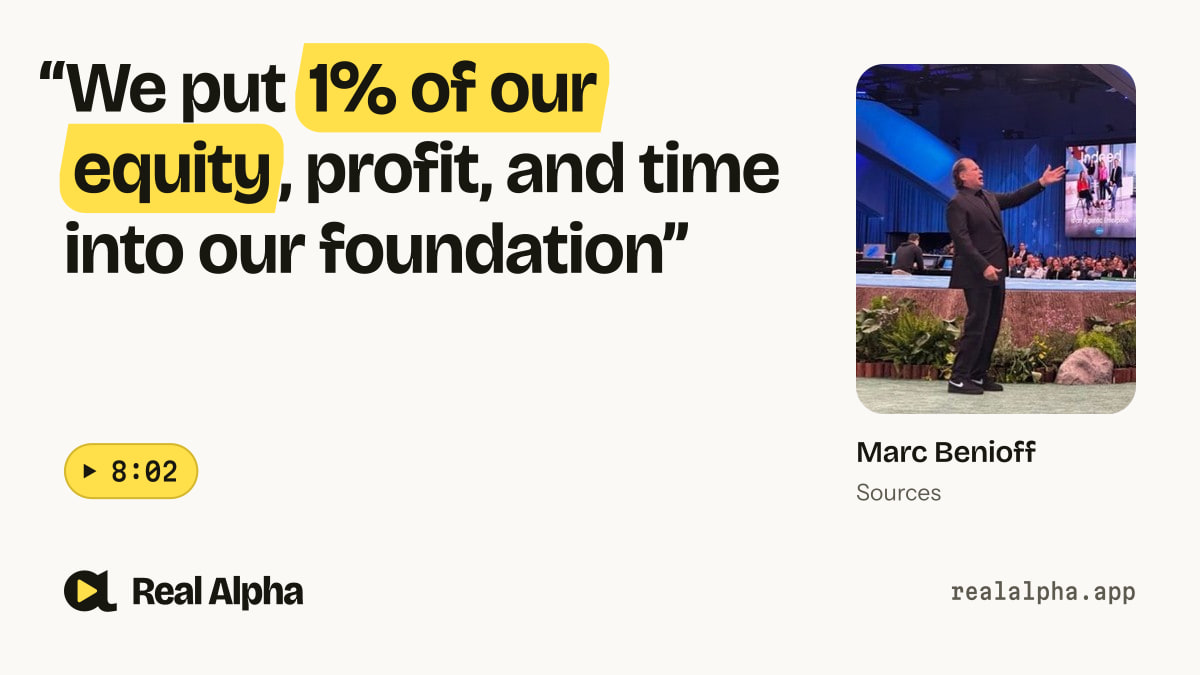
“We put 1% of our equity, profit, and time into our foundation”
 Marc Benioffat 8:02 · Sources
Takeaways
- Salesforce commits 1% of equity, profit and employee time.
- Benioff cites 11 million volunteer hours and $1 billion in grants.
- The company gives each middle-school principal in San Francisco and Oakland $100,000 yearly.
About this segment
Marc Benioff says Salesforce puts 1% of equity, profit and time into giving, citing grants, volunteer hours and school support. His account shows how the 1-1-1 model works at scale.

Marc Benioff is CEO of Salesforce.
Founded Salesforce in 1999, pioneering cloud computing and building one of the world's leading enterprise software companies.

Alex Heath, Host · Founder & host, Sources
Left The Verge to start Sources in 2025; it has made over $1M since, mostly from sponsors.
From “Marc Benioff on Dreamforce memes and the AI SaaSpocalypse”, Sep 22, 2026. Watch the full episode
Thanks. We'll look at and fix what's off.
Transcript
From the transcript Sources publishes with the episode.
- 7:21
That's J-I-R-A dot com. You had Sam. Sam and Dario here, which I think you might deserve a Nobel Peace Prize for. But there's gonna be so much wealth that's unlocked by those two IPOs in San Francisco. I mean, a record amount. And you and the company really pioneered a way to do philanthropy, right? With your 1-1-1 concept and it's still obviously a big part of what you do. And I'm curious if you've had conversations with some of, you know, Dario, some of these other AI leaders about what you've learned from philanthropy and how you would like to see them give back.
- 7:54
Because, I mean, we are talking about a record amount of wealth that's about to be generated.
- 7:58
Well, telling entrepreneurs anything is extremely difficult. Yeah. So, and especially those entrepreneurs, but I would just say that you're right. We put 1% of our equity, profit, and time into our foundation, you know, so many years ago, and that has unlocked this incredible capability, you know, our ability to get back at scale. We've done 11 million hours of volunteerism. A billion in grants. We run 65,000 nonprofits and NGOs for free.
- 8:28
Many of them are here. That is very important to us, you know, that we didn't just do it, but we did it the right way. We didn't have to kind of go back and say, oh, I wish I had done it like that. We're older than these companies for 27 years, but we don't have to look backwards and say, well, I guess we should have, would have, could have done it. You know, we've done, you know, millions of hours of volunteerism in the schools.
- 8:53
That is really important to me. I came from public schools that, you know, we're rebuilding playgrounds, painting schools. We give $100,000 every year to every middle school principal in San Francisco and Oakland to make sure that they have what they need to be successful. That is very important to us. So we're not just building another company that we're trying to get back. And also we're not going to be like a hundred years old and now we're going to get back.
- 9:22
Because the power in giving is actually through, yes, you have this ability to write checks because you're public, but no, your greatest power is that you have your company, so the relationships And the employees and all of that is the ability to really make change. Yeah.
- 9:39
I had Sam on my podcast recently and I asked him about this and I said, could you give back more? Could you build libraries? You know, lessons from the industrial revolution, right? And he said, well, I think the main way to get people to like AI is to build great products, which No question there. But I haven't heard any of the current leaders of this AI boom talk about it in the way you just talked about it.
- 10:01
I don't know if you agree with me, but I would like to see more of that in terms of what practically are you doing in the community? Because as you know, people have a very strong feeling about AI right now. And if these companies were to be playing more integral roles in their communities, I wonder if that would shift.
- 10:15
Entrepreneurs always get dropped into different buckets in this category. And one bucket is a good friend of mine who's a great entrepreneur said, Hey, Mark, I don't think you're right at all. Who's done more for the world, the Ford Foundation or the Ford Corporation? And I said to him, I think this is a false choice, both. You know, why can you not do both? That's my whole perspective. When you start to actually try to separate These two things you're doing, I think everyone a disservice when you put it together.
- 10:47
You're doing everybody a great service and you have so much power in your capability as a CEO of a company or as an entrepreneur. If you actually decide to not only build great products or have great customers, but also have great impact. You can do it all. And so, you know, this has been our message for a long time, but not everyone is going to buy in because entrepreneurs are very opinionated. Doesn't matter who they are.
- 11:15
They have strong philosophical statements and they'll either buy into that or they won't. But 20,000 companies have joined our 1-1-1 model through pledge1percent.org. And if you do go to pledge1percent.org, you can learn all about how to do this with your company. And I think it adds to your culture, makes for a great company, helps you to set the right values. Also, I think it helps in the employee behavior, that it sets the right tone from the top, we call it in business, that our employees know you need to really behave this way.
- 11:46
And I think it's benefited us in so many ways.