The alpha, twice a week
That was 2 min.
Get the best new moments in your inbox every Wednesday and Saturday. It's free.
Check your inbox
We sent a link to your address. Click it to finish signing up. Not there in a minute? Look in spam.
or
Bloomberg Tech · 2 min · Oct 29, 2026
Samsung is spending to regain HBM leadership
 Peter Elstrom
Samsung is raising capital spending about 60% as it tries to regain HBM leadership from SK Hynix.
In this episode
Full analysis- 21:02Google needs ads to fund its AI expansionPro pick 2 min
- 24:51Microsoft can use its credit rating to fund AI spending3 min
- 33:16Driverless trucks could nearly double annual utilization2 min
- 11:26Marvell’s Lumentum deal targets sold-out data-center optics3 min
- 28:16Samsung is spending to regain HBM leadership2 min
- 31:05Aurora is scaling through retrofits and factory installs2 min
- 14:35Instacart adds advertising and enterprise software to DoorDash2 min
- 17:01Tech firms are preparing for more congressional AI scrutiny4 min
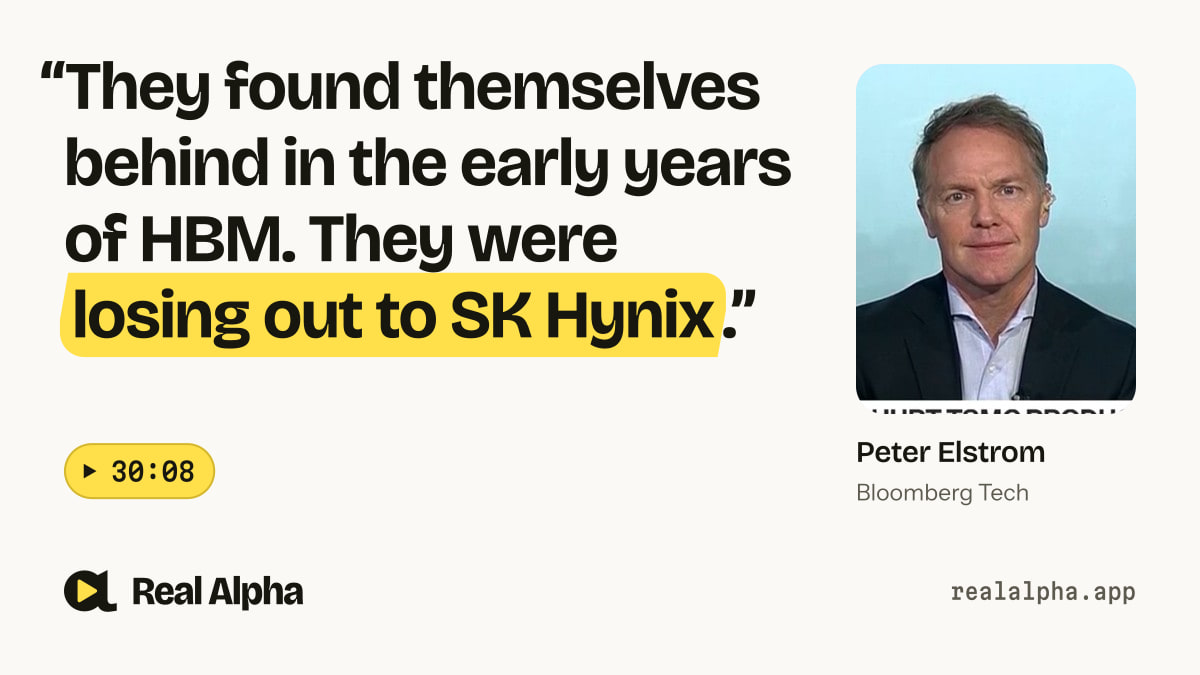
“They found themselves behind in the early years of HBM. They were losing out to SK Hynix.”
 Peter Elstromat 30:08 · Bloomberg Tech
Takeaways
- Samsung’s revenue doubled from a year earlier.
- It plans to raise capital spending about 60%.
- The company wants to avoid falling behind in HBM again.
About this segment
Samsung is raising capital spending about 60% as it tries to regain HBM leadership from SK Hynix. Its lack of detail on shareholder returns also weighed on the stock.

Executive editor for global tech, Bloomberg
Edits Bloomberg's global technology coverage; previously reported for Businessweek and led Japan's Foreign Correspondents' Club.

Ed Ludlow, Host · Host & correspondent, Bloomberg
Hosts Bloomberg Tech and reports on technology, supply chains, deals and finance for Bloomberg News.
From “Google Sales Miss Reignites AI Fears, Microsoft Eyes $25B Debt Offering | Bloomberg Tech”, Oct 29, 2026. Watch the full episode
Thanks. We'll look at and fix what's off.
Transcript
From the transcript Bloomberg Tech publishes with the episode.
- 28:19
failed to outline plans for sharing profits, which surged 15-fold. Joining us, Bloomberg executive editor Peter Elstrom. We talked about this in advance yesterday. So there are, again, two separate stories. There's how well it's going for Samsung, and then there's the shareholder return story. Let's start with how it's going, particularly for his chips business.
- 28:37
Yeah, well, this is part of the big picture in the AI trade, where we're seeing this very aggressive build-out in AI infrastructure. Samsung, of course, makes memory chips, the leading maker of memory chips, and it's done very well in that business historically. So the numbers that they reported were actually pretty good. Revenue was double what it had been a year earlier. They made $ 60 billion, the equivalent of $ 60 billion. Their profit margins are more than 50%.
- 29:02
And remember, this is a company that It sells not just memory chips, but also refrigerators and microwaves and other things like that. So those are pretty extraordinary profit margins. But there were a couple of things that weighed on the results. First, as you were talking about earlier with Sarah, Alphabet's earnings kind of cast a bit of a sense of gloom over the market. And then in addition to that, Samsung said it's going to hike its capital spending this year about 60%. There's a very sharp hike, greater than expected.
- 29:29
On top of that, they did not articulate exactly how they're going to return cash to shareholders. They talked back in August that they were going. To return $ 80 billion in cash. Either buybacks or dividends to its shareholders, but they didn't give more detail on that front. So I think the combination of those two things left investors a little bit with some questions.
- 29:51
So we'll go back to yesterday's story, which is SK Hynix, their rival in high bandwidth memory in particular, boosted shareholder returns. That context is important, Peter.
- 30:02
That context is important. Yeah, SK Hynix was very clear on that front. I think the takeaway from Samsung is they're getting very aggressive here. I mean, this is a very aggressive company to begin with. They found themselves behind in the early years of HBM. They were losing out to SK Hynix. They don't want to be in that position. They're not used to being in that position. And I think the sign that they're going to spend 60% more in capital spending this year is a signal to the rest of the industry that they're bidding to take a leadership position again and make sure that they don't fall behind in this segment.
- 30:33
Bloomberg's Peter Elstrom covering all things Asia Tech. Thank you very much indeed. Okay, coming up, driverless truck firm Aurora says it's on the road to some progress, some profitability