The alpha, twice a week
That was 2 min.
Get the best new moments in your inbox every Wednesday and Saturday. It's free.
Check your inbox
We sent a link to your address. Click it to finish signing up. Not there in a minute? Look in spam.
or
Bloomberg Businessweek · 2 min · Nov 11, 2026
Small biotech teams are using AI to move work through pipelines
 Jenny Rooke
 says AI lets even a dozen-person biotech advance product work in parallel.
In this episode
Full analysis- 13:17Biotech AI gains value from data, not just compute4 min
- 19:18Delayed research funding can weaken US biotech leadershipPro pick 5 min
- 24:18Gene editing could solve simple genetic diseases in our lifetime2 min
- 4:24Anthropic's IPO demand includes multibillion-dollar anchor orders4 min
- 0:42CoreWeave is spreading its data-center costs to partners3 min
- 10:37Small biotech teams are using AI to move work through pipelines2 min
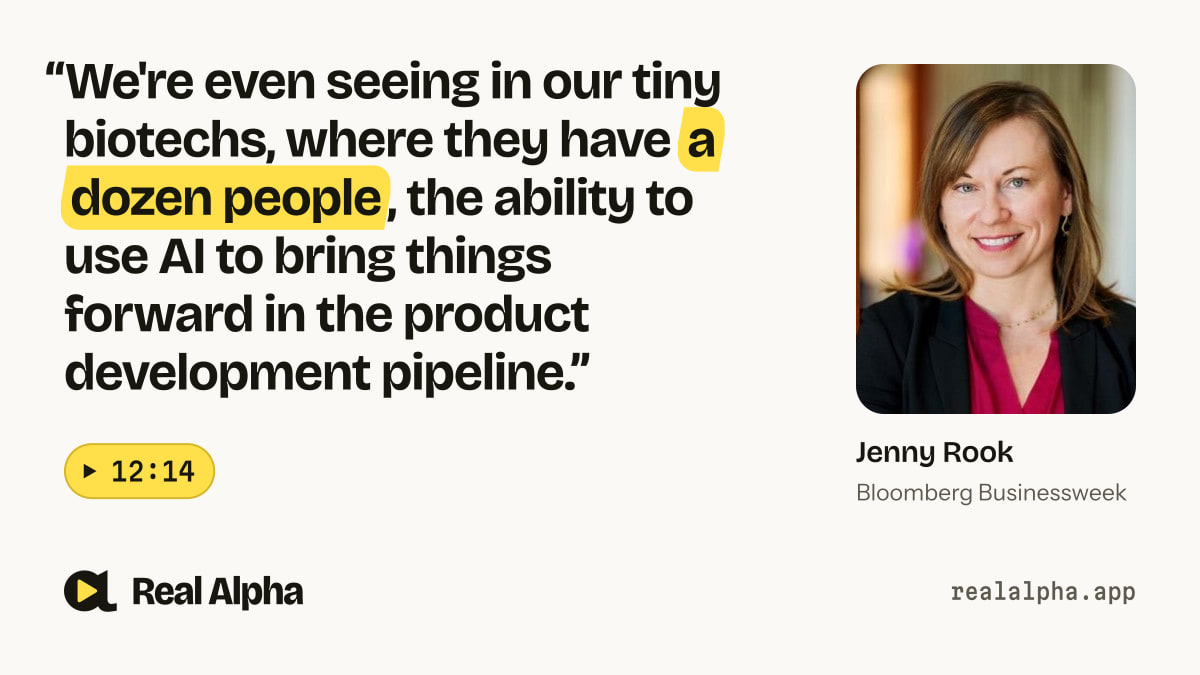
“We're even seeing in our tiny biotechs, where they have a dozen people, the ability to use AI to bring things forward in the product development pipeline.”
 Jenny Rookat 12:14 · Bloomberg Businessweek
Takeaways
- AI is helping traditional biotech and pharma workflows.
- Teams of about a dozen can use it to advance pipeline work.
- Parallel development may improve biotech risk-reward.
About this segment
Jenny Rooke says AI lets even a dozen-person biotech advance product work in parallel. That can increase pipeline throughput without requiring a large team.

Founder & Managing Director, Genoa Ventures
Founded Genoa Ventures and backed biotech innovators including Zymergen, Caribou Biosciences and Intabio.
- CM
Carol Massar, Host

Tim Stenovec, Host · Co-host, Bloomberg
Interviewed leaders including Reed Hastings, Stephen Schwarzman and Mary Barra as a Bloomberg Businessweek co-host.
From “AI Rally Sets Emerging Stocks Up for Best Streak Since September | Bloomberg Businessweek”, Nov 11, 2026. Watch the full episode
Answers “Is AI paying off for companies?” See all 116 answers
Thanks. We'll look at and fix what's off.
Transcript
From the transcript Bloomberg Businessweek publishes with the episode.
- 10:40
We love checking in with you to get the temperature of your world right now. We spoke to you a lot in the last two years about changes at the federal level when it comes to funding and research. I want to start off with what you're seeing out there in Silicon Valley right now in terms of opportunities outside of everything that we talk about each day, which is AI. What are you seeing?
- 11:02
Well, certainly AI is one of the big vectors, and that is touching everything from the beginnings of discovering new medicines to delivering healthcare. We continue to see one of the great things about being in the Bay Area is this sense of convergence of different types of technologies and coming together and applying those in areas yes, include healthcare, but are also in some of these other areas that touch our lives, like you mentioned, pet food and even chemicals and how we make the things that we need to use as inputs in the world.
- 11:29
Yeah, I think we think of it as playing and doing searches and figuring out things, at least on kind of an easy level or basic level. But what is going on in medicine? Because I do feel like everyone says that there's so much potential or figuring out new compositions for doing things, like Where is that process or what are those companies that we may not be talking about yet but probably will be?
- 11:51
What kind of companies? I think one of the quiet successes that's happening that's maybe harder right now to take a headline is the efficiencies that we'll call them traditional biotech and pharma are finding in all of their workflows. And that doesn't necessarily mean that they're going to be doing less. It actually suggests that they'll be able to move more through pipelines. We're even seeing in our tiny biotechs, where they have a dozen people, the ability to use AI to bring things forward in the product development pipeline. Something we were going to get to in years. The efficiencies that AI are delivering means that you can start doing that in parallel.
- 12:34
maybe that results in better risk-reward ratios, whether you're a big pharma or a little biotech. Very hard to see that on the headlines, but we think it's happening.