The alpha, twice a week
That was 4 min.
Get the best new moments in your inbox every Wednesday and Saturday. It's free.
Check your inbox
We sent a link to your address. Click it to finish signing up. Not there in a minute? Look in spam.
or
Behind the Craft · 4 min · Oct 18, 2026
Specialized AI can compete by owning a narrow workflow
 Anthony Pompliano
 argues that a focused finance product can beat general-purpose AI with specialized workflows, its own intelligence stack and relevant data.
The episode’s best minutes
Full analysis- 13:40Work trials reveal fit faster than interviews4 min
- 25:23Personal financial context can unlock tax and estate planningPro pick 3 min
- 32:05Specialized AI can compete by owning a narrow workflowPro pick 4 min
- 5 more moments in the full episode
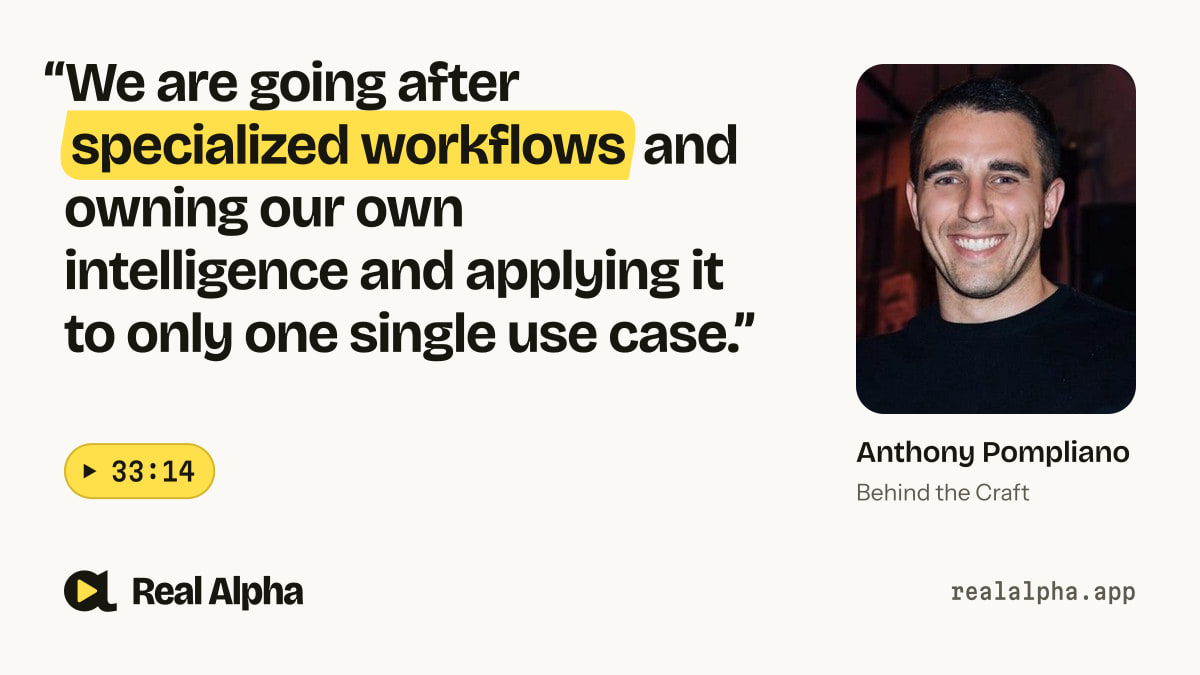
“We are going after specialized workflows and owning our own intelligence and applying it to only one single use case.”
 Anthony Pomplianoat 33:14 · Behind the Craft
Takeaways Pro pick
- General-purpose AI labs have strategic limits in specialized markets.
- Build models and workflows around a specific use case.
- Measure success by whether users grow their net worth faster.
One of Pro's picks, open to you here. Try Pro free for 7 days
One of Pro's picks. The rest of the summary and the 3 takeaways are in Real Alpha Pro; the video, the quote and the transcript stay free.
Read it with Pro, 7 days freeAbout this segment
Anthony Pompliano argues that a focused finance product can beat general-purpose AI with specialized workflows, its own intelligence stack and relevant data. He says the test is whether it helps users grow their net worth faster.

Anthony Pompliano is an investor, best-selling author, public company CEO, and founder of Silvia.
Invested in more than 300 private companies, including over 20 unicorns, and hosts The Pomp Podcast.

Peter Yang, Host · Host, Behind the Craft
Led product at Roblox, Reddit, Twitch and Meta for 10+ years.
From “We Built an AI CFO to Help You Grow Your Net Worth | Anthony Pompliano”, Oct 18, 2026. Watch the full episode
Thanks. We'll look at and fix what's off.
Transcript
Transcribed by machine (Whisper) from the episode’s audio, so a word may be off here and there.
- 32:11
like I just feel like there's always a threat. I think you talked about some of this already. There's always a threat that one of these labs will try to go after your use case. They are coming after us. Peter, do you know what it's like to wake up one day? And you've known, you have been waiting for a trillion dollar company to compete with you. That happened to me. It was awesome. psych. Because every single person involved in the business, every investor, every single person immediately emails, what do you think? And you're like, dude, I know they're trying to compete.
- 32:40
But here's the thing that I think we've learned is I actually think that the large language models and the labs are at a significant disadvantage in competing in a sector like personal finance, because they will never, ever route the query to any other company's model. They're only going to out the queries to their models, which is what they should do. That is their business. They also will have a very hard time in competing with somebody who is going after specialized workflows and being able to own their own intelligence. And so what you get is you get a strategic bet at the company level. They're going after general intelligence and then trying to apply general intelligence to all these different use cases. We are going after specialized workflows and owning our own intelligence and applying it to only one single use case. These companies are
- 33:26
worth trillions of dollars. They have tens of thousands of employees. They have raised hundreds of billions of dollars. Our engineering team is less than 10 people. We do not have hundreds of billions of dollars, or excuse me, hundreds of billions of dollars that we've raised. But it's not about how many resources you have now. It is all about how do you get the most leverage using the right approach with the models. And so I think that is probably the single biggest thing that I've learned over the last six months or so, is that as these labs started to compete with us, we realized that we're very fortunate to have made the strategic bet, now we have to press the advantage.
- 34:00
Now we have to use the intelligence stack that we've built to actually start to pull away because ultimately the user is gonna have to make a decision. Do I wanna use something that is for a specialized workflow or do I wanna use something that is general purpose and I can go shopping on Amazon, talk about my finances and also get the babysitter to come on Friday night all from a single interface.
- 34:22
You got to be even better to get them to use you just for a personal finance compared to more of a personal assistant or some sort of general assistant. Yeah, I think it all comes down to how much proprietary data your stuff is trained on or like, you know, obviously all of mine is everything because if you have high net worth individuals using the platform and you just know more about their use cases than like a general model, right?
- 34:43
So, yeah. Yeah, look, and as much as I like to antagonize the large language models, we use their stuff. I'm a user of every single one of their products, right? I am very much a fan of what they've built. I just think that in this specific vertical, our approach is going to be the better approach. But guess what? Just because I think that doesn't make us right, ultimately the user in the market's gonna decide.
- 35:04
And so what I remind the team all the time is the single thing that matters in this business is can we get these people to make more money? That is ultimately the goal of the business, right? Is if you use this product, does your net worth grow faster than if you did not use the product? And that may be for some people like, hey, I made an investment that I wouldn't have made. For some people, that's I mitigated taxes I wouldn't have mitigated. It may be some sort of estate planning thing that they're able to benefit their children. There's all kinds of ways that you could do that. But really, that is going to be the ultimate measurement of these products is who is best at helping them make more money than they otherwise would have. And if you look at it from that perspective, then it becomes very
- 35:43
clear what products do you release? What features do you release? What do you work on? How do you