The alpha, twice a week
That was 4 min.
Get the best new moments in your inbox every Wednesday and Saturday. It's free.
Check your inbox
We sent a link to your address. Click it to finish signing up. Not there in a minute? Look in spam.
or
Behind the Craft · 4 min · Oct 18, 2026
Work trials reveal fit faster than interviews
 Anthony Pompliano
’s team pays candidates to work on real projects for two to four weeks.
The episode’s best minutes
Full analysis- 13:40Work trials reveal fit faster than interviews4 min
- 25:23Personal financial context can unlock tax and estate planningPro pick 3 min
- 32:05Specialized AI can compete by owning a narrow workflowPro pick 4 min
- 5 more moments in the full episode
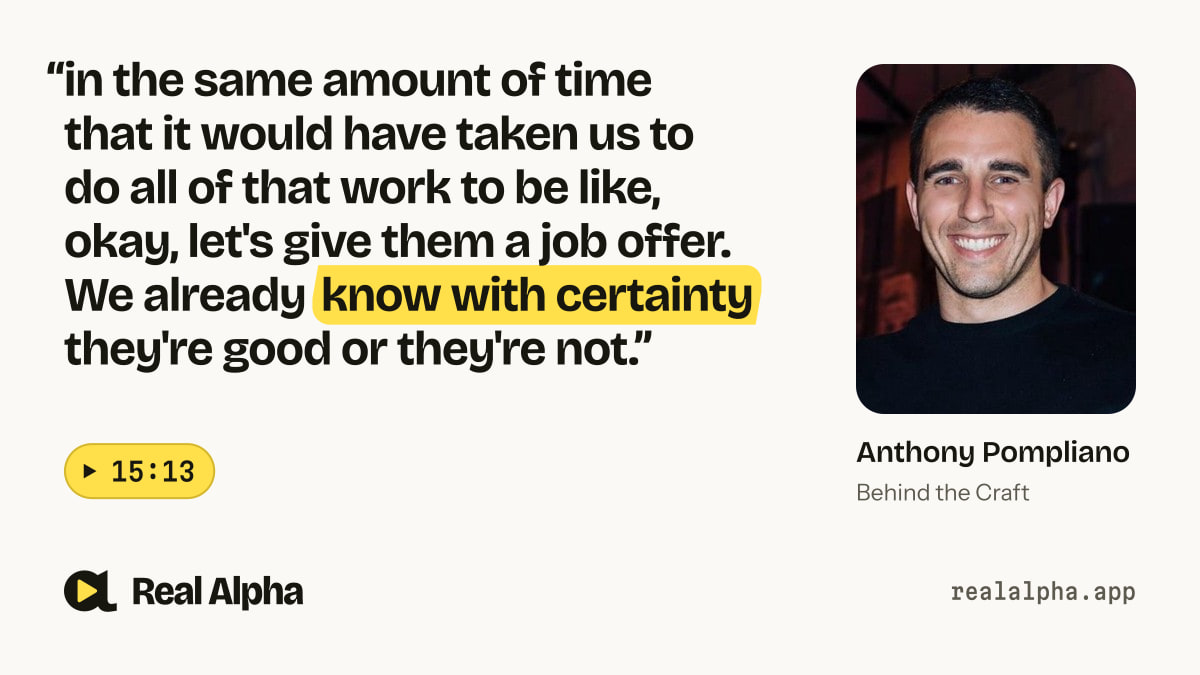
“in the same amount of time that it would have taken us to do all of that work to be like, okay, let's give them a job offer. We already know with certainty they're good or they're not.”
 Anthony Pomplianoat 15:13 · Behind the Craft
Takeaways
- Pay candidates market rate for a two-to-four-week trial.
- Judge work quality, communication, feedback and team fit.
- A successful trial can ship a real product feature.
About this segment
Anthony Pompliano’s team pays candidates to work on real projects for two to four weeks. Both sides can judge the work and team fit while shipping something useful.

Anthony Pompliano is an investor, best-selling author, public company CEO, and founder of Silvia.
Invested in more than 300 private companies, including over 20 unicorns, and hosts The Pomp Podcast.

Peter Yang, Host · Host, Behind the Craft
Led product at Roblox, Reddit, Twitch and Meta for 10+ years.
From “We Built an AI CFO to Help You Grow Your Net Worth | Anthony Pompliano”, Oct 18, 2026. Watch the full episode
Thanks. We'll look at and fix what's off.
Transcript
Transcribed by machine (Whisper) from the episode’s audio, so a word may be off here and there.
- 13:45
who don't have a lot of experience, because if you hire from big companies, they have like the resume, right? How do you find good people with high agency who don't have a lot of experience? Do you just make them do like a work trial or something? Or how do you find these people? We have almost exclusively gone to, if you want to work at one of our companies, you got to do a trial. We'll do two to four week trials.
- 14:02
And what I've learned over time is that was never a thing 10 years ago. I'd never, I don't think I ever heard of someone being like a work trial. It was like there was projects during an interview process, but it was kind of, you get it, you work on it for two or three days and you bring it back and then they judge your abilities based on that. What we do now is, especially engineering, product, analytics, all that kind of stuff, We say, look, we'll pay you the market rate for two to four weeks, and you get full access.
- 14:25
You're coming in the Slack. You're getting access to all the systems, everything, and you're going to start working. And we're going to judge you not only on your productivity, but also the quality of your work. We're going to be able to very quickly tell, do you gel with the team? How do you communicate? How do you take feedback? How do you deal with any sort of issues or kind of corrections we give you, all that stuff?
- 14:45
And what we find is not only one is it very obvious very quickly who's good and who's not, but two is it's a better thing for the candidate as well, because what we don't have to do is we don't have to go and say, OK, we want you to go through six, seven, eight, 10 interviews, then give us all these references, take a four week process, you know, blah, blah, blah, whatever. We literally will meet people.
- 15:09
I'll talk to them, co-founder will talk to them. And then all of a sudden, we're just like, hey, let's do the trial. And we just jump right in. And so now, two to four weeks later, we're like, they're good or they're not. And in the same amount of time that it would have taken us to do all of that work to be like, okay, let's give them a job offer. We already know with certainty they're good or they're not.
- 15:27
And it's just a much more efficient process that I think is better for us and for them. Yeah, because there's a lot of bullshit that can happen. People can bullshit you in interviews, right? You have no idea if they can actually do the job or not. Especially with AI, right? Like if you, okay, hey, go do this project. And you're like, by the way, I think AI helped in this. I kind of sort of don't care because I want them to use AI once they're inside the company.
- 15:48
But also, are they just good at prompting or can they actually critically think? Can they actually solve the problem, right? You don't know. And so one of the aspects that, take engineering maybe as a good example. We had an engineer recently who. who we met, we liked, we thought that he could do the job. He'd worked at another company that we really respected. And we had a very specific feature that we wanted to build.
- 16:08
It was basically a demo account for Sylvia. So one of the problems is that people don't want to immediately just sign up and connect, you know, a million accounts. And they're like, hey, what about security, privacy, whatever, before I go and I connect my bank account or something, let me try it. And so this demo account basically allows you to do that. Well, we just said to him, hey, you got two weeks, build it.
- 16:25
And there's not a lot of direction. It's kind of all figure it out, which is exactly what we would do to somebody on the team anyways, right? And so when we did this, he had some questions and tried to get the lay of the land in terms of the infrastructure and the code base, whatever. But he built it. Like, dude, I don't have to question whether you can work here or not. You were able to do the thing that we would have given to someone on the team anyways.
- 16:44
And by the way, not only do we have confidence that you can work on the team, you have confidence you like us. And guess what? We didn't waste four weeks to get to that point. We just shipped a new feature. And so we all feel great about this because we already have shipping velocity and it's your introduction to the team. And so I think that's where the world is starting to move a little bit more towards is it's kind of less credentialized and it's much more just here's the problem, solve it.
- 17:04
If you can solve it and you have agency, then, you know, you get a much better shot to get a job or work on something. Yeah, I hate the credential shit, dude. Like, you know, people are like, hey, I manage a hundred people.