The alpha, twice a week
That was 4 min.
Get the best new moments in your inbox every Wednesday and Saturday. It's free.
Check your inbox
We sent a link to your address. Click it to finish signing up. Not there in a minute? Look in spam.
or
Latent Space · 4 min · Nov 25, 2025
Synthetic worlds can bridge the gap in robot training data
 Fei-Fei Li
 says robotics needs realistic data but cannot get enough from the physical world, while internet video lacks control.
In this episode
Full analysis- 20:55Current models can mimic physics without learning its lawsPro pick 8 min
- 29:45Marble turns text and images into editable 3D worlds4 min
- 42:02Spatial intelligence is the ability to reason and act in space6 min
- 2:15Spatial data needs far more compute than language3 min
- 9:26Academia can explore neural architectures for future hardware4 min
- 33:57World models could add physics directly to Gaussian splats4 min
- 38:29Synthetic worlds can bridge the gap in robot training data4 min
- 55:30Transformers can model sets, not just sequences3 min
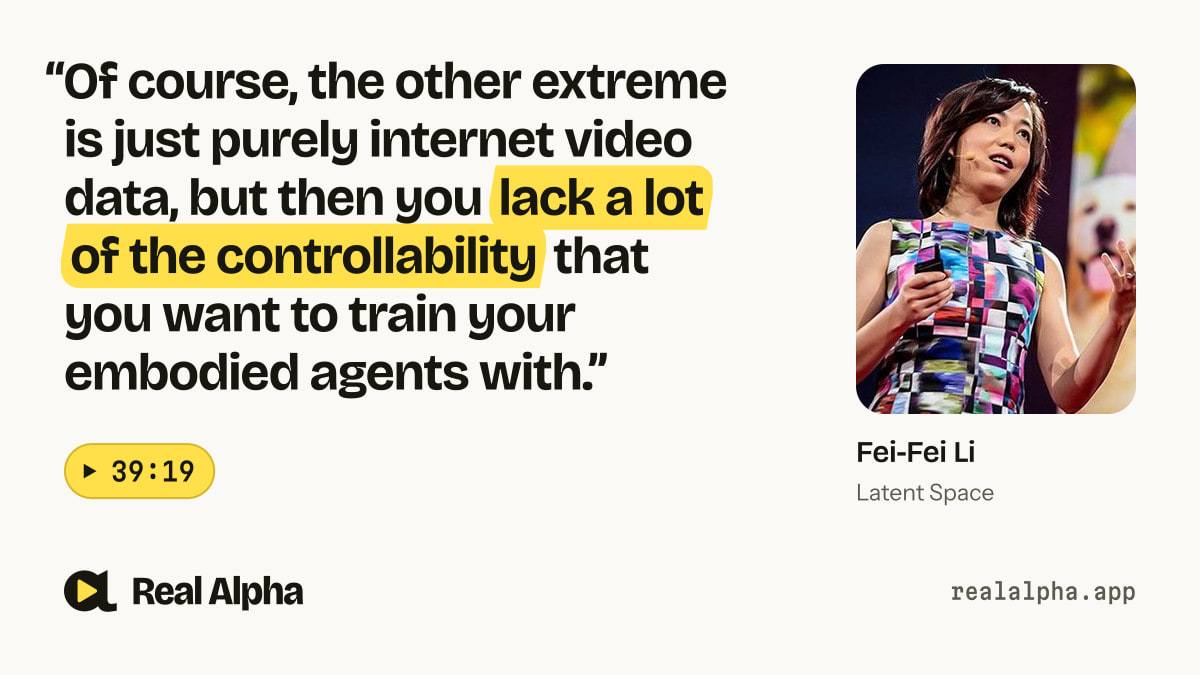
“Of course, the other extreme is just purely internet video data, but then you lack a lot of the controllability that you want to train your embodied agents with.”
 Fei-Fei Liat 39:19 · Latent Space
Takeaways
- Real-world robotic data is high fidelity but scarce.
- Internet video offers scale without enough controllability.
- Synthetic simulations can provide controllable training environments.
About this segment
Fei-Fei Li says robotics needs realistic data but cannot get enough from the physical world, while internet video lacks control. Generated simulations could supply controllable training environments.

Co-founder, World Labs
Co-founded World Labs, whose Marble product generates persistent, high-fidelity 3D worlds from images, video or text.

Shawn Wang (swyx), Host · Co-founder, AI Engineer
Wrote “The Rise of the AI Engineer” and founded Smol AI, maker of AI News.

Alessio Fanelli, Host · Founder, Kernel Labs
Partner at Decibel, backing technical founders who build developer tools.
From “After LLMs: Spatial Intelligence and World Models — Fei-Fei Li & Justin Johnson, World Labs”, Nov 25, 2025. Watch the full episode
Thanks. We'll look at and fix what's off.
Transcript
Transcribed by machine (Whisper) from the episode’s audio, so a word may be off here and there.
- 38:41
higher resolution in your scenes one use case i was expecting but didn't hear from you was embodied use cases are you you're just focusing on virtual for now if you go to world labs home home page There is a particular page called Marble Labs. There we showcase different use cases, and we actually organize them in more visual effect use cases or gaming use cases, as well as simulation use cases. And in that, we actually show this is a technology that can help a lot in robotic training, right? This goes back to what I was talking about earlier in speaking of data starvation, robotic training really lack data. You know, high fidelity, real world data is absolutely very critical, but you're just not going to get a ton of that.
- 39:31
Of course, the other extreme is just purely internet video data, but then you lack a lot of the controllability that you want to train your embodied agents with. So simulation and synthetic data is actually a very important middle ground for that. I've been working in this space for many years, and one of the biggest pain point is where do you get the synthetic simulated data? You have to curate assets and build these, compose these complex situations.
- 40:03
And in robotics, you want a lot of different states. You want the embodied agent to interact in the synthetic environment. Marble actually is a really potential for helping to generate these synthetic simulated worlds for embodied agent training. Obviously, that's on the homepage. It'll be there. I was trying to make the link to, as you said, you also have to build a business model. The market for robotics, obviously, is very huge.
- 40:33
Maybe you don't need that, or maybe we need to build up and solve the virtual worlds first before we go to embodied. And obviously, I think that's a big stepping stone. That is to be decided. I do think that... Because everyone else is going straight there, right? Not everyone else, but there is an excitement, I would say. But, you know, I think the world is big enough to have different approaches.
- 41:01
Yeah, I mean, and we always view this as a pretty horizontal technology that should be able to touch a lot of different industries over time. And, you know, Marble is a little bit more focused on creative industries for now. But I think the technology that powers it should be applicable to a lot of different things over time. And robotics is one that, you know, is maybe going to happen sooner than later.
- 41:17
Also design, right? It's very adjacent to creative. Oh, yeah, definitely. Like, I think it's like the architecture stuff. Yes. Yeah, I mean, I was joking online. I posted this video on Slack of like, oh, who wants to use Marble to plan your next kitchen remodel? It actually works great for this already. Just like take two images of your kitchen, like reconstruct it in Marble, and then use the editing features to see what would that space look like if you change the countertops or change the floors or change the cabinets.
- 41:41
And this is something that's, you know, we didn't necessarily build anything specific for this use case. But because it's a powerful horizontal technology, you kind of get these emergent use cases that just fall out of the model. We have early beta users using an API key that is already building for interior design use case. I just did my garage.