The alpha, twice a week
That was 3 min.
Get the best new moments in your inbox every Wednesday and Saturday. It's free.
Check your inbox
We sent a link to your address. Click it to finish signing up. Not there in a minute? Look in spam.
or
Latent Space · 3 min · Nov 25, 2025
Transformers can model sets, not just sequences
 Justin Johnson
 explains that attention operates over token sets, with positional embeddings supplying order.
In this episode
Full analysis- 20:55Current models can mimic physics without learning its lawsPro pick 8 min
- 29:45Marble turns text and images into editable 3D worlds4 min
- 42:02Spatial intelligence is the ability to reason and act in space6 min
- 2:15Spatial data needs far more compute than language3 min
- 9:26Academia can explore neural architectures for future hardware4 min
- 33:57World models could add physics directly to Gaussian splats4 min
- 38:29Synthetic worlds can bridge the gap in robot training data4 min
- 55:30Transformers can model sets, not just sequences3 min
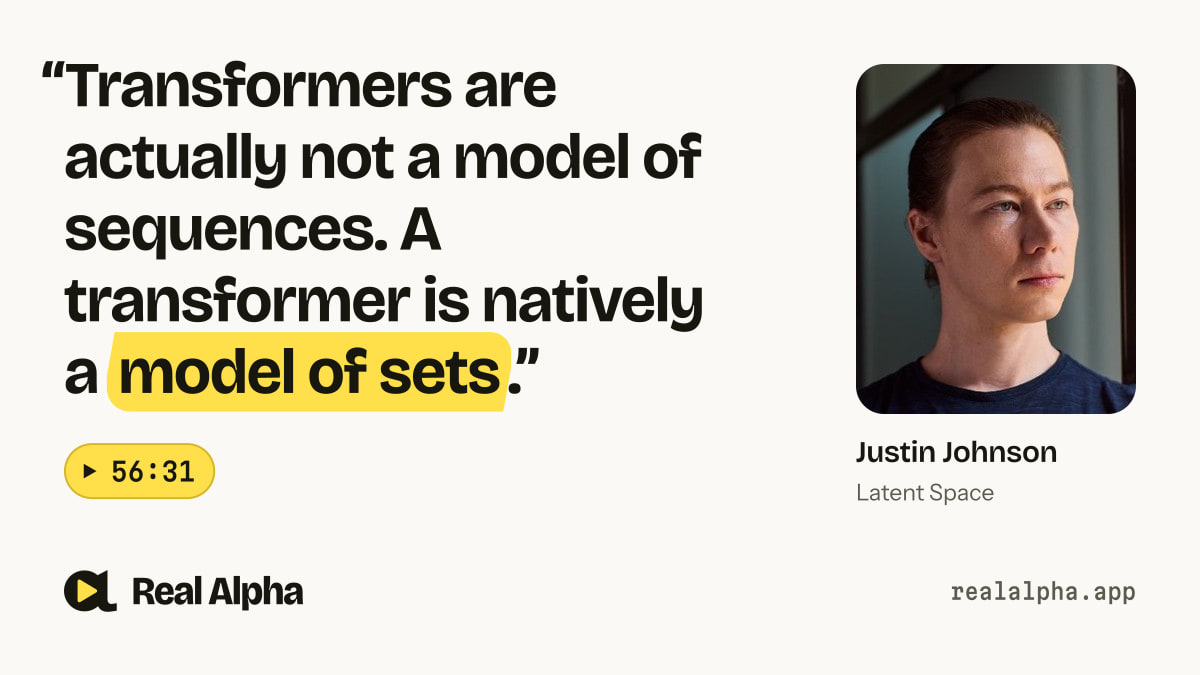
“Transformers are actually not a model of sequences. A transformer is natively a model of sets.”
 Justin Johnsonat 56:31 · Latent Space
Takeaways
- Positional embeddings are what supply token order.
- Attention is permutation-equivariant across tokens.
- The architecture can represent sets beyond 1D sequences.
About this segment
Justin Johnson explains that attention operates over token sets, with positional embeddings supplying order. The same architecture can represent structures beyond one-dimensional sequences.

Co-founder, World Labs
Co-founded World Labs with Fei-Fei Li, building frontier world models, including the 3D world model Marble.

Shawn Wang (swyx), Host · Co-founder, AI Engineer
Wrote “The Rise of the AI Engineer” and founded Smol AI, maker of AI News.

Alessio Fanelli, Host · Founder, Kernel Labs
Partner at Decibel, backing technical founders who build developer tools.
From “After LLMs: Spatial Intelligence and World Models — Fei-Fei Li & Justin Johnson, World Labs”, Nov 25, 2025. Watch the full episode
Thanks. We'll look at and fix what's off.
Transcript
Transcribed by machine (Whisper) from the episode’s audio, so a word may be off here and there.
- 55:42
People are starting to depend on these things probably too much. And that's a whole topic of other debate. I do have to ask because a lot of people have sent this to us. How much do we have to get rid of? you know, is sequence to sequence modeling out the window? Is attention out the window? Like, how much are we re-questioning everything? I think, I think you stick with stuff that works, right? So attention is still there. I think attention is still there. I think there's a lot, like you don't need to fix things that aren't broken. And like, it's, there's a lot of hard problems in the world to solve, but let's focus on one at a time. I think it is pretty interesting to think about new architectures or new paradigms or drastically different learning ways to learn.
- 56:23
But you don't need to throw away everything just because you're working on new modalities. I think sequence to sequence is actually, in world models, I think we are going to see algorithm or architecture beyond sequence to sequence. Oh, but here actually, I think there's a little bit of technological confusion. And transformers already solved that for us. Transformers are actually not a model of sequences.
- 56:46
A transformer is natively a model of sets. And that's very powerful. But because a lot of the transformers grew out of earlier architectures based around recurrent neural networks, and RNNs definitely do have a built-in architectural, they do model one-dimensional sequences. But transformers are just models of sets, and those sets could be 1D sequences, they could be other things as well. Do you literally mean set theory?
- 57:10
Yeah, yeah. Galois, whatever. Yeah, yeah. So a transformer is actually not a model of a sequence of tokens. A transformer is actually a model of a set of tokens. right the only thing that gives that that injects the order into it in the transfer in the standard transformer architecture the only thing that differentiates the order of the things is the positional embedding that you give the tokens right so if you if you choose to give a sort of 1d positional embedding that's the only mechanism that the model has to know that it's a 1d sequence but all the all like operators that happen inside a transformer block are either token wise right so that either you have an ffn you have qkv projections like you have the norm per token normalization All of those happen independently per token.
- 57:47
And then you have interactions between tokens through the attention mechanism. But that's also sort of, it's permutation equivariant. So if I permute my tokens, then the tension operator gets a permuted output in exactly the same way. So it's actually natively an architecture of sets of tokens.