The alpha, twice a week
That was 3 min.
Get the best new moments in your inbox every Wednesday and Saturday. It's free.
Check your inbox
We sent a link to your address. Click it to finish signing up. Not there in a minute? Look in spam.
or
The Mishal Husain Show · 3 min · Oct 30, 2026
Taxing capital income can curb incentives to over-automate
 Daron Acemoğlu
He argues for taxing capital and labor income more evenly, reducing incentives to favor machines over workers.
In this episode
Full analysis- 25:54AI investment should focus on making workers more productivePro pick 4 min
- 17:25Taxing capital income can curb incentives to over-automate3 min
- 22:35Mamdani's politics may not generalize beyond New York3 min
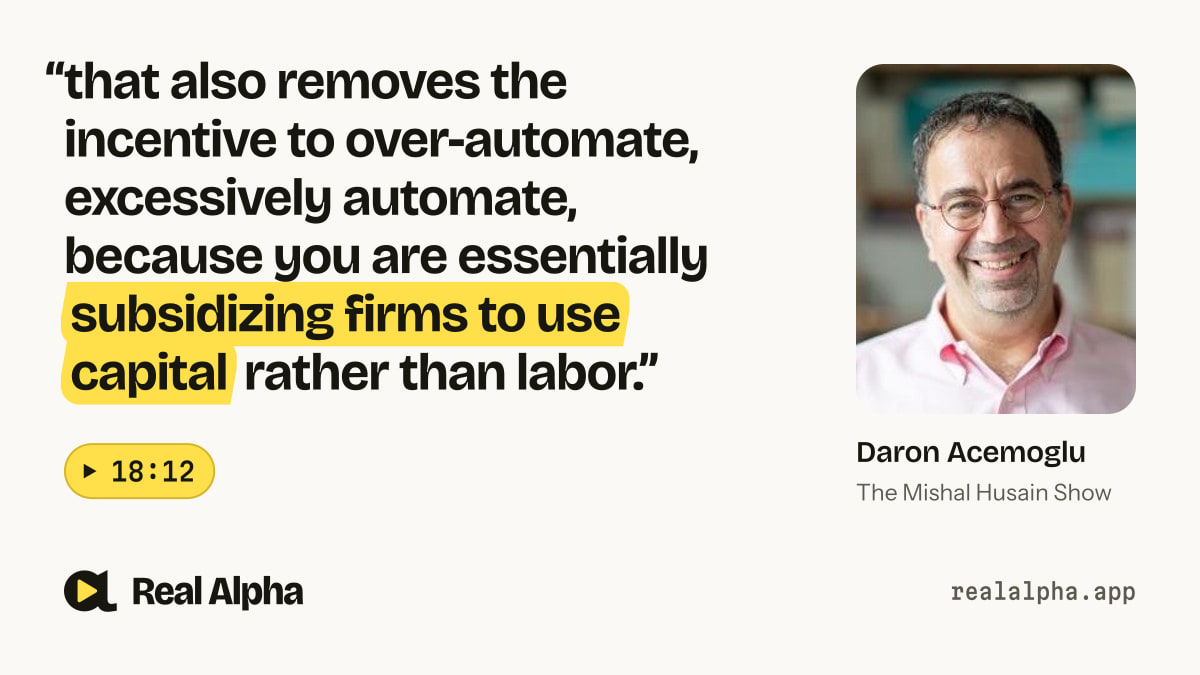
“that also removes the incentive to over-automate, excessively automate, because you are essentially subsidizing firms to use capital rather than labor.”
 Daron Acemogluat 18:12 · The Mishal Husain Show
Takeaways
- He says capital income is taxed less than labor income.
- Taxing income at source could simplify the tax base.
- He argues the change could reduce incentives to over-automate.
About this segment
He argues for taxing capital and labor income more evenly, reducing incentives to favor machines over workers. A national, source-based tax could also simplify the system, though mobile businesses remain a concern.

Daron Acemoğlu is an MIT professor and 2024 Nobel Prize in economics co-winner.
Nobel-winning MIT economist who studies how AI and automation reshape work, productivity, inequality and economic growth.

Mishal Husain, Host · Host, The Mishal Husain Show
From “Nobel-Prize Winning Economist Daron Acemoglu on Musk, AI and Democracy | The Mishal Husain Show”, Oct 30, 2026. Watch the full episode
Thanks. We'll look at and fix what's off.
Transcript
From the transcript The Mishal Husain Show publishes with the episode.
- 17:38
Well, I think many countries, the United States ahead of the UK, but also the UK need more tax revenue. Increasing marginal tax rates, the rate that you pay as you earn your last dollar, has often costs. But we have a big opportunity to expand the base of taxation in the US and to some extent also in the UK. We don't tax capital income enough. If you are a business owner and you call the income you get from your company labor income, you pay a much higher tax than if you call it your capital income. So if you broaden that tax base that you increase But it also has another benefit, which has to do with the direction of AI, that also removes the incentive to over-automate, excessively automate, because you are essentially subsidizing firms to use capital rather than labor.
- 18:32
Yeah, but let's say an employee like me, I'm going to pay national insurance. Exactly. And my employer is also going to pay national insurance. If the government was going to reduce that, that burden on the employer, that is going to give up a large chunk of tax revenue, which... they're going to find very difficult to make up elsewhere. Yeah.
- 18:50
So that's where you need to increase taxes. Don't increase it on the working people, but increase it on the tax dollars that are not marginal, so that are already accruing to the richest people.
- 19:01
And what you might then have is businesses complaining that they are being taxed too highly, but you also might have very wealthy people choosing to leave the UK. And that's just happened to the third biggest taxpayer in in this country, Chris Rocco's hedge fund billionaire.
- 19:15
Yeah, I know. That is a real concern. That is an absolutely real concern. So what do you do if you're the UK government?
- 19:19
First of all, this is why absolutely you should not do this at the local level. You should not increase, say, corporate taxation at the local level because businesses are very mobile. But at the national level, most businesses are sticky. And I think there's a very simple thing we can do, which actually also gets rid of a lot of accounting effort that we spend. Just tax all income at source with...
- 19:41
any regards to whether we're going to call it capital or labor income. It will really simplify things. Now, your concern still remains because businesses might flee to Bermuda or the Bahamas. But I think at the moment, that's got both social, economic, and political costs. And you know what? Here is the very important thing. A new governing philosophy has to come with aspirations that unite people and based on shared moral values. We've lost those. If we have those shared moral values, I think it would be a horrible thing for people to say, because I don't want to pay like three more percent of my vast wealth, I'm going to go to Bermuda. That would be just like the most sort of selfish act. Today, we accept those kinds of selfish acts. But if we can bring people together around shared values, that becomes much harder. So
- 20:32
some of that is also internal, endogenous to the kind of governing philosophy we choose.