The alpha, twice a week
That was 2 min.
Get the best new moments in your inbox every Wednesday and Saturday. It's free.
Check your inbox
We sent a link to your address. Click it to finish signing up. Not there in a minute? Look in spam.
or
In Good Company with Nicolai Tangen · 2 min · Sep 16, 2026
Tesla targeted 30% gross margins against a 10% industry norm
 Jon McNeill
 says Tesla aimed for Apple's roughly 30% gross margin while the car industry averaged about 10%.
In this episode
Full analysis- 1:22Tesla cut online car orders from 300,000 configurations to twoPro pick 5 min
- 10:25Speed reveals broken processes before it improves themPro pick 6 min
- 15:47Tesla nearly went bankrupt by automating too early4 min
- 8:30Tesla targeted 30% gross margins against a 10% industry norm2 min
- 5:59Mapping the work reveals steps customers do not pay for2 min
- 20:24Ambitious targets force teams to rethink the operating system4 min
- 27:34Curiosity and financial levers guide McNeill's management calls3 min
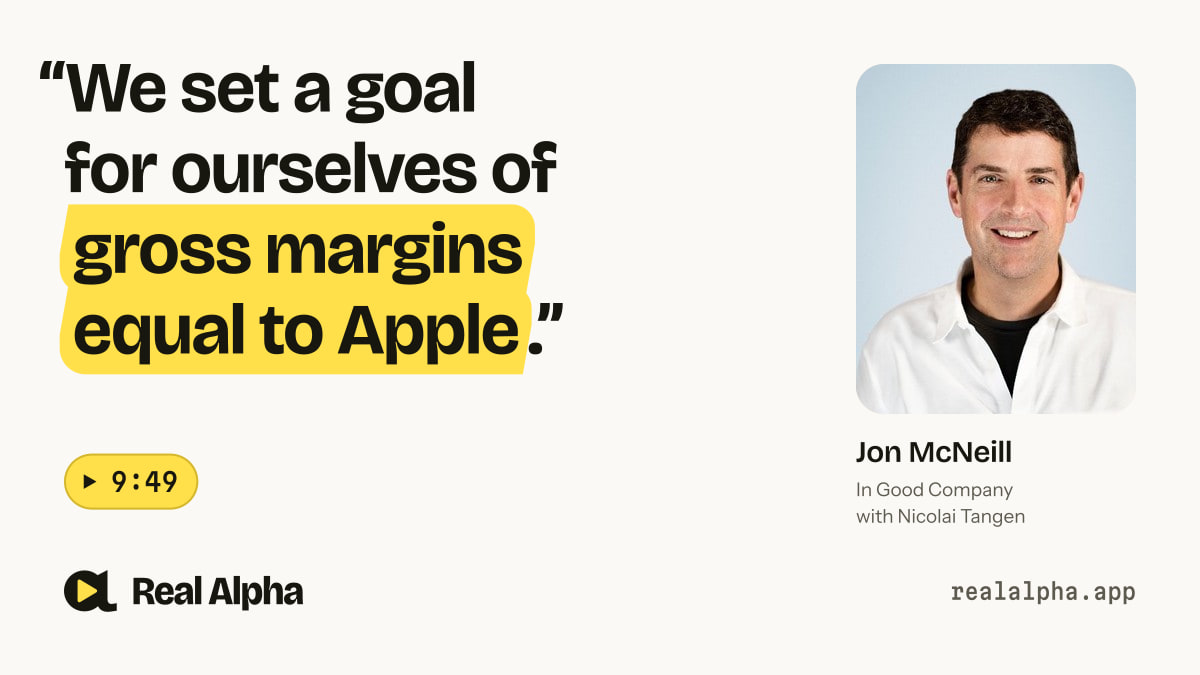
“We set a goal for ourselves of gross margins equal to Apple.”
 Jon McNeillat 9:49 · In Good Company with Nicolai Tangen
Takeaways
- Tesla set a 30% gross-margin target.
- The car industry benchmark was about 10%.
- Tesla's gross margin stayed around 24–28% for years.
About this segment
Jon McNeill says Tesla aimed for Apple's roughly 30% gross margin while the car industry averaged about 10%. Tesla ran at 24–28% for years, giving teams a measurable definition of great.

Jon McNeill is CEO and co-founder of DVx Ventures; author.
Founded and scaled six companies, then grew Tesla revenue from $2B to $20B as president.

Nicolai Tangen, Host · CEO, Norges Bank Investment Management
From “Jon McNeill: The Algorithm Behind Tesla and SpaceX | Podcast | In Good Company”, Sep 16, 2026. Watch the full episode
Thanks. We'll look at and fix what's off.
Transcript
Transcribed by machine (Whisper) from the episode’s audio, so a word may be off here and there.
- 8:35
Okay, simplify and optimize. So how is simplification different from deleting things? So once you've deleted, now you've got a new process that you have to try out. And it's got a whole lot less steps. And so what we do in the third step is we put that new process together. And we start to test it manually first. This is hard for technologists because we all want to put hands on keyboards, especially in the age of AI. We want to rush to the digital solution. And what we insist teams do is they manually run the process first and then start to add the fourth step, which is the magic ingredient of speed.
- 9:14
because speed reveals where the process breaks and a lot of people say you can't get good fast or cheap pick two it turns out that really great process yields good fast and cheap it's got to be high quality to run fast and once you're running fast at high quality you're running high throughput and so you're actually getting cheap so we we combine really those steps three and four to say start to run the process and speed it up speed it up speed it up speed it up when when is simple simple enough? I think in our case, we tried to achieve margins that were twice the margins of the industry. And so we started out above that. We set a goal for ourselves of gross margins equal to Apple. And Apple's gross margins are roughly 30%. The car industry's gross margins are roughly 10. And so we aimed for 30 and said, if we can reach this, we're
- 10:09
to be world-class. And for years, the gross margin hovered between 24% and 28%. So we were more than almost two and a half times the gross margin of our competitors. And that's the metric we used. We had a hard time defining what perfect looked like, but we knew what great looked like. And so we started to aim for great with a financial metric that the markets could understand and