The alpha, twice a week
That was 5 min.
Get the best new moments in your inbox every Wednesday and Saturday. It's free.
Check your inbox
We sent a link to your address. Click it to finish signing up. Not there in a minute? Look in spam.
or
All-In · 5 min · Aug 24, 2026
The administration is setting ambitious science targets
 Michael Kratsios
 outlines goals for the Moon, quantum computing, fusion and AI-enabled research.
The episode’s best minutes
Full analysis- 15:49Golden tickets could make science grants less conservative5 min
- 22:11The administration is setting ambitious science targets5 min
- 38:42The U.S. needs a stronger homegrown STEM pipelinePro pick 5 min
- 5 more moments in the full episode
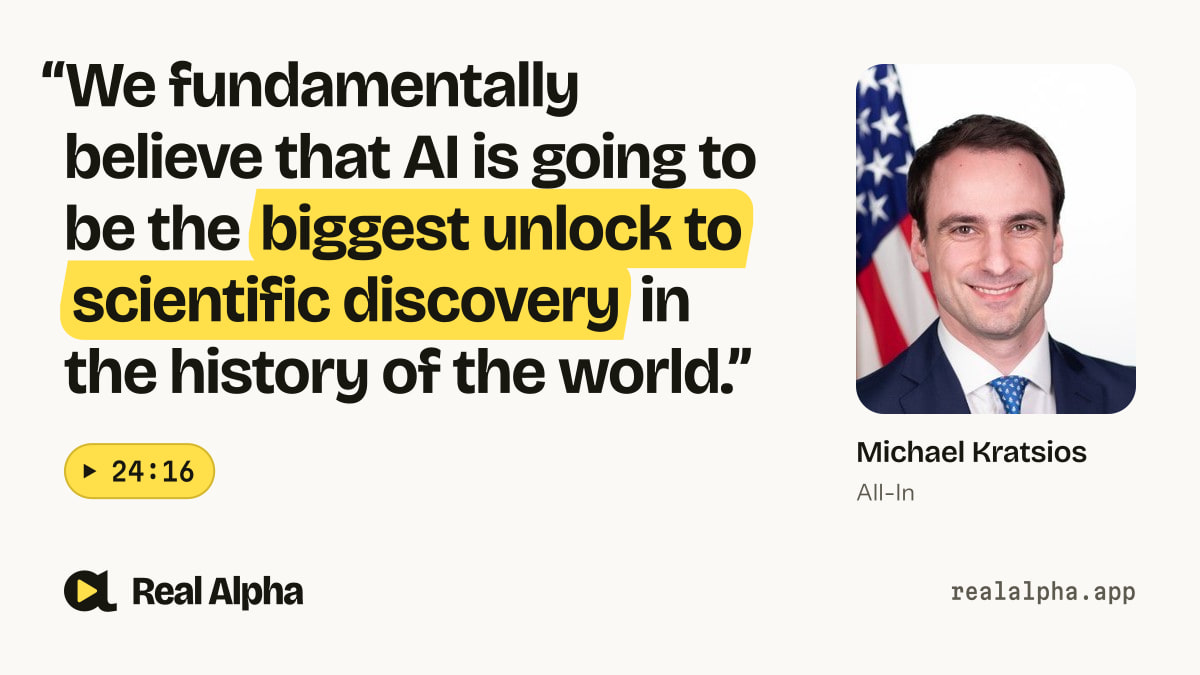
“We fundamentally believe that AI is going to be the biggest unlock to scientific discovery in the history of the world.”
 Michael Kratsiosat 24:16 · All-In
Takeaways
- The targets include a scientific quantum computer by 2028.
- The Genesis Mission aims to double U.S. scientific output with AI.
- Government research should focus on work private industry is unlikely to fund.
About this segment
Michael Kratsios outlines goals for the Moon, quantum computing, fusion and AI-enabled research. He argues government should back basic science and missions private markets may not prioritize.

Michael Kratsios is a director of the White House Office of Science and Technology Policy.
Led the American AI Initiative as U.S. CTO and now directs the White House science and technology agenda.

Chamath Palihapitiya, Host · Founder & CEO, Social Capital
Led Facebook's growth team; his firm backed Slack and AI chipmaker Groq.

Jason Calacanis, Host · Founder & CEO, LAUNCH
Early Uber angel; sold Weblogs Inc. to AOL; hosts This Week in Startups.

David Sacks, Host · Co-founder & partner, Craft Ventures
PayPal's first COO, founded Yammer; White House AI & crypto czar 2025–26.

David Friedberg, Host · CEO, Ohalo
Founded The Climate Corporation, sold to Monsanto for about $1.1B in 2013.
From “Inside Trump's Science Agenda: Anti-Science Claims, Fauci's Damage, DEI & China w/ Michael Kratsios”, Aug 24, 2026. Watch the full episode
Thanks. We'll look at and fix what's off.
Transcript
Transcribed by machine (Whisper) from the episode’s audio, so a word may be off here and there.
- 22:24
achieve that objective. Is that an alternative funding model? And if so, how do we organize and execute in a world where you got small labs, everyone's kind of working on their own. Maybe people are even competing with each other for grants. You've got private industry doing their thing. Do we have the capacity as a nation to tackle big meaty projects that can really make incredible breakthroughs for humanity, but requires significant capital and time and a long-term commitment?
- 22:52
I think the short answer is yes. And I think what we advocate for and argue in Science New Golden Age is that we have lost our way on doing that. I think back to even what I mentioned earlier, I think most Americans sort of look back favorably on things like the Apollo mission. It kind of brought the country together. There was a discrete goal of something you're trying to accomplish. And only the federal government could sort of marshal the resources to do that.
- 23:15
and we advocate foreign golden ages, we have to return to that. Not that's the only thing we should do, but that should be one of the things we do along with everything else I just mentioned. And a couple examples of what we're doing in that domain now, I think the first is around space. The president very boldly sort of said in the first Trump administration that we're going to go back to the moon and we're almost there. I mean, we're going to have American boots back on the moon in 28. We said we're going to have a nuclear reactor in space by 28. We're going to have the first elements of a moon base by 2030. These are like big, bold bets that take a decade to accomplish and we're going to do it. I think the second is around quantum computing. President signed an executive order just last month, launching a new national quantum initiative. One of the key goals
- 23:54
there that we're trying to do is create a scientifically relevant quantum computer by 2028. This was a directive to the Department of Energy. we're going to be working very hard to make sure we can hit that pretty crazy timeline. I mean, your camp, we really want to get the fusion by 2035, and we're trying very hard to get the resources allocated at DOE and combined with all the private sector investment to get there. And I think the last one, which is kind of our big flagship project for the whole administration, is called the Genesis Mission. And that is where we want to essentially double the scientific output of the United States by applying AI to our hardest scientific challenges and endeavors. We fundamentally believe that AI is going to be the biggest unlock to scientific discovery in the history of the world. Whether you're in material science, whether you're in
- 24:37
chemistry, whether you're in math, whether you're in physics, applying AI to your discipline is going to fundamentally change the way that you can do your science and accelerate the way that it's done. And we launched an initiative in late last year to do that. And now we have the pretty much all of government sort of working towards that effort. So let me just break this down and try understand the selection process then because some things you could argue can be funded by private industry and they will be because there's hundreds of billions of dollars of capital flowing into ai there's a natural market incentive for individuals to use ai because it makes them more productive you really need the government to fund things like quantum computing and ai and science when those things are getting hundreds of billions of dollars of private capital versus funding
- 25:23
things that are like not going to be found in the private capital markets like, you know, deep space research, understanding the origins of the universe, pure physics, looking at these kind of more fundamental scientific breakthroughs that everyone kind of waves off. But we always find that in those fundamental understandings of our universe emerge some application years down the road that we weren't even thinking about.
- 25:46
And how do we make those selections? Yeah, no, that's a great point. Something that we've advocated for quite aggressively is we have to return the primary focus of government-funded research on basic, early-stage, pre-competitive R&D, this discovery science. That is an area where the private sector is not incentivized to participate in, and only the government can do that. At the same time, having these kind of big, bold ideas only the government can do is also very important for enterprise.
- 26:12
If you think about sort of the urgency to create a scientifically relevant quantum computer by 2028, there's lots of activity in quantum going on throughout the private sector. But to them, it's for commercial applications. We want to create an instrument that can be used for scientific discovery that will pay huge dividends across all of the ecosystem. And I think the AI for science, I think the nuance there is we're not spending money on the science that the private sector is doing around AI.
- 26:40
You know, there is more computing, more money going into AI than anything you could ever imagine today. And the government's not trying to compete in that space. What it's trying to do is saying, like, look, if you are doing basic research on all the things that you mentioned are so important, you should be considering how AI is going to impact or accelerate the work that you're doing, and we want to help you along in that journey.
- 26:59
I always felt like so much of the challenge with government is the complication. It's like entropy over time. you have all these different agencies, all these different groups, all competing for budget and