The alpha, twice a week
That was 5 min.
Get the best new moments in your inbox every Wednesday and Saturday. It's free.
Check your inbox
We sent a link to your address. Click it to finish signing up. Not there in a minute? Look in spam.
or
All-In · 5 min · Aug 24, 2026
The U.S. needs a stronger homegrown STEM pipeline
 Michael Kratsios
 points to the falling share of American computer science PhDs and the challenges facing early-career researchers.
The episode’s best minutes
Full analysis- 15:49Golden tickets could make science grants less conservative5 min
- 22:11The administration is setting ambitious science targets5 min
- 38:42The U.S. needs a stronger homegrown STEM pipelinePro pick 5 min
- 5 more moments in the full episode
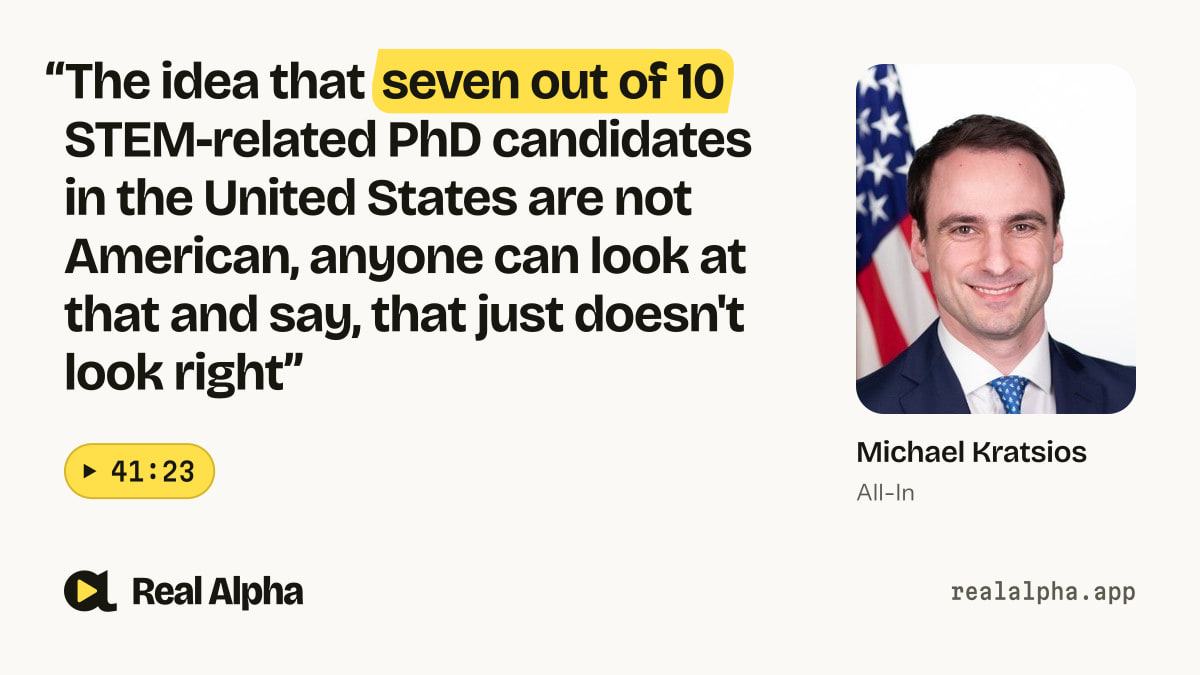
“The idea that seven out of 10 STEM-related PhD candidates in the United States are not American, anyone can look at that and say, that just doesn't look right”
 Michael Kratsiosat 41:23 · All-In
Takeaways Pro pick
- The share of U.S.-born computer science PhDs has reversed over 30 years.
- Seven out of 10 STEM PhD candidates in the U.S. are not American.
- Kratsios says programs should encourage talented students to pursue STEM.
One of Pro's picks, open to you here. Try Pro free for 7 days
One of Pro's picks. The rest of the summary and the 3 takeaways are in Real Alpha Pro; the video, the quote and the transcript stay free.
Read it with Pro, 7 days freeAbout this segment
Michael Kratsios points to the falling share of American computer science PhDs and the challenges facing early-career researchers. He calls for better support for young U.S. talent.

Michael Kratsios is a director of the White House Office of Science and Technology Policy.
Led the American AI Initiative as U.S. CTO and now directs the White House science and technology agenda.

Chamath Palihapitiya, Host · Founder & CEO, Social Capital
Led Facebook's growth team; his firm backed Slack and AI chipmaker Groq.

Jason Calacanis, Host · Founder & CEO, LAUNCH
Early Uber angel; sold Weblogs Inc. to AOL; hosts This Week in Startups.

David Sacks, Host · Co-founder & partner, Craft Ventures
PayPal's first COO, founded Yammer; White House AI & crypto czar 2025–26.

David Friedberg, Host · CEO, Ohalo
Founded The Climate Corporation, sold to Monsanto for about $1.1B in 2013.
From “Inside Trump's Science Agenda: Anti-Science Claims, Fauci's Damage, DEI & China w/ Michael Kratsios”, Aug 24, 2026. Watch the full episode
Thanks. We'll look at and fix what's off.
Transcript
Transcribed by machine (Whisper) from the episode’s audio, so a word may be off here and there.
- 38:54
Look, I think to me, what we could be doing a lot more of is encouraging more Americans to enter the STEM fields. This is something that has been on my mind for many, many years. And a statistic that I've tracked for a long time is sort of the percentage of US-born PhD recipients in computer science, for example. If you rewind the clock 30 years, I think it was 70% were American and 30% were foreign.
- 39:19
and now it's inverted. And I think to us as a country, I believe that having a STEM literate workforce is one of the most important superpowers we could have as a country. And we're doing everything we can to kind of find ways to encourage our younger students to continue to pursue these degrees. And to me, I mean, back to this thing, I think another thing that we have to take a lot more seriously is, and what I've observed in our science ecosystem is, our young scientists, the ones that have just finishing up their PhD and are starting their academic careers.
- 39:49
You know, these are one of the toughest jobs you can imagine. You're paid almost nothing. You know, you're in a university, you're toying away trying to do research. Here's the most underpaid people you could imagine for what they're doing for our country. And to us, I think we have to return. our scientific enterprise to reward them, to give them opportunities to work on their best ideas and to allow them to excel. I think that's what we're focused on.
- 40:12
So we train a lot of foreign students. We bring them in. They get PhDs here. Why don't we let them stay more? And so what is the immigration policy that also bolsters the points you made earlier about getting the right people in the field, getting the right people into scientific research? We've got a lot of Chinese students that come here, get a degree, get a PhD, and then we don't have a program for actively retaining that talent. They go back and they work in the Chinese lab or Chinese industry or, you know, in other countries. And China is now starting to attract scientists from India, from Europe. Why aren't we doing that? Because we don't have the homegrown talent pool in science. Shouldn't we be more active in recruiting and retaining? I think for us, I think you got to do two things. I think one, you got to make sure that
- 40:58
we're encouraging young Americans to go into these STEM fields and for those who do want to stay, allow them to sort of pursue legal pathways to stay here. So is that policy being heard by the administration? Is it accepted or is it in conflict with a more America first policy, which is looking out for Americans first, making sure jobs are for Americans before? Well, I don't think anything that says in conflict with the policy. I mean, I think we as basics, Before we even start thinking about anyone else, we have to get our house in order about how we can get more Americans to pursue this stuff.
- 41:31
Again, these numbers around computer science should be very alarming for people. The idea that seven out of 10 STEM-related PhD candidates in the United States are not American, anyone can look at that and say, that just doesn't look right, given the way that we've been educating Americans for so many decades. And I think we have a huge opportunity through a lot of these science programs to sort of bring folks back in.
- 41:57
I think one thing that I discovered kind of in writing this book and this report was, you know, we used to have programs at National Science Foundation that would actually support and encourage gifted and talented students in American high schools and middle schools. Those were stopped. For some reason, encouraging high-performing young students to pursue STEM in America was something that an actual decision was made of the government to no longer fund that.
- 42:19
And I think those are sort of discouraging actions that we want to turn around. Why is that? Seems silly. It feels like it's sort of part of this larger sort of DI effort. I mean, they were, you know, you can imagine, and you probably know well being in California, I mean, there were all these initiatives out in San Francisco where they stopped wanting to teach, you know, advanced algebra to students in high school.
- 42:40
And there's this battle right now at the University of California on SAT scores. The professors are all saying, we got kids coming in and we have to do remedial math to teach them how to do math. at UC Berkeley, which is where I went. And it was like, like you had to get like a 1500 on your SATs just to get in there back in the, wow, this was when it was on 1600. I don't know if it still is, but they stopped taking SATs. And now you're seeing it in the performance when the kids show up. And the professor initially didn't want to remove the SATs. You're now saying, no, no, no, we need it back. We need it back. These policies are like fundamentally harming the progression of talented STEM kids in America to create that pipeline for the next scientists in America.
- 43:19
Yes, we should be rewarding the greatest and most talented Americans and giving them opportunities to pursue all of their great science and techs for dreams and endeavors. And I think to me, that's what's most tragic, where you have kids that have potential to pursue this, yet we actively run programs which discourage them from doing that. And that has to stop. The rest of the world's doing it, and then they're getting paid a lot and giving nice homes and moving to China now.
- 43:43
Yeah, yeah. That is a crazy, crazy fact.