The alpha, twice a week
That was 5 min.
Get the best new moments in your inbox every Wednesday and Saturday. It's free.
Check your inbox
We sent a link to your address. Click it to finish signing up. Not there in a minute? Look in spam.
or
TBPN · 5 min · Nov 11, 2026
The Endowment ties funding to measurable veteran outcomes
 Dan Goldenberg
 explains how the Call of Duty Endowment selects and monitors nonprofit partners.
The episode’s best minutes
Full analysis- 1:47:18Fractile is betting on memory bandwidth, not one workload5 min
- 1:10:05The Endowment ties funding to measurable veteran outcomes5 min
- 1:27:06Durable defense components can serve many weapons systems5 min
- 5 more moments in the full episode
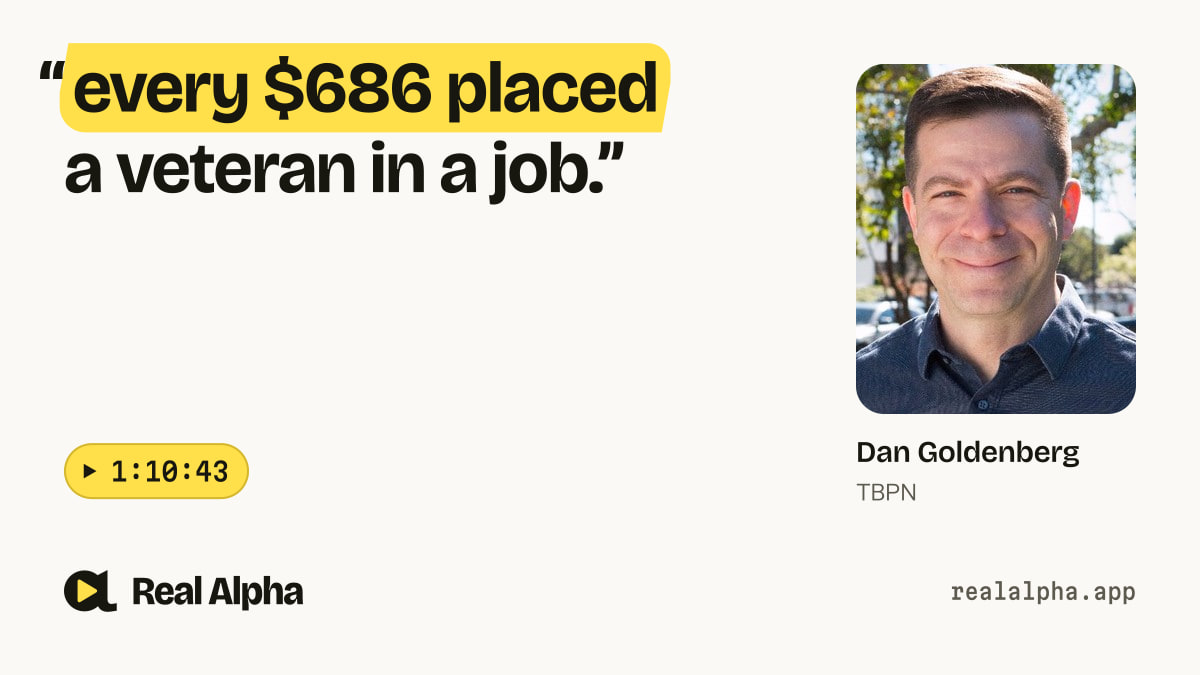
“every $686 placed a veteran in a job.”
 Dan Goldenbergat 1:10:43 · TBPN
Takeaways
- Each veteran placement cost $686 last year—one-fourteenth of the federal cost.
- Placed veterans earned double the starting salaries and had better retention.
- Grantees face quarterly reviews and lose funding if they miss targets.
About this segment
Dan Goldenberg explains how the Call of Duty Endowment selects and monitors nonprofit partners. Its approach cut placement costs and improved job quality by measuring results and ending funding when grantees fall short.

President, Call of Duty Endowment
Led the Endowment to place 169,000+ veterans in quality jobs, generating $10 billion in economic value.

John Coogan, Host · Co-host, TBPN
Co-founded Soylent and Lucy; OpenAI bought his show TBPN in April 2026.

Jordi Hays, Host · Co-host, TBPN
Founded Branded Native; co-founded fintech Capital, which Rho bought.
From “🇺🇸 Veterans Day 🇺🇸 | CoreWeave Prints, AI is BACK! Brian Chesky Secures Early Spot On The Nice List™”, Nov 11, 2026. Watch the full episode
Thanks. We'll look at and fix what's off.
Transcript
From the transcript TBPN publishes with the episode.
- 1:10:15
Yeah. I love to talk about this. And one other thing I have to say is like we we've been... Our model... So so it all begins with getting the impact model. Right? Because if you can't deliver those results, no one was gonna... No one should give you the money, in my opinion. Mhmm. And I think that's where a lot of nonprofits fall off. So Deloitte was critical to us and still is today in helping us find the high performing nonprofits. And we've got a whole process. That's really was our hockey stick moment. Mhmm. We implemented this process for finding and evaluating and and and holding accountable these organizations.
- 1:10:49
That's what's enabled us to get where we are, where our last year, every $686 placed a veteran in a job. That's one fourteenth the cost per placement, one fourteenth of the federal government's efforts. Yeah. And the results, double the salaries, more than double the starting salaries Wow. And 40% greater twelve month retention rates. Yes. So better jobs, higher quality jobs, much much cheaper. And for the last three years, we've placed more vets in jobs than the federal government has. Yes. So...
- 1:11:18
Wow. Yeah. And so our... Gong? Of course. Yeah. Let's... Written the Gong for you. That's an incredible stat. Alright. Thanks. I love it. Kind of
- 1:11:31
the opposite of the Gong show when I was a kid. Exactly. So cumulatively, that's a 180,000 bets we've placed in jobs so far. Wow. Insane. So... And I say we, it's our grantees. It's the
- 1:11:43
organization's fund. Structurally, when you walk into the office, what what does the team look like? Does it look like a like a venture capital fund essentially where you have a... Maybe some accounting back office but a lot of people that are are evaluating effectively founders of nonprofits or...
- 1:11:57
If you couldn't tell, we think of everything as venture capitals as people in our best... No. No. No. This is great. No. But yeah, you are... You're basically a capital allocator.
- 1:12:05
Honestly, when I when I first... We first started this work, the way we build it was it's a light venture philanthropy model. Sure. Yeah. So you know, it's all about performance.
- 1:12:13
Yeah. You're looking at return on investment but through a different lens but it's still the same economic analysis. Yeah. Still business. Thinking.
- 1:12:19
When we started, our cost per placement before we put the system in place was on par with the federal government. Yeah. So just like today they're 14 times more expensive.
- 1:12:28
Yeah. So thousands and thousands of dollars. Like accountability, accountability, accountability. Yeah. But the model itself, this vetting model Yeah. Is what's made all the difference. Mhmm. In in many ways, it'll look like that. So we have an open application process Mhmm. Just like a VC firm. You know, you can you can try and get in And have a very strict criteria. It's about the application is like a page and a quarter long Yeah.
- 1:12:51
But it's very metrics oriented. And then we go back and check with Deloitte. We partner and they go in to check, hey, were they truthful about what they said? We do really four things. We check performance metrics. We do background checks on their key leadership. We do financial checks, so past finances, current finances, and future financial health. And finally, policies and procedures. Are they following the law? Are they taking good care of their Those four things made all the difference in the world.
- 1:13:17
Yeah. So we have a theory of the case just like any VC firm would, you know, like we have a vetting model, we have criteria and that's that's what gave us the hockey stick was applying that. Yeah. Then on a quarterly basis, we hold our grantees. So once they pass that vetting Sure. They're in the family. Yeah. And we fund them. But we fund them with very specific goals. And every quarter we check to see if they're on track.
- 1:13:40
If they're not, we analyze, we have a conversation, we try to provide help to get them back on track. But at end of the year, if they're not on track, we don't fund them anymore. Mhmm. We move on to someone else. Yeah. And that's... It's it's accountability. And it... You know, it's accountability results. And this is the thing, I get in an argument a lot with about something called trust based philanthropy.
- 1:14:01
So other people give lots of money to nonprofits. There's a school of thought which is write them a big check and get that out of the way. You don't know their business, they know their business. The data shows that does not work. Mhmm. Our data shows when we have accountability, you get performance. Mhmm. Everybody gets better. Yeah. And it's not, you know, you gotta be tough minded and warm hearted in this business. Yeah. Not just warm hearted.
- 1:14:23
No. But focus on focus on the... You're warm hearted about the mission. Absolutely. Nothing else. Nothing else. Like like what's the... What grown ups