The alpha, twice a week
That was 5 min.
Get the best new moments in your inbox every Wednesday and Saturday. It's free.
Check your inbox
We sent a link to your address. Click it to finish signing up. Not there in a minute? Look in spam.
or
TBPN · 5 min · Nov 24, 2026
The Fed put grew alongside baby boomer wealth
 John Coogan
 explains how the Fed’s market backstop took shape as boomers became the dominant voters and asset owners.
The episode’s best minutes
Full episode- 5:25The Fed put grew alongside baby boomer wealthPro pick 5 min
- 1:17:38Erebor finances manufacturers against customer contracts6 min
- 1:07:24HubSpot will experiment without leaving its core market5 min
- 4 more moments in the full episode
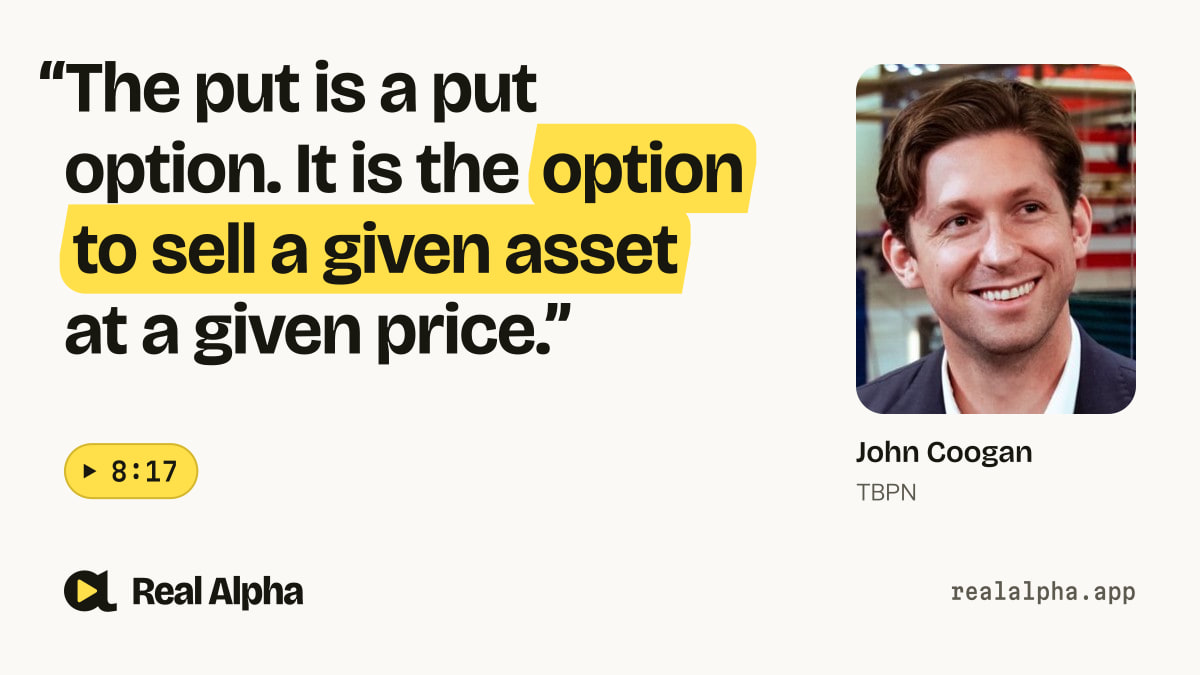
“The put is a put option. It is the option to sell a given asset at a given price.”
 John Cooganat 8:17 · TBPN
Takeaways Pro pick
- The 1987 response to Black Monday established a new market backstop.
- The government intervened again after major shocks in 1998, 2001, 2008 and 2020.
- Boomers’ share of national wealth grew from 18% to over 50%.
One of Pro's picks, open to you here. Try Pro free for 7 days
One of Pro's picks. The rest of the summary and the 3 takeaways are in Real Alpha Pro; the video, the quote and the transcript stay free.
Read it with Pro, 7 days freeAbout this segment
John Coogan explains how the Fed’s market backstop took shape as boomers became the dominant voters and asset owners. The history helps frame why market support could change as that political alignment shifts.

John Coogan, Host
Co-host, TBPN
Co-founded Soylent and Lucy; OpenAI bought his show TBPN in April 2026.

Jordi Hays, Host · Co-host, TBPN
Founded Branded Native; co-founded fintech Capital, which Rho bought.
From “The Boomer Put, Stripe @ $200b, Microsoft Code Red, China Slowing Down?”, Nov 24, 2026. Watch the full episode
Thanks. We'll look at and fix what's off.
Transcript
Transcribed by machine (Whisper) from the episode’s audio, so a word may be off here and there.
- 5:30
And I want to summarize this, then synthesize it to apply it to the current moment. Because NVIDIA reinstating Jensen is all over every newspaper. he's on the cover because it is one of the most fascinating stories in business history for sure so the core thesis of the boomer bubble is basically the last 40 years of rising asset prices were sustained by a political compact built around the baby boomers basically up only who became the baby boomers were america's dominant voters consumers and asset owners And so governments wound up repeatedly cutting rates, injecting liquidity, and rescuing markets because protecting accumulated wealth aligned with protecting the median voter.
- 6:18
The boomers were the median voter. They had the wealth, and so you have to protect them. And so as they retire and die, that alignment breaks, even though some of the assets might pass down. Younger generations have less wealth to protect and more reason to favor cheaper housing, redistribution, economic restructuring. So things are going to change. People have been talking about this a lot, but the actual implications, near-term knock-on effects are very interesting.
- 6:40
So this could lead to higher interest rates, greater volatility, because you don't have as much pressure. Hey, lower the interest rates. My assets are going down in value. If people have less assets, they're less likely to vote for a president who can push low interest rates or low interest rate agenda. And so higher interest rates, higher volatility, weaker government support during crashes. fundamentally changing the rules that investors have relied on since the 1980s and the 1980s is the start of this boomer bubble because that is when uh the put was created this is um this is a direct quote from the boomer bubble and so the boomer compact was born a 40-year political cultural settlement in which capital the intelligentsia and the median voter found their interests uniquely aligned prices would go up money would stay cheap entitlement spending
- 7:31
would continue to expand and asset holders would be bailed out whatever the cost and so jason goes back to black monday 1987 uh when the fed put was born boomers at the time had an estimated 18 percent of american household wealth by 20 uh by 2003 when bush's post-tech bubble capital gains cuts passed the senate 50 50 uh that share had more than doubled to 44 percent in 2008 when tarp passed 74 to 25.
- 7:58
The boomers own 50. 3% of national wealth. So through no real fault of their own, they had become an immovable, illiquid asset class. So if you're not super familiar with the Greenspan put, this was the first time that the Federal Reserve came to the market and said, we are basically going to guarantee security of asset prices. And that's what that means. The put is a put option. It is the option to sell a given asset at a given price. And so Greenspan, Alan Greenspan, who was the head of the Fed at the time, was saying, I'm basically giving you a put option. So you will always be able to sell your stocks at this price. So you should always be buying if the price is ever below that price. That's effectively what he was doing. Now, how did he actually say that?
- 8:49
It was incredibly curt. His statement on October 20th, 1987, the day after Black Monday, was basically just, the Federal Reserve, consistent with its responsibilities as the nation's central bank, affirmed today its readiness to serve as a source of liquidity to support the economic and financial system. And so he was saying, if the stock market crashes badly enough, I will cut interest rates and inject liquidity into the economy. And so he's creating this bottom floor for asset prices that creates, you know, there's still upside and there's still drawdowns, but at no point will the market be allowed to crash. Stocks go up in this country. Exactly. Exactly.
- 9:32
And so that 1987 Greenspan put was a historical moment. It was the first time the Fed had acted this way really. And it was the, the, really the beginning of this new era, but it came into, uh, into action many, many times, basically once a decade, something bad happened and the government stepped in, in one way or another. And so, uh, this right after 1987, you have 1998, uh, the Russian default and the long-term capital management, uh, uh, blow up a hedge fund exploded, basically, collapsed. So in 1989, the government stepped in. Then in 2001, after the dot-com bust and 9-11, they cut interest rates again. In 2008, after the housing bubble burst, there was liquidity injected into the American financial system. And then 2020, after COVID, you had a bunch of interest rate cuts and stimulus going into the economy. And so the
- 10:30
The question is like, what's happening now?