The alpha, twice a week
That was 6 min.
Get the best new moments in your inbox every Wednesday and Saturday. It's free.
Check your inbox
We sent a link to your address. Click it to finish signing up. Not there in a minute? Look in spam.
or
Bloomberg Surveillance · 6 min · Nov 20, 2026
VanEck pairs technology with Treasuries and real assets
David Schassler sees higher rates and AI financing pressuring markets, but keeps a technology tilt.
In this episode
Full analysis- 5:34Falling AI prices may expand usage, but open models compete3 min
- 17:31AI returns are strong, but infrastructure supply is the constraint4 min
- 26:34AI financing may keep bond yields high into 20273 min
- 8:06Munster sees AI adoption below 1% and substantial value ahead3 min
- 10:59Big Tech may accelerate AI infrastructure spending into 20273 min
- 40:25Automatic enrollment can lift retirement outcomes by 30 points3 min
- 31:57VanEck pairs technology with Treasuries and real assets6 min
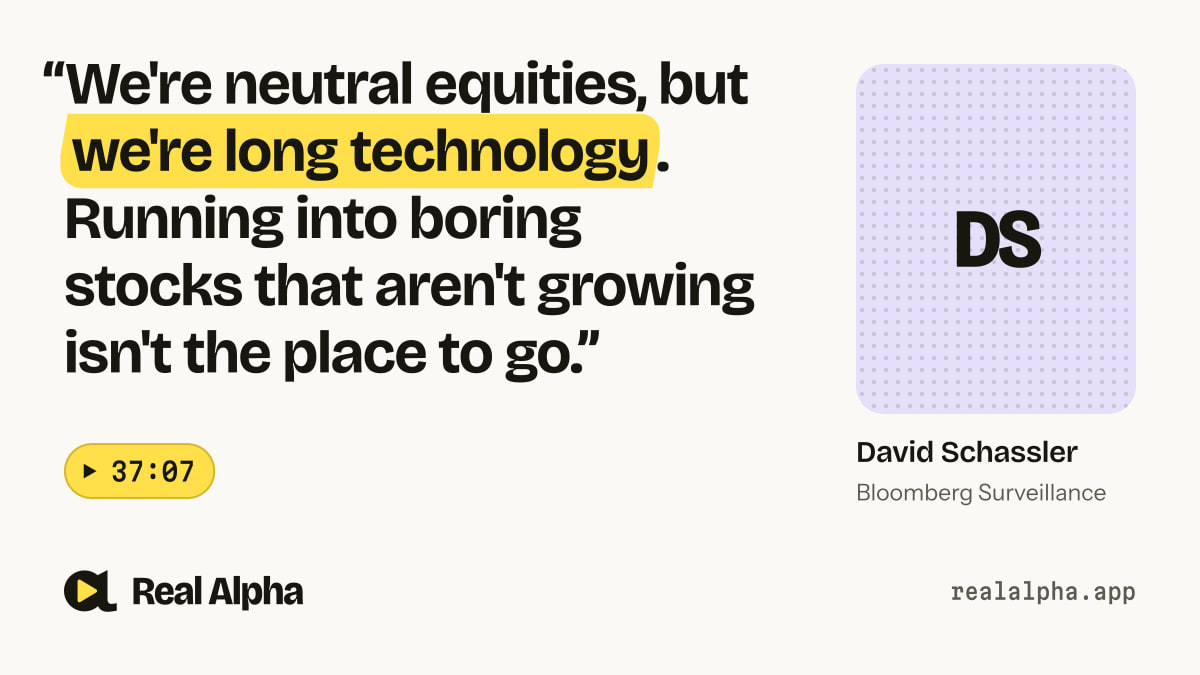
“We're neutral equities, but we're long technology. Running into boring stocks that aren't growing isn't the place to go.”
Takeaways
- Stay neutral on equities but favor technology.
- Use 7-to-10-year Treasuries as portfolio ballast.
- Diversify with gold and the broader real-asset complex.
About this segment
David Schassler sees higher rates and AI financing pressuring markets, but keeps a technology tilt. His playbook adds 7-to-10-year Treasuries and real assets, including gold.
Head: Multi-Asset Solutions, VanEck
- TK
Tom Keene, Host
- PS
Paul Sweeney, Host
From “AI and the Equity Selloff | Bloomberg Surveillance”, Nov 20, 2026. Watch the full episode
Thanks. We'll look at and fix what's off.
Transcript
From the transcript Bloomberg Surveillance publishes with the episode.
- 32:00
Yeah, so we are multi-asset solutions. As the name implies, we invest across asset classes. I look out at a market right now that wants to fall. Why do I say that? Because most of the things that we're investing in are falling. Here's the thing. Interest rates, you said a heavy equity market, interest rates are being weighed. You know, to fund these mega cap IPOs, you've got to take liquidity from somewhere. To fund this tremendous CapEx build, you've got to take money from somewhere.
- 32:25
You put higher inflation on top of that, you get higher rates. Higher rates are pressuring everything. That's what you're seeing across the board. The markets being the adult in the room as it comes to AI. You borrow too much money, you get punished for it. You don't show a credible path towards an ROI, you get punished for it. People are questioning the whole narrative. Here's the thing with AI. The theme got so big. We're thematic investors. We're trend followers.
- 32:46
The theme got so big that it pulled in everything. And that's effectively where you're at right now. So when you're starting to see an unwind like you're seeing right now, it's impacting everything. It's significantly more volatile.
- 32:56
Essentially, we had Heath Terry sitting from head of Tech Research at Citi sitting in your seat earlier this morning. And their work shows very good returns on investment on this AI spending from some of the hyperscalers. But again, I'm not sure that message is necessarily getting out. Or if it is, it's not being applied across the board here. Because you're right. We look at the VIX at 30. That tells you there's angst out there.
- 33:24
There certainly is. We were talking about it right before we went live. you're really close to giving up all the gains on the S & P, on the NASDAQ. That's where you're at. You're negative on bonds.
- 33:33
I agree. That hasn't been said. Thank you. You're negative on bonds, but bonds are providing stability. So we are long bonds. We'll talk about that as well. Commodities have been the rock star. We run a commodity strategy. It's still up 40% this year. It was up 60%. It's still up 40%, though. Big deal.
- 33:49
This is special, folks. VanEck is a name that's such a heritage for the Wall Street, which is why we can talked to David Schassler about squeezing a five-day workweek into a six-day workweek. But the heritage here of VanEck is 1968, when John VanEck blew up the industry by saying gold matters. Within your framework here of AI, is gold an intelligent place to be?
- 34:18
Gold is suffering from the same thing we were just describing about higher interest rates, a stronger dollar. But here's the thing with gold. We've seen this movie. You kind of know how it ends up. When you get higher interest rates and you get these pressures, gold falls. Now, why is gold falling so much? Gold went up too much too fast last year. That's what drove. Our performance last year in our commodity fund pit. It went up too much too fast. We changed positioning and went towards energy. 2026 was all about energy. Now it's certainly not. Things are reversing really, really quick as we go from supply shortages to the exact opposite.
- 34:53
Okay, but from John VanEck to Jan VanEck, there's a heritage here of long-term view. What is the VanEck view on gold out three years, five years, a decade?
- 35:05
You buy gold right now, we think you look really smart. Here's the thing with gold, and this is the way to think about it. Gold, if you just line up the asset classes and go back a really long time, you've got global equities that compound around 11%. You've got gold that compounds around 8% and bonds at 5%. Here's the beautiful thing about gold. When equities and fixed income traditionally are under the most pressure, that's when gold does the best. Gold's temporarily under pressure because it went up too much too fast, so it was a mean reversion that's now transitioned into a falling trend simply because of interest rates are pushing it. When interest rates stabilize, you expect gold to catch a bid. That's why I said you buy gold now. You still may have significantly more downward pressure, but we think you look really smart 18, 24,
- 35:42
36 months out right now. 10 years out, we think it's a great hedge. David Slasser with us now, head of multi-asset solutions at VanEck. What a wonderful day yesterday. BlackRock and Vesco amplify. I behave myself. It was the Belchunas seminar. He signs autographs. He just walks around, you know, does selfies and the whole thing. And the opening question I had, David, for the bond people yesterday is look at the track record.
- 36:10
There's no total return. Is that an opportunity in bonds or is there more of the same of flatness or underperformance in fixed income?
- 36:20
We are significantly more optimistic on fixed income than we were. We are running pretty close to neutral. What I would say, and this is kind of just a big picture idea, what people do next is what matters. This will be the most important thing that we talk about. People have already taken the pain. Not a lot of people are looking at their statements and saying, I'm really, really excited about how I've done so far in 2026. Once you get fear into there, bad decision-making kicks in. And this is the critical point for investors. So what you do next makes all the difference. And that's where fixed income comes in.
- 36:48
And that's a catharsis. And I think you're dead on. We really haven't seen catharsis, have we?
- 36:54
You're at a point right now where you cannot take excess risk, but you also can't run and hide. So what do you do? I'll tell you how we'll stack it up. We'll go across asset classes. And I hope that this provides the listeners with something to think about, at least. We're neutral equities, but we're long technology. Running into boring stocks that aren't growing isn't the place to go. You want to still maintain your equity exposure. And from our view, lean into growth, which is technology. That being said, you want to diversify with fixed income. We own a lot more treasuries than we have for some time, specifically the 7 to 10 year.
- 37:28
That's providing our ballast. And then we're diversifying it all with real assets. We spoke about gold a little bit before, but it's the entire real asset complex. But right now, it's diversification at length. Why am I saying that? I want to snap back. This will fade away and the markets will turn. And when they turn, I want to capture the upside as much as the upside as possible while cushioning the downside.
- 37:48
That's the takeaway.