The alpha, twice a week
That was 8 min.
Get the best new moments in your inbox every Wednesday and Saturday. It's free.
Check your inbox
We sent a link to your address. Click it to finish signing up. Not there in a minute? Look in spam.
or
TRIGGERnometry · 8 min · Nov 21, 2026
Why Eisman sees concentration risk across the AI supply chain
 Steve Eisman
 traces the AI investment chain from Nvidia’s customers to the hyperscalers and OpenAI and Anthropic.
The episode’s best minutes
Full analysis- 39:03Why Eisman sees concentration risk across the AI supply chain8 min
- 57:35Why Eisman says U.S. debt is easier to carry than France’s5 min
- 1:13:27Why Eisman thinks U.S. banks are safer after Dodd-Frank3 min
- 5 more moments in the full episode
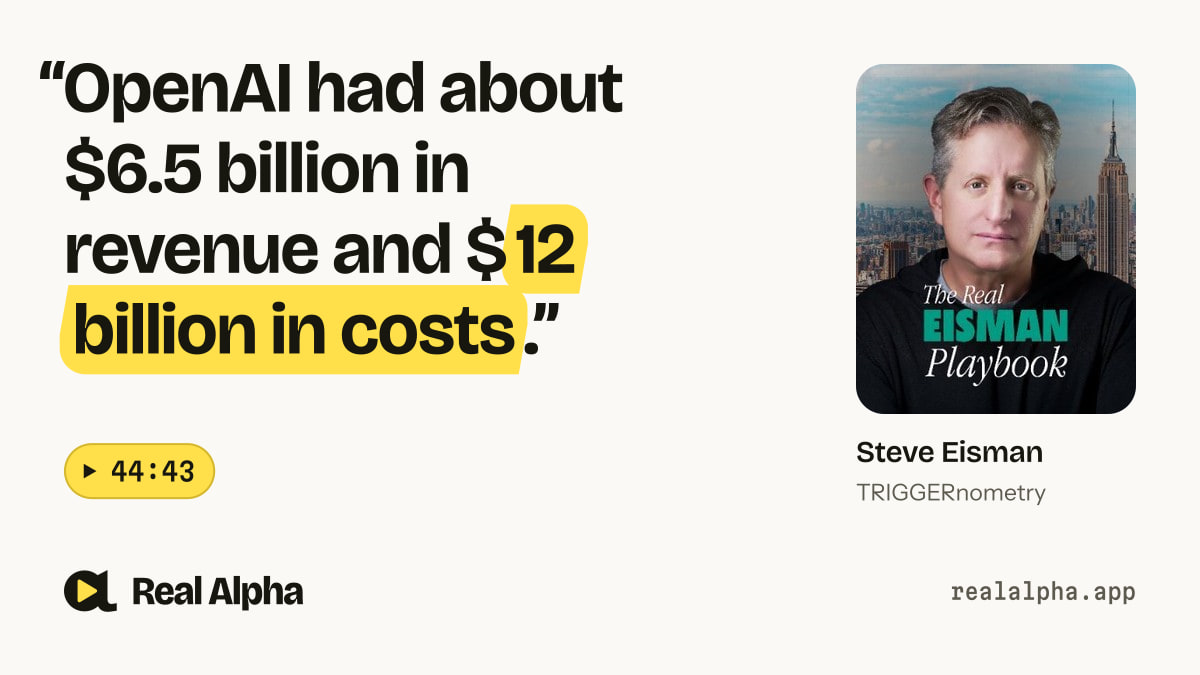
“OpenAI had about $6.5 billion in revenue and $12 billion in costs.”
 Steve Eismanat 44:43 · TRIGGERnometry
Takeaways
- Eisman says five customers account for 70% of Nvidia’s receivables.
- He says hyperscalers’ AI revenue relies heavily on OpenAI and Anthropic.
- He cites OpenAI’s $6.5 billion in revenue against $12 billion in costs.
About this segment
Steve Eisman traces the AI investment chain from Nvidia’s customers to the hyperscalers and OpenAI and Anthropic. He says the companies’ weak economics and commitments could make a failure spread through the sector.

Steve Eisman is an investor known for The Big Short.

Konstantin Kisin, Host · TRIGGERnometry

Francis Foster, Host · TRIGGERnometry
From “Big Short Investor: Is the AI Bubble About to Burst? - Steve Eisman”, Nov 21, 2026. Watch the full episode
Answers “How does OpenAI make money, and is it profitable?” See all 15 answers
Thanks. We'll look at and fix what's off.
Transcript
Transcribed by machine (Whisper) from the episode’s audio, so a word may be off here and there.
- 39:07
So here's how I sort of think about the risks. Like, we'll start at the top with NVIDIA, and we'll work our way down to Anthropic and OpenAI. So NVIDIA reported its most recent quarter about a month and a half ago. Revenue growth was over 100%. now think about that for a minute the largest company on planet earth had revenue growth of over a hundred percent insane i mean it's this is not a billion market cap company that grew its revenue by over a hundred this is a five and a half trillion company that grew its revenue by over a hundred percent so that tells you the power of this whole thing that's happening that people are just spending money like crazy there's a lot of picks and shovels being solved a lot of picks and shelves because you're building these data centers that need to be filled up with all these
- 40:00
very very expensive things um then but if you go into the 10q there's a very interesting sentence and the sentence is 70 of NVIDIA's this quarter of NVIDIA's accounts receivable which is like a proxy for revenue 70 percent was from five customers Now, that's a little alarming. Forget about NVIDIA. If you were running a company, you wouldn't want to be running a company where you only had five customers.
- 40:39
Because if you lost one customer, that'd be really bad. So the fact that the largest company in the world has over 100% revenue growth, but it's mostly just with five customers, that's like an alarm bell. Okay, so then let's move down one level to the hyperscalers, you know, Microsoft, Google, Amazon, and Oracle. So if you just look at Microsoft, Amazon, and Google, 70% of their AI revenue is just from Anthropic and OpenAI.
- 41:18
Now, 70% of their AI revenue is equal to about 25% of their entire cloud revenue, which is basically a huge division within the company. Oracle is even worse, because Oracle has a backlog of about 600 billion. Over half of it is just from OpenAI. So tremendous concentration. And then you go down a level, basically, if you go NVIDIA, the five customers are probably the hyperscalers. The hyperscalers depend upon OpenAI and Anthropic.
- 42:04
Anthropic and OpenAI lose money. So the entire chain is basically dependent upon two companies. The risk to these two companies right now is two vectors. Number one, there are no moats around these LLM businesses. Explain to people what a moat is. So a moat is basically like a barrier to entry in your business. So there can be a regulatory barrier to entry. or a business barrier to entry so a regulatory barrier entry would be something like let's say i'm in a small town and i own the grocery store and i got the mayor of the town to create an ordinance that said no other grocery stores are allowed to open in this town that would be a barrier to entry. A non-barrier to entry, a business barrier.
- 42:59
to entry would be something like, take Google search. Who on planet Earth doesn't use Google search? And not only do we all use Google search, we can't even think about using anything other than Google search, until recently because of AI. So for 20 some odd years, Google, the search business, had this insurmountable moat that does everybody use Google search and nobody's going to use anything else?
- 43:27
Yeah, it literally became a verb to Google. Why? The verb. When you're a verb, you know you got something. So the way this sort of LLM thing works is somebody is using Claude to create software. And then somebody else shows up with another model that you hear is really good. And you switch, and you use their model. And so people are switching all the time. There's no moat. that that's a very long-term problem um the other but the the other problem which is even more pressing is that these chinese open weight models are just much cheaper they're not as good but you know you don't need to have a mercedes-benz to drive around the block so for many tasks you'll use the open weight model and what i'm hearing is that um anthropic and open ai are starting to cut price because they're losing share now that wouldn't be so terrible if they were very
- 44:29
profitable companies but they're not profitable at all how not profitable are they insanely unprofitable like nuts so uh let's see in the most recent quarter i'll be maybe a little bit off OpenAI had about $6.5 billion in revenue and $12 billion in costs. That's just current. But what they have done is, because they see, in their opinion, that they're going to grow forever. they need more and more compute power to deal with all the business that they think they're going to get so they have signed hundreds upon hundreds of billions of dollars of commitments to data centers so it's not just that they're unprofitable right now they have committed to spend insane amounts of money. So essentially what you're saying is that they're probably over leveraged, aren't they? I don't know what leverage, well, there's leverage and there's
- 45:42
leverage. There's balance sheet leverage, which, you know, shows up on the balance sheet. That's not what we're talking about. If you have a commitment to spend, I'll make up a number, $500 billion over the next six, seven years, that doesn't show up on your balance sheet. That's in a footnote. Wow. But we could think about it just that it's really debt. I mean, it's your commitment. You wrote a contract.
- 46:06
You signed a contract. But it technically isn't leverage. It's a commitment. But it's leverage. So is this a bubble? Is this one giant bubble, the entire AI industry? I don't know yet. I mean, it just... If tomorrow or within the next year, One of these two companies, and OpenAI is the weaker company, one of these two companies failed. I think the entire AI complex would slow to a crawl because it's so dependent upon these two companies.
- 46:41
And I think the U.S. economy would go into a recession immediately. It's not a financial crisis. It's a plain vanilla recession. It'd be like the dot-com bubble, and eventually you come out of it. If one of these companies fails, In the next four or five years, you know, probably things will be much more diversified and it'll be fine. So I don't know yet. I'm keeping very close track on the pricing situation.