The alpha, twice a week
That was 3 min.
Get the best new moments in your inbox every Wednesday and Saturday. It's free.
Check your inbox
We sent a link to your address. Click it to finish signing up. Not there in a minute? Look in spam.
or
TRIGGERnometry · 3 min · Nov 21, 2026
Why Eisman thinks U.S. banks are safer after Dodd-Frank
 Steve Eisman
 credits Dodd-Frank and Fed supervision with reducing bank leverage and risk in the U.S. He argues Europe’s weaker growth has more to do with regulation and a smaller technology sector than with its banks.
The episode’s best minutes
Full analysis- 39:03Why Eisman sees concentration risk across the AI supply chain8 min
- 57:35Why Eisman says U.S. debt is easier to carry than France’s5 min
- 1:13:27Why Eisman thinks U.S. banks are safer after Dodd-Frank3 min
- 5 more moments in the full episode
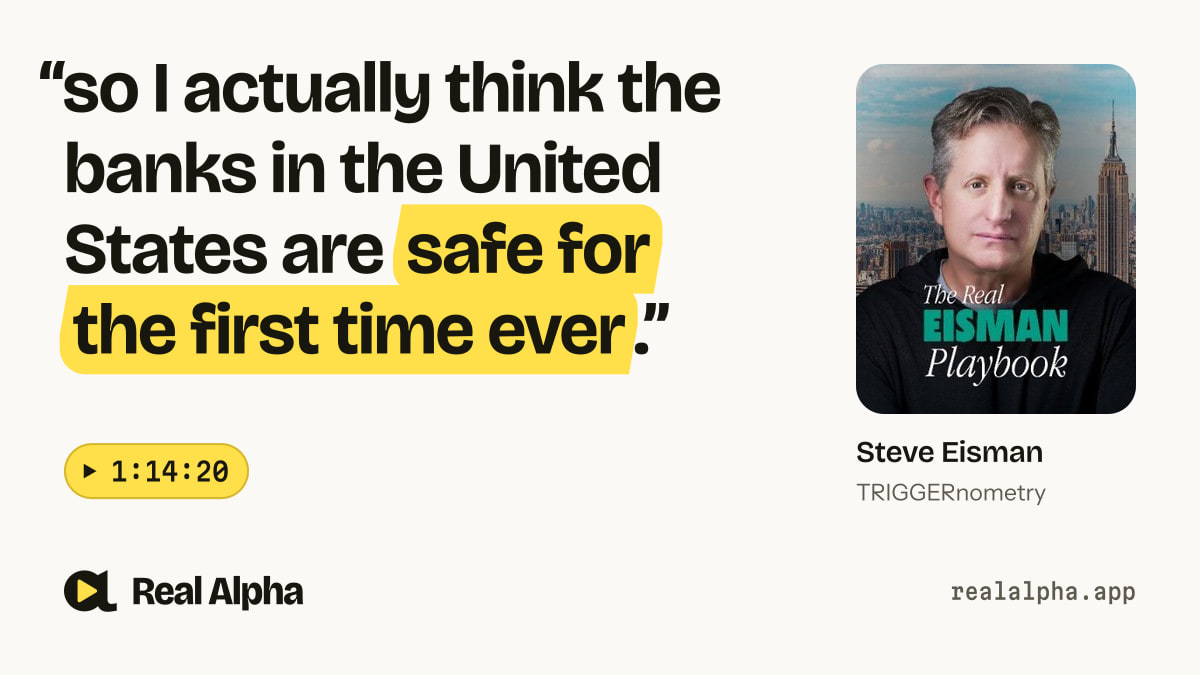
“so I actually think the banks in the United States are safe for the first time ever.”
 Steve Eismanat 1:14:20 · TRIGGERnometry
Takeaways
- Eisman says Dodd-Frank created a chief bank regulator at the Fed.
- He says U.S. banks have less leverage and risk than before.
- He links Europe’s weaker growth to its smaller tech sector.
About this segment
Steve Eisman credits Dodd-Frank and Fed supervision with reducing bank leverage and risk in the U.S. He argues Europe’s weaker growth has more to do with regulation and a smaller technology sector than with its banks.

Steve Eisman is an investor known for The Big Short.

Konstantin Kisin, Host · TRIGGERnometry

Francis Foster, Host · TRIGGERnometry
From “Big Short Investor: Is the AI Bubble About to Burst? - Steve Eisman”, Nov 21, 2026. Watch the full episode
Thanks. We'll look at and fix what's off.
Transcript
Transcribed by machine (Whisper) from the episode’s audio, so a word may be off here and there.
- 1:13:31
the 08 crash? Oh, dramatically. So, you know, Dodd-Frank got, which was this legislation that It got passed in late 2010, and probably the most important thing that it did was it created a new position in the Fed called Vice Chair of Financial Supervision, which was basically a fancy term for chief bank regulator of the United States. So when you think about it, the United States never had a chief bank regulator.
- 1:14:02
How insane is that? So that position was occupied by Fed Governor Daniel Tarullo, who did an unbelievable job. You know, the banks, he basically took the leverage and he cut it in half. And then not only did he do that, he made them reduce their risk. And so I actually think the banks in the United States are safe for the first time ever. Really? Ever. That's so interesting because... That doesn't mean that bad stuff can't happen.
- 1:14:36
I'm just saying they are not levered enough. They don't have enough risk for there to be any serious problems in the banks. In the banks. It seems that 08 was this moment where there was a real fork in the road between America and between Europe. I would argue, and you can push back on me all you want, I don't think we've recovered in Europe. If you look at wages, wages... haven't recovered if you look at i think but i don't think that's a financial system issue i think that's a the way you regulate your economy and it's just much much less dynamic i mean to your point i think just before the financial crisis the the gdp of the u.s and the gdp of you of the eu was more or less roughly the same and now i think the u.s is like 60 bigger But that is a testimony just to how dynamic the U.S. is
- 1:15:28
and how into technology it is, as opposed to Europe. You think that it's entirely that? Yes. Take Germany, for example. I had a great... One of my first podcasts, I interviewed a guy who wrote a book called Kaput, The End of the German Economic Miracle. And his argument was basically that for a long time, You know, Germany ran this industrial policy where the government and the companies were all in bed to one another, and they chose certain industries, autos, chemicals, and Germany did very well for a long period of time.
- 1:16:06
And then basically what happened was the world passed it by, and they never built up a technology sector, and German GDP hasn't grown in the last five years. Five years. It's astonishing. No growth in GDP in Germany for five years. Well, because they have no tech sector.