The alpha, twice a week
That was 2 min.
Get the best new moments in your inbox every Wednesday and Saturday. It's free.
Check your inbox
We sent a link to your address. Click it to finish signing up. Not there in a minute? Look in spam.
or
Tangle · 2 min · Nov 19, 2026
Why Kmele Foster doubts government can fill a spiritual void
 Kmele Foster
 argues that government cannot resolve people’s search for belonging, partly because political power will eventually pass to opponents.
In this episode
Full analysis- 16:52Why Isaac Saul says the outages changed his AI risk assessment4 min
- 51:03Why Mike Rounds wants defense briefings shared across parties4 min
- 38:20How Audrey Moorhead says Vance's memoir changed her view8 min
- 22:25Why Kmele Foster sees AI vulnerability scans as defensive4 min
- 46:35Why Kmele Foster doubts government can fill a spiritual void2 min
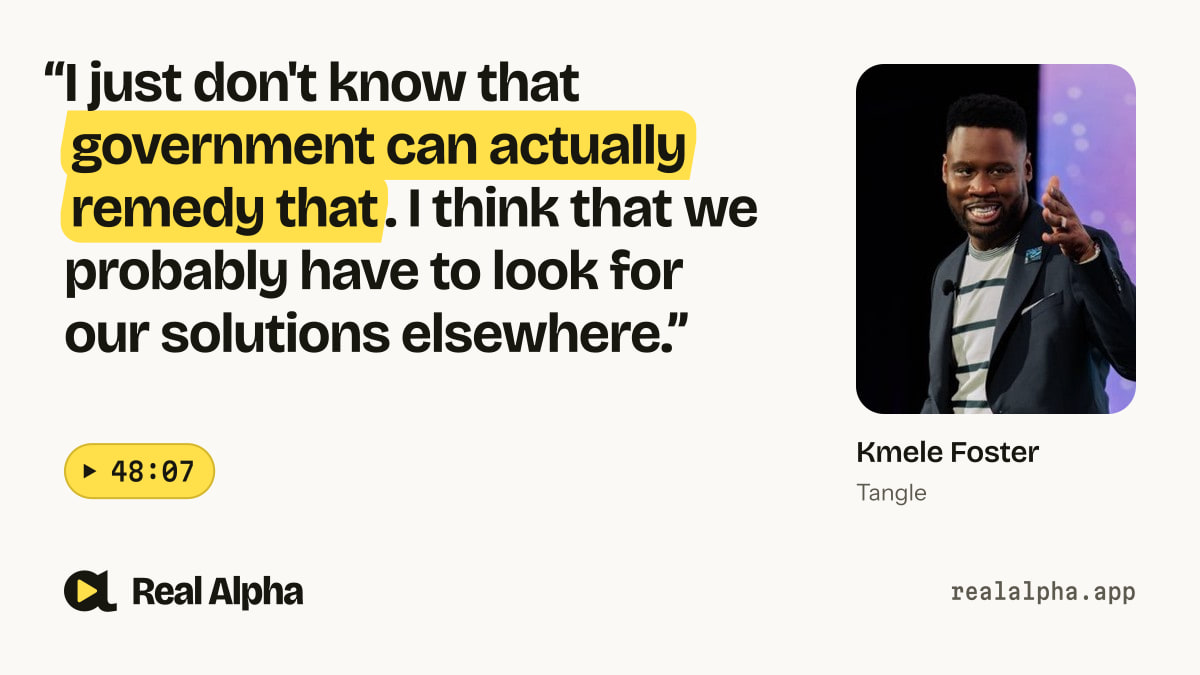
“I just don't know that government can actually remedy that. I think that we probably have to look for our solutions elsewhere.”
 Kmele Fosterat 48:07 · Tangle
Takeaways
- He worries later governments could use the same power for different political ends.
- He distinguishes voluntary cooperation from politics backed by force.
- He says the search for belonging may need solutions outside government.
About this segment
Kmele Foster argues that government cannot resolve people’s search for belonging, partly because political power will eventually pass to opponents. He distinguishes politics backed by force from voluntary cooperation and says people should look elsewhere for solutions.

Editor-at-large, Tangle
Built Freethink/Big Think into a media brand reaching millions monthly and co-hosts The Fifth Column.

Isaac Saul, Host
From “The Problem With the “Everything Is Breaking” Theory”, Nov 19, 2026. Watch the full episode
Thanks. We'll look at and fix what's off.
Transcript
Transcribed by machine (Whisper) from the episode’s audio, so a word may be off here and there.
- 46:47
Because at some point in the conversation, we were talking about something similar, like adjacent to this kind of God-shaped hole and the aspiration that the government should in some way, shape, or form, like help fill that hole, that it had an obligation to do so. And I asked him a question sort of about the limiting principle in his politics. Like for him, it's like we're accruing power. We're going to use government in these active ways, almost as though, you know, in talking that way, it almost sounds like I'm talking like someone from the progressive left.
- 47:04
They have a similar sort of attitude towards government. And from my standpoint, the two concerns I have are, one, you guys won't always be in control. At some point, you'll lose power. They'll come into power, and they'll be trying to fill that same hole with their politics. And I don't really know that I want my hole filled by either of you. The other thing is, I just dispositionally, government is, I see why you guys laughed there.
- 47:25
I did not mean it that way. Government and politics can be thought of in a couple of different ways. It can be this thing that we're all doing together and kind of with agreement and fine, we've solved our big problems. Or it could be something that we appreciate can only ever be kind of economic or political. Economic being that there is mutual cooperation, but that it's a kind of voluntary exchange.
- 47:50
And political meaning that force is being employed. And I have a very difficult time with the state being leveraged for those kinds of ends without us being really cognizant of the fact that that's what's happening. So I would agree generally with the notion of there being kind of a, there seems to be a kind of searching in the populace. I don't know if I would call it a kind of spiritual deficiency that people have, but definitely a kind of searching and an aspiration to belong.
- 48:20
I just don't know that government can actually remedy that. I think that we probably have to look for our solutions elsewhere. The one other thing I'd say, Isaac, is metaphorically speaking, chameleons, they're hiding. Shapeshifters, on the other hand, they are trying to deceive you.