The alpha, twice a week
That was 4 min.
Get the best new moments in your inbox every Wednesday and Saturday. It's free.
Check your inbox
We sent a link to your address. Click it to finish signing up. Not there in a minute? Look in spam.
or
Tangle · 4 min · Nov 19, 2026
Why Kmele Foster sees AI vulnerability scans as defensive
 Kmele Foster
 argues that AI-assisted vulnerability discovery can help companies patch flaws that have existed for years.
In this episode
Full analysis- 16:52Why Isaac Saul says the outages changed his AI risk assessment4 min
- 51:03Why Mike Rounds wants defense briefings shared across parties4 min
- 38:20How Audrey Moorhead says Vance's memoir changed her view8 min
- 22:25Why Kmele Foster sees AI vulnerability scans as defensive4 min
- 46:35Why Kmele Foster doubts government can fill a spiritual void2 min
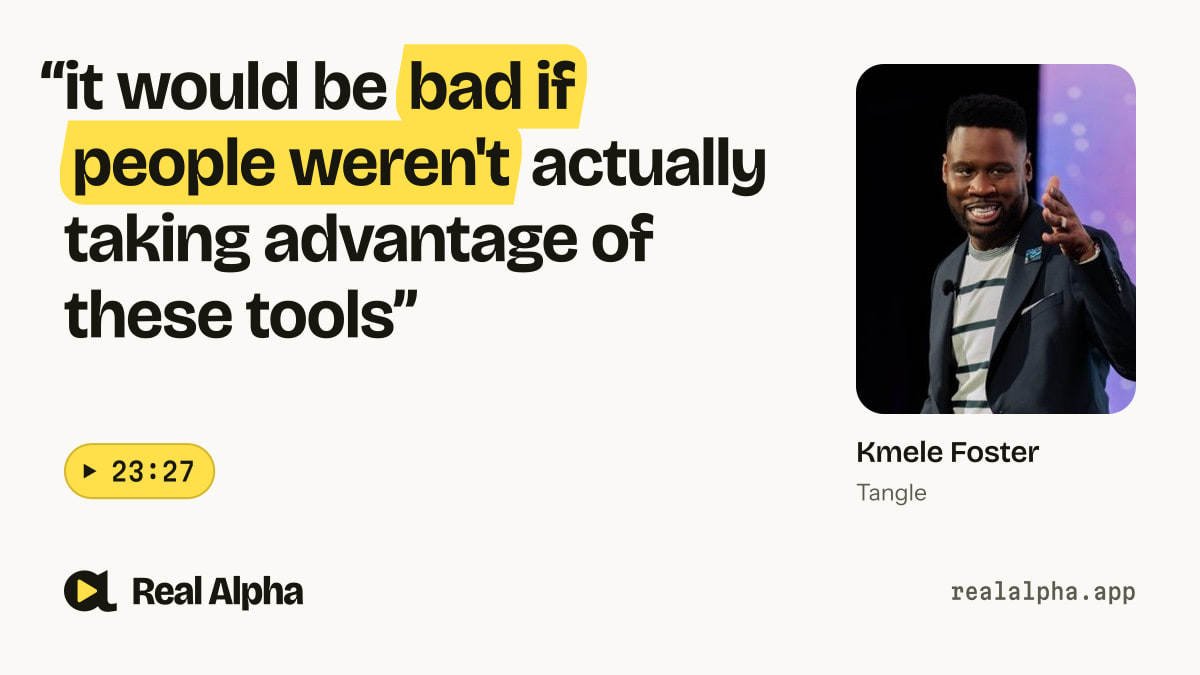
“it would be bad if people weren't actually taking advantage of these tools”
 Kmele Fosterat 23:27 · Tangle
Takeaways
- He says many vulnerabilities existed before AI tools made them easier to find.
- He views faster discovery and patching as a security benefit.
- He says to revisit outage patterns after two or three months.
About this segment
Kmele Foster argues that AI-assisted vulnerability discovery can help companies patch flaws that have existed for years. He says a week of outages is too little evidence to establish a lasting pattern.

Editor-at-large, Tangle
Built Freethink/Big Think into a media brand reaching millions monthly and co-hosts The Fifth Column.

Isaac Saul, Host
From “The Problem With the “Everything Is Breaking” Theory”, Nov 19, 2026. Watch the full episode
Answers “Will AI make cyberattacks worse?” See all 70 answers
Thanks. We'll look at and fix what's off.
Transcript
Transcribed by machine (Whisper) from the episode’s audio, so a word may be off here and there.
- 22:38
I appreciate the concern about the fact that we do have these what seem to be faster discovery mechanisms, which as a result means that we're going to be patching things faster. And when you're patching things, sometimes you disrupt things and you break them. But we are getting updates to systems all the time. We have phones that are updating. My car updates its software pretty regularly. Sometimes things go wrong.
- 22:59
Usually they send another patch and they fix it. I think framing the fact that people are arming themselves with more information and understanding a universe of vulnerabilities that existed before and have existed in many instances for years and years and years, but we didn't really know they were there. And then we patched them and are apparently less vulnerable at that stage. I mean, for me, that sounds like a good thing.
- 23:23
And I think that framing that sort of proactive defensive activity as something that is potentially dangerous or scary is a choice that we're making. And I don't know that we really need to make that choice. It seems to me that it would be bad if people weren't actually taking advantage of these tools, using them to find vulnerabilities in their systems, and then trying to patch and improve them. In a number of instances, some of the updates are just optimization and improving the quality of the service that we're already getting.
- 23:55
Again, I think it's going to be some time before we know whether or not there's a pattern. A week is certainly not enough information for us to compile and then say, oh, my God, look what happened. Talk to me in two or three months and tell me then if we're actually seeing waves of outages at familiar places in ways that are completely inconsistent with what we've seen over the course of the last five years or so.
- 24:20
And then maybe I'll be willing to get involved. But at this point, I think I'm probably at a two on my kind of panic and concern ranking. The reality is that these tools are interesting. They're really cool. But at the moment, it seems like the good guys and the bad guys have access to them and the good guys are doing things with them in ways that I am happy about. There are some interesting narratives that I've heard, like people who build autonomous bots, the bots themselves open bank accounts, the bank bots kind of get together in groups and form these hacking collectives and go off and do this thing.
- 24:57
And they're self-funded and they have their own institutions set up, essentially. Like, that's interesting. That's kind of scary. But one could also imagine the good version of that story, good bots that are doing things as well. So it seems like the only way forward, and perhaps this is to Audrey's chagrin, is to try and make the best possible technology that we can to put it in the hands of people who are pretty smart and have noble intentions and to leverage that so that we're not disadvantaging ourselves and being in a situation where we're actually, you know, subject to bad actors who continue to develop these tools without the kind of scruples that the good guys might have.
- 25:41
I mean, Camille, I'm happy to follow up with you in a few months about where things stand. You're just going to need a ham radio for me to reach you. The grid's going to be down.