The alpha, twice a week
That was 6 min.
Get the best new moments in your inbox every Wednesday and Saturday. It's free.
Check your inbox
We sent a link to your address. Click it to finish signing up. Not there in a minute? Look in spam.
or
Odd Lots · 6 min · Nov 27, 2026
Windfall-profit taxes can target energy-shock inequality
 Isabella M. Weber
 backs wealth and windfall-profit taxes, plus targeted taxes on high-energy consumption.
In this episode
Full analysis- 9:47Affordability needs immediate relief and public investment9 min
- 32:52Essential-price shocks explain why the economy feels worse4 min
- 37:58Price stabilization depends on the sectorPro pick 5 min
- 21:33Windfall-profit taxes can target energy-shock inequality6 min
- 29:44Build clean energy before retiring existing supply3 min
- 27:22Long-term price planning needs agencies that outlast elections3 min
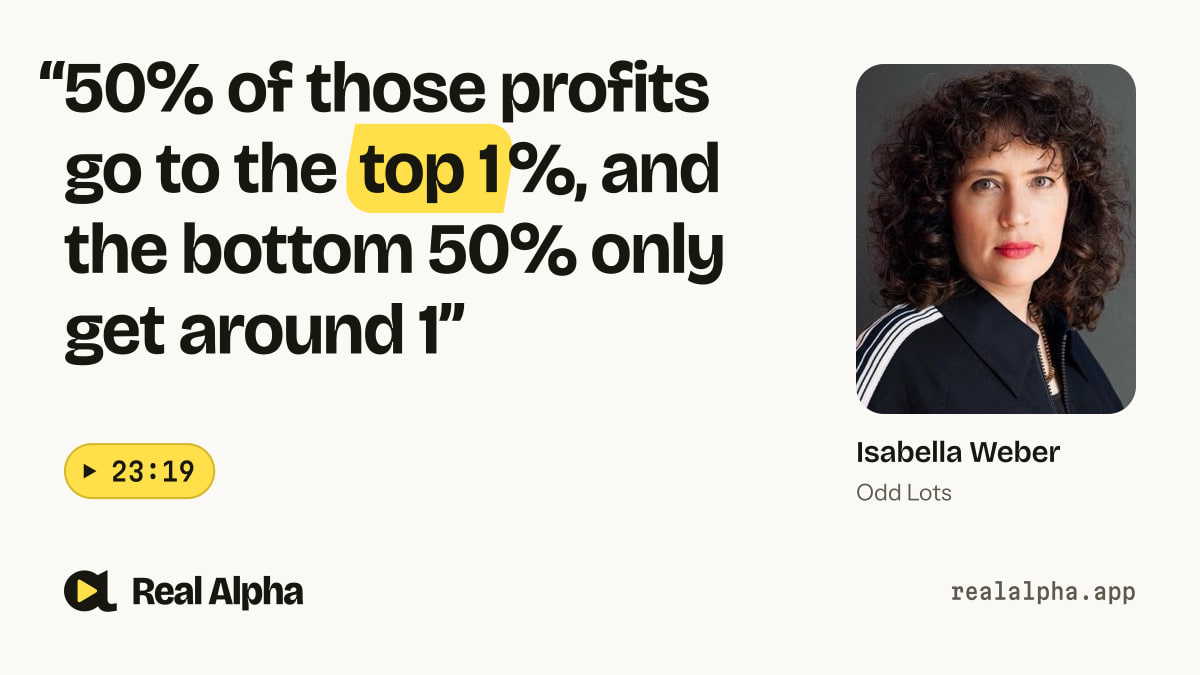
“50% of those profits go to the top 1%, and the bottom 50% only get around 1”
 Isabella Weberat 23:19 · Odd Lots
Takeaways
- Half of 2022 fossil-fuel profits went to the top 1%; the bottom half got 1%.
- She supports taxes on extreme wealth and windfall profits.
- Private jets and superyachts are examples of high-energy consumption to target.
About this segment
Isabella M. Weber backs wealth and windfall-profit taxes, plus targeted taxes on high-energy consumption. She says 50% of 2022 fossil-fuel profits went to the top 1%, while the bottom half got about 1%.

Isabella M. Weber is a professor of economics at the University of Massachusetts.
Explained China’s market reforms in an award-winning book and advances policies for inflation and affordability.
- JW
Joe Weisenthal, Host · Bloomberg
- TA
Tracy Alloway, Host · Bloomberg
From “Isabella Weber's Vision for an Affordability Agenda | Odd Lots”, Nov 27, 2026. Watch the full episode
Thanks. We'll look at and fix what's off.
Transcript
From the transcript Odd Lots publishes with the episode.
- 21:46
You know, when I was growing up, people used to talk about like tax and spend liberalism is like a slur. But like it feels like Democrats don't even defend taxes anymore and the importance of taxes. And I haven't heard anything about reversing any of the Trump tax cuts that were implemented from the new Congress. And then we're not going to find any elected who's like willing to like reverse the taxes on tips, et cetera. And I get it.
- 22:16
But it's like both a reinvigorating or sort of like no taxes are part of the answer here. And then also just as a counterpoint. Why not as an alternative to some of these sort of like long-term rearrangements, et cetera, what about just like an aggressively progressive consumption tax? And just say, look, if you spend a lot, if you're a consumer of a lot of real resources in your life, if you buy a lot of cards, if you buy like luxury housing, et cetera, you're going to pay a tax on that. And then you don't have to worry about like getting all the details right. You just like make it more punitive to spend a lot.
- 22:59
Interesting. I would, of course, be for dialing back on the Trump taxes. I think it's very important to have taxes on extreme wealth. I think it's also important to have windfall profit taxes in the context of the kind of windfall profits that we are witnessing. Once more right now. And That is important, especially from a distributional perspective, where actually, I mean, we have done research on the previous fossil fuel profits in 2022, and we found that 50% of those profits go to the top 1%, and the bottom 50% only get around 1% of those profits. But each of these profit bouts, we actually get a redistribution from the bottom to the top that I think actually also further undermines trust in democracy because we are.
- 23:50
In the middle of an obscene inequality crisis. Do you worry that left-of-center parties have lost the willingness to fight for the legitimacy of taxes? When you look around the world, it's like taxes do play a role in stabilization. Nobody loves them, but again, or yeah, sure, we all love, in theory, paying lower taxes. But if we want to curb consumption, et cetera, or if we want to have some balance, the taxes do play a role in this. And do you worry when you look at just politics, that people are losing their appetite to defend the premise of taxation.
- 24:30
Yeah. And I mean, I like your idea of thinking about targeted taxes on specific types of consumption goods. So I actually think that in the middle of a global energy crisis, we should have a very strict regulation on the use of private jets and super yachts, which are, you know, using up significant. Shares of energy. And you could also think of this as adding a high tax on similar kinds of items.
- 24:58
I mean, I think that we actually have had kind of a revival of the question of taxing the rich in recent years, like under the Brazilian leadership of the G20, you know, there has been the most energetic initiative towards a global.
- 25:13
Billionaires tax that we have seen in a pretty long time. And on the progressive side, I mean, we often have this divide between people who want to tax and people who want to change pre-distribution, right? And then, you know, there's often this like, oh, if you only want to tax, you're not actually changing the system. And then, you know, the counter argument is like, oh, but if you only do a pre-distribution, then, you know, the arc is very long until you get there. democracy might already have imploded.
- 25:44
And I would say that we just need both. I think that generally speaking, we need much more of an openness to combining different kinds of tools. I mean, there's a similar kind of divide between folks who want more public ownership and planning and folks who want a harsher antitrust enforcement and competition policy. And I would say we need both. There's no reason why those things can't be combined. So if you do the basket policy on food, you could combine this with a price gouging ban for everything else.
- 26:23
And you could combine this with a sector investigation into the grocery and food processing sectors. So I don't see this as kind of mutually exclusive or kind of an either-or type of thing. I think that as we move forward, into the age of affordability. In a way, we are leaving the world of macro policy will manage our economies to the world of sectoral policies, especially for essential sectors. And once you enter the realm of sectors, you get into the very messy reality that you guys have been documenting so beautifully on your podcast.
- 27:06
Reality is pretty messy. I can say we've learned that for sure. And that means that there's not going to be a silver bullet for any of these things. But I mean, taxes, yes. Price stabilization, yes. Build out of supply, yes. But you do have to think about time horizons. And I think delivering relief in the here and now is really critical and has to be combined with these deeper structural measures.