The alpha, twice a week
That was 4 min.
Get the best new moments in your inbox every Wednesday and Saturday. It's free.
Check your inbox
We sent a link to your address. Click it to finish signing up. Not there in a minute? Look in spam.
or
Sourcery · 4 min · Jul 27, 2026
Windsurf's product integration was gradual, not forced
 Scott Wu
Cognition had 35–40 people against Windsurf's roughly 200, so the teams first focused on serving customers and then integrated products gradually.
In this episode
Full analysis- 8:14Cognition negotiated the Windsurf acquisition in one weekend4 min
- 20:17Enterprises need help changing how they build softwarePro pick 7 min
- 33:24A MongoDB setup error revealed Devin’s potential4 min
- 13:22Windsurf's product integration was gradual, not forced4 min
- 28:22AI progress still faces organizational and feedback constraints4 min
- 4:13Coding-agent adoption could reach far beyond software engineers4 min
- 37:13AI coding's bigger payoff may be expanding what people can build3 min
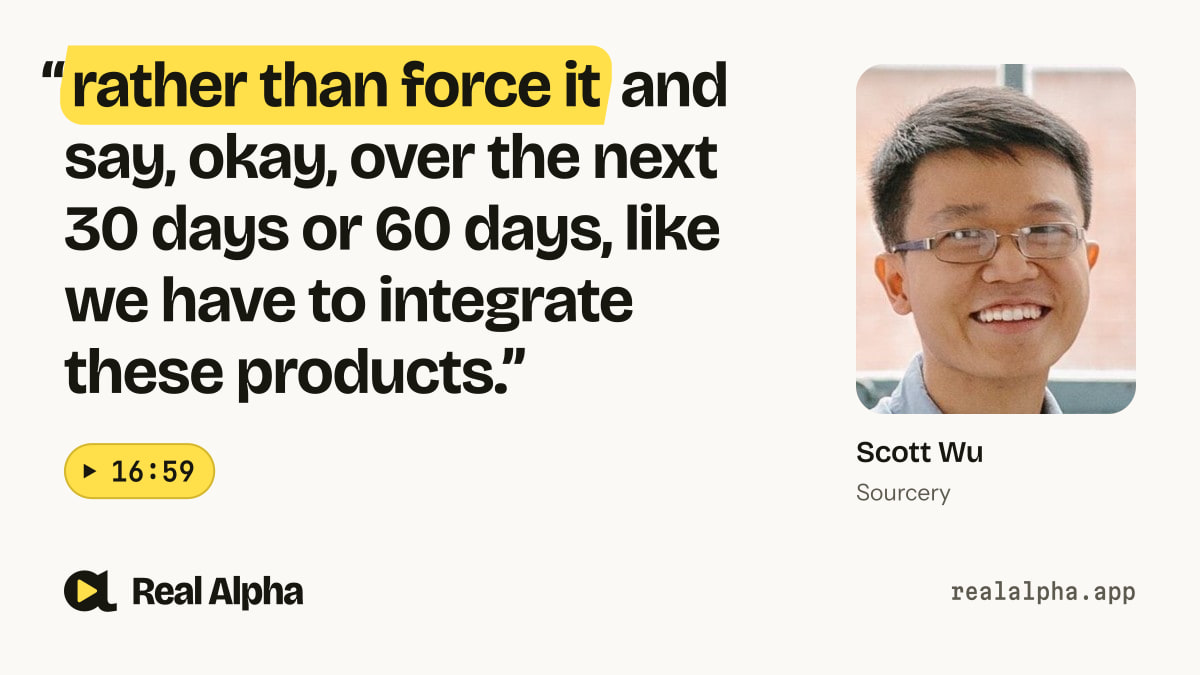
“rather than force it and say, okay, over the next 30 days or 60 days, like we have to integrate these products.”
 Scott Wuat 16:59 · Sourcery
Takeaways
- Cognition had 35–40 people; Windsurf had about 200.
- The teams focused first on keeping products and customer support running.
- Usage and new features guided the gradual product integration.
About this segment
Cognition had 35–40 people against Windsurf's roughly 200, so the teams first focused on serving customers and then integrated products gradually. Scott Wu says usage and feature overlap should pull products together instead of imposing a deadline.

Scott Wu is cofounder and CEO of Cognition.
Co-founded Cognition, the company behind Devin, an autonomous software engineer; three-time IOI gold medalist.

Molly O'Shea, Host · Founder, Sourcery
Ex-Upfront Ventures investor; has interviewed Alex Karp and Palmer Luckey.
From “Inside the Fastest-Growing Category in AI: Scott Wu, CEO of $26B Cognition”, Jul 27, 2026. Watch the full episode
Thanks. We'll look at and fix what's off.
Transcript
Transcribed by machine (Whisper) from the episode’s audio, so a word may be off here and there.
- 13:27
the teams together yeah um no that was a real process and by the way one of the things that was tricky about that process is cognition at the time was all of 35 or 40 people um and we had a meaningful business with you know real traction we were doing um in the range of 70 or 80 million of revenue run rate at the time. But it was a very small team. Windsurf, on the other hand, because it had kind of scaled up go-to-market and set all that up, it was around 200 people at the time.
- 13:54
And so a lot of details to figure out, obviously. And so for a few months, I mean, the immediate day of or week of, all of us were just like, okay, let's just write the ship. Let's make sure folks know, customers know that we're going to be there for them. We're going to be shipping. we're gonna be like um you know taking care of both sides of the product and doing that well right and let's just go and deliver um over the first few months obviously a lot of it was just like figuring out how we um how we kind of get into a good state and then you know as with all things it's kind of like it's much easier to go build these things and do all this you know with with some time um and so um you know we had a lot of little like kind of like fun off sites which helped I think for people getting to know each other ton of strategy sessions obviously
- 14:40
like working out all the details and so on and then you know pretty soon like at the end of last year we got to kind of like we were looking for like a bigger SF office space obviously like as soon as possible just as like a tactical matter because you know we needed an office that could fit everybody right and so like but by the end of the last year we got that office space and then kind of were able to put everyone in one space and all kind of like work together and um and those were i would say kind of the big milestones that like made things super super smooth how did you work through the product integration i mean it was it was a lot of steps for sure um no i i mean i think the um one way i'd put it is like you know not trying to overly force it um and so you know for the time being it was like there's a windsurf product there's a devon product both those are
- 15:31
great let's work on both those and kind of do the obvious like next steps on each of these things um and then as we kind of had pieces of overlap just like naturally building them in together and so it wasn't like uh you know one month later windsurf is gone and that's it you know it was like over the course of the last year even we've been building all these things and now it's kind of like you know devon cloud and devon desktop are like super super like nicely paired together you can start sessions from one and hand Off to the other, you can work with them all in the same systems, whatever, right? But it was much more of a gradual thing. And I think one of the things that was interesting for us was a lot of the users of either product were kind of already naturally looking for the other side, right?
- 16:17
And so we had a ton of people, for example, who were on the IDE framework. And obviously, right around this time that we're talking about, late 25, early 2026, is right around when these asynchronous agents were really starting to get big. And so all these folks were thinking about, okay, well, what should my strategy be? And obviously, it's great to be able to work with a single team and somebody that already understands your code base and has all the details kind of figured out and deployed, right?
- 16:45
And so that was nice. And then on the reverse side, obviously, similarly, for a lot of folks who were, like, you know, adopting the cloud agent, it's very nice to say, okay, yeah, like, the local side of it is there, too, for any of the developers who still want to use the local form factor and who want to have that, right? And so I think it's kind of like maybe the simple way to put it is like rather than force it and say, okay, over the next 30 days or 60 days, like we have to integrate these products.
- 17:09
It's much more of like letting the actual usage and the new features that we're building, the kind of next paradigms that we're getting to, like letting those like pull the products together more gradually rather than forcing it. How were you getting advised during this? Were you just making it up as you go or were you like who were you turning to?