The alpha, twice a week
That was 8 min.
Get the best new moments in your inbox every Wednesday and Saturday. It's free.
Check your inbox
We sent a link to your address. Click it to finish signing up. Not there in a minute? Look in spam.
or
Decoder · 8 min · Nov 9, 2026
YouTube licensed music even after winning in court
 Mitch Glazier
 contrasts YouTube’s licensing partnerships with Google’s fair-use arguments for search and AI training.
The episode’s best minutes
Full analysis- 13:44Fans may decide whether AI music can earn their loyaltyPro pick 8 min
- 39:56YouTube licensed music even after winning in court8 min
- 31:59Deepfake rules need safeguards for speech and likeness8 min
- 5 more moments in the full episode
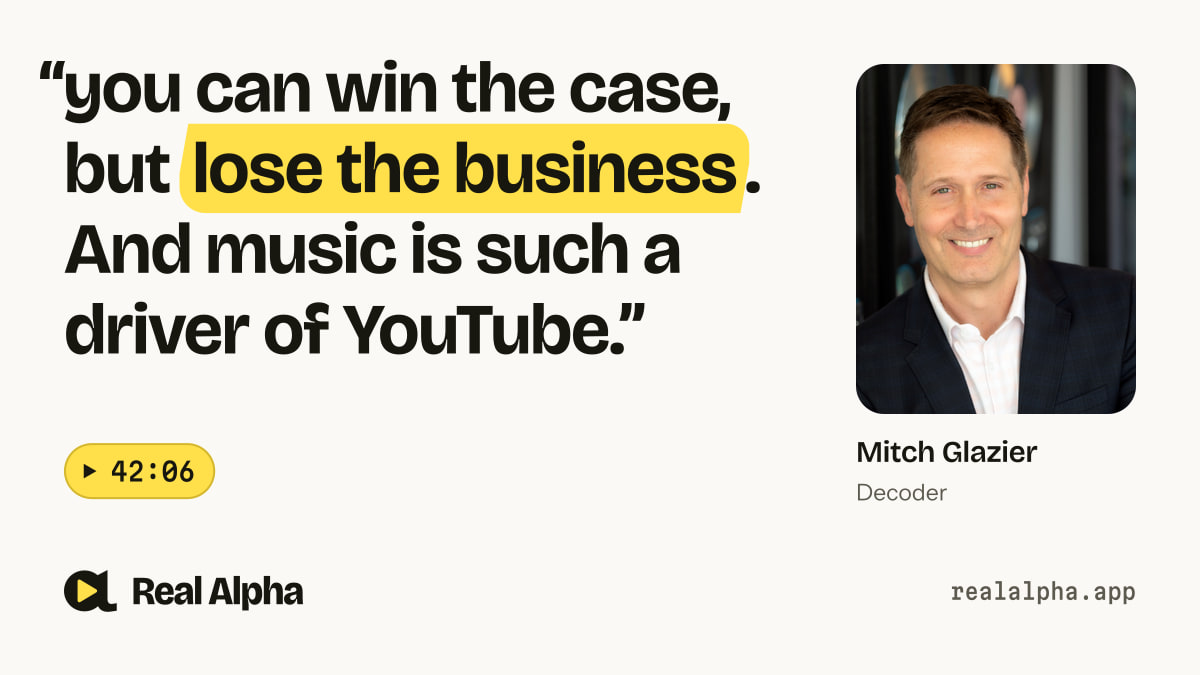
“you can win the case, but lose the business. And music is such a driver of YouTube.”
 Mitch Glazierat 42:06 · Decoder
Takeaways
- YouTube built Content ID despite winning its case.
- Music licensing can improve the fan experience and business.
- The RIAA says AI training on music requires permission or payment.
About this segment
Mitch Glazier contrasts YouTube’s licensing partnerships with Google’s fair-use arguments for search and AI training. He says a service can win a legal fight but still need licenses to deliver what fans want.

Mitch Glazier is chairman and CEO of the Recording Industry Association of America.
Built legal and policy foundations for digital music streaming and leads the RIAA’s work on generative AI.

Nilay Patel, Host · Editor-in-chief, The Verge
Helped start The Verge in 2011 and has hosted Decoder since 2020.
From “The man who fought Napster is now fighting AI | Decoder”, Nov 9, 2026. Watch the full episode
Thanks. We'll look at and fix what's off.
Transcript
Transcribed by machine (Whisper) from the episode’s audio, so a word may be off here and there.
- 40:02
the initial debates about copyright law music were about player pianos like we've built huge institutions to manage these rights i said i was going to talk about google a lot and the tension inside of google when it comes to this is the next sort of nightmare law school hypothetical for you google has two conceptions of itself youtube describes itself as a licensing regime right There's a lot of content on YouTube.
- 40:26
The creators make it. Google takes a license to it. Whether or not any creator ever gets to negotiate that license is a secondary concern. There's a lot of music on YouTube. And the industry had to fight its way into licenses on YouTube because music is existential for YouTube and the industry knows it has that power. There's a real back and forth. Maybe the only industry that has true negotiating power with YouTube is the music industry.
- 40:51
And you can see this play out over and over and over again. On the other side of the house, Google search, it's a huge business, is they will describe it to you as a fair use regime, right? We're going to ingest all the photos in the world and let you search them. And that's fair use. And we're going to litigate our way through that. We're going to ingest all the books in the world for Google Books.
- 41:09
And that's fair use. And we're going to litigate that. And they have done that over and over and over again. You can go work with the people at YouTube. They're very reasonable. Neil Mohan is a smart guy. He understands that he needs music on that platform to survive. And he will build you the tools that you're asking for. And he has. And then the people running Google are like, we're just going to eat everything.
- 41:27
And training an AI model is fair use. And just in that one company, they are totally at odds with each other. They're going to kill each other somehow. How do you make sense of that? What's so fascinating to me about YouTube is that it is the first real lesson in the arc of sort of the DMCA, where I think a technology-based company realized that even if you win the fight on intellectual property rights, if you don't have partnership through a license in the actual market where fans are, you're not going to have the service that fans really want.
- 42:06
And so it was the first time that, you know, we... It took, everybody realized that, you know, you can win the case, but lose the business. And music is such a driver of YouTube. And I think this applies to sort of AI too, that having a pristine, having pristine copies, right, that fans really want, and then having marketing partnerships and partnerships with people who invest with and partner with creators who have a better sense of how to create the bond between that particular artist that they've been living with and sort of building a brand around and understand versus like sitting in a cubicle in a tech company and like trying to decide how to connect the fan with the artist in the best way like that former piece is irreplaceable and i think youtube realized that and developed content id even though they technically won in
- 43:05
court right and didn't have to so to speak and now it's so ingrained the partnership is so ingrained that there's a there's a dependency or a co-dependency and and that's how it's supposed to work it also works because of this concept in copyright law called substitution right like if what you're creating substitutes for something else it's probably not fair use that's what we're arguing in our case against Suno. You're basically creating music that is competing on the same platform right next to human-made music. And you can click on either one and you're paying the same subscription fee. And so you're affecting the economic pool and you're effectively substituting in the marketplace. This is the fourth factor of the fair use. This is the fourth factor of fair use, which, yeah, which courts say is the most important, which is, are you affecting the
- 43:57
potential market for the underlying work. And, you know, if you are, that's sort of problem number one. Google, in their case, unlike the YouTube case under the DMCA, Google, in their case that they won in the Supreme Court, was about creating an index. And the idea is if you click on it, it could lead you to the work that you might then buy. So instead of substituting for the work, The search result doesn't substitute for the work, but it could lead you to the work, which at the end of the day may not have the same economic consequence.
- 44:32
It could even have a positive economic consequence. At least they would argue that. So there's this weird thing like Google won its case and YouTube won its case. But YouTube formed a partnership despite it because it needed to do so because that's the best fan experience. And Google didn't because it wasn't as related to the fan experience. The fan experience was potentially pointed to by their activity.
- 44:54
So that's my weird, like, law school take on the two cases. If you're running Google, if you're in charge of Google Gemini, you need all of the data in the world. Yes. Right? Like, that is just how it works. To make the models better and to win against OpenAI, you need more data. And all of those companies just took it. I do not think Google came to you and said, can we license all the music in your database?
- 45:19
Even though we already have a license on YouTube. In fact, they just scraped YouTube. I don't think creators have woken up to the fact that they've given a lot of economic value to Google and its models. The other AI companies also scraped YouTube, and Google can't yell at them because then they will have to reveal that they scraped YouTube, and this is about as tense a fight in the AI industry as there is.
- 45:41
Yes. You're going to come to Google at some point, and you're going to say, no, you got to pay us for that training, right? I know you're suing Suno, but that feels like a little test balloon for the people with the real money. At some point, they're going to say, no, this training was fair use, right? We're watching this dynamic play out in dozens of these cases across the industry. How do you make sense of that, right?
- 46:04
Where you're going to say, you're going to kill us if the AI models flood YouTube. with fake music, you're actually going to kill the supply of the data that you need. So there's the legal side and the business side. On the legal side, obviously, we're bringing this case as a precedent-setting case to show that it is not fair use to train on music. Whatever exemption you want to think of, it's hard for us to imagine how it applies, right? I don't think national security is at risk because you have to copy Drake. I just don't think that there's- What did we play in, like, the war in Panama?
- 46:40
We, like, played Metallica at them at full volume. Right, right. Now, right, maybe it'll be used for, like, you know, for soft power or, you know, propaganda blasted on the screen. The Clash was very upset when Rock the Casbah was the soundtrack. I'm just letting you know. I bet. Going back to securing the rights, we're bringing this case to make sure that the rights are secured. so then every company knows that you are not allowed to make reproductions of other people's music without consent or compensation. That's basically what we're trying to establish.
- 47:13
And then once you secure the right, you let the marketplace develop from there. And I'm sure that the good people at Google and at other companies understand the risks.