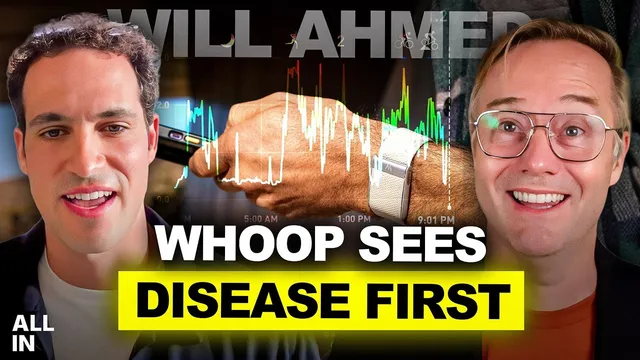
Full episode · 51 min
Daniel Ek: Life After Spotify, Broken Healthcare Incentives, Catching Disease Early & AI's Potential
Daniel Ek argues that better longitudinal health data can move care from reactive treatment toward prevention.
 All-In · Jason Calacanis & David Friedberg
- Daniel Ek is a Spotify cofounder and executive chairman; Neko Health cofounder.
The best minutes
- 1:58Spotify secured label deals by guaranteeing their near-term budgets4 min
- 27:22Short insurer tenures discourage investment in preventionPro pick 4 min
- 19:37Longitudinal scans can track changes across hundreds of moles3 min
Also worth watching
- 39:24Ek sees compute as one signal of AI capability3 min
- 17:30Neko detects serious undiagnosed conditions in about 1% of members2 min
- 47:31Stardoll cut page loads from four minutes to under a second2 min
- 44:26Spotify supports open podcast feeds alongside platform features2 min
Skip the opening Spotify setup outside the label-deal story, the extended Neko service walkthrough, and most of the AI policy discussion.
Summary · 4 min read
Ek cofounded Spotify in 2006 at age 23 and led it for two decades before becoming executive chairman. He also cofounded Neko Health in 2018, a company that combines diagnostic scans, blood tests and clinician reviews.
Ek argues that Neko Health can help shift healthcare from reactive treatment to prevention by collecting better health data over time and pairing diagnostics with clinicians. He describes Neko’s $499 scan and says about 1% of its members have a serious undiagnosed condition that the company discovers; he also says its unit economics are positive. He says U.S. healthcare incentives can discourage preventive investments whose benefits may take 10 to 20 years to appear. On AI, Ek has no firm position on pacing development, supports open and closed models coexisting, and wants the industry to better explain AI’s potential benefits.
A Pro write-up, open to you here. Try Pro free for 7 days
A Pro write-up. The rest of the summary and the minute by minute are in Real Alpha Pro; the episode, its moments and the transcript stay free.
Read it with Pro, 7 days freeMinute by minute
- 1:58Spotify turned piracy into a licensing opportunity
Ek says he and cofounder Martin started Spotify in 2006, when piracy was widespread and Sweden had fast broadband but no iTunes. They offered record labels a guarantee that they would meet next year’s budget and preserve bonuses, with the option to shut down after a year if the service failed. Spotify launched in late 2008, then expanded to the UK and the U.S. in 2011.
- 6:07Neko follows the Spotify playbook
Ek says Neko began in 2018, spent five years developing and testing its product in Sweden, and then expanded to the UK and the U.S. He recalls discussing healthcare as early as 2012 or 2013 and says he prefers building companies to investing in them.
- 10:18Prevention depends on better data
Ek argues that healthcare spending is rising while outcomes worsen, and that chronic diseases are often preventable or easier to treat when found early. He says Neko’s approach is to gather more data across different diagnostic methods and over time, then use AI to help identify risks earlier.
- 15:13Neko packages diagnostics into an hour
Ek describes Neko’s $499 visit as a vertically integrated, roughly one-hour checkup. It measures 53 blood markers, takes over 6,000 high-resolution images of the skin, checks heart and blood circulation, and includes time with a clinician to review results.
- 17:47Repeated scans can catch change
Ek says Neko has completed more than 100,000 scans and finds a serious, previously undiagnosed medical condition in around 1% of its members. He says the average member has 950 moles, which Neko’s AI flags for clinician review; repeat scans can help track changes that a doctor may not remember from year to year.
- 22:12Ek recommends annual health checks
Ek recommends members get a scan annually, comparing the habit to visiting a dentist each year, and says $499 can be a worthwhile investment for people who can afford it. He says Neko’s vertically integrated model gives it positive unit economics and that some clinics are already profitable.
- 27:22US incentives favor acute treatment
Ek says healthcare systems were built around treating infectious disease and are still oriented toward acute care. He argues that employer-linked insurance and job changes can make it difficult for insurers to justify preventive investments when benefits may take 10 or 20 years to appear.
- 31:35Neko is building longitudinal evidence
Ek says Neko is not yet ready to draw population-level conclusions from its data, but it has completed four clinical trials, has two underway and plans four more. He argues that 10x or 100x more health data could yield broader insights, and says Neko accepts data imported through Apple Health.
- 36:01Ek wants more AI benefits in view
Ek says he has no firm view on whether AI development should be paced, but believes people can still steer its effects. He points to personalized music and tracking skin changes as useful applications, and says the tech industry has not done enough to explain AI’s potential benefits.
- 39:24Ek backs open models alongside closed ones
Ek says open and closed models will coexist, as other technology platforms have. He says Spotify uses frontier models as well as fine-tuned ones, which can help with cost, efficiency or customization. He also suggests compute could be one factor in assessing AI risk.
- 44:26Spotify supports open podcast standards
Ek says Spotify supports open podcast standards alongside platform-specific features. Spotify’s tools distribute podcasts to other platforms through open standards, while its own platform has features such as comments. He says he will take requests for live and donation features to the team.
- 47:31Stardoll's page loads fell below a second
Before Spotify, Ek helped rebuild Stardoll, which grew out of Paper Doll Heaven in Turku, Finland. He says pages initially took about four minutes to load; after he reworked the site’s architecture and hired a new technical team, they loaded in under a second and traffic grew. Sequoia then invested.
- 49:57Neko plans US expansion beyond New York
Ek says Neko’s first U.S. location is at 300 Lafayette in New York, with further New York expansion, Miami and Washington, D.C. planned. He says the company aims to expand across the U.S. over the coming 12 to 24 months.
Published Sep 28, 2026.
Transcript · 39 min read
All-In, hosted by Jason Calacanis and David Friedberg, with Daniel Ek.
Transcribed by machine (Whisper) from the episode’s audio, so a word may be off here and there.
All right, everybody, welcome back to the All-In Interview Show, where we, the All-In Podcasts, dedicate an hour to just some of the great thinkers, creators of our time. And today will be no different. Daniel Eck is with us. You know him, the co-founder of Spotify, which he started 20 years ago, and he ran it for those two decades to an extraordinary state of affairs today, well over 700 million active users, over 300 million premium subscribers. But on January 1st this year, he shifted and became the executive chairman with me and David Friedberg today. Daniel Leck, how are you, sir? Welcome to the program. Well, thank you so much for having me. It's good to be on.
Yeah, it's good to see you. We've known each other for 20 years. I remember the first Shack, your partner, leaned into me at an internet summit or something and said, hey, check this out. And he showed me Spotify. But this was at a time when nobody had a subscription service. So we're going to talk today about your new startup, which is incredible in the healthcare space. But take us back to the launch of Spotify and how that crazy idea got started. And then how hard it was to break through with the music industry, which are also known as the hardest partners in the world. As your wealth grows, have you noticed how much more complex things get between investments, tax strategy, and estate planning?
Managing it all is a full-time job that you didn't ask for. Creative Planning can help. Their coordinated team of investment managers, CPAs, and affiliated estate attorneys can do much of the heavy lifting so you don't have to. Creative planning, where wealth works together. Go to creativeplanning.com slash all in.
Read the whole transcript
“And we said to the record labels, what if we would guarantee you that basically you'd keep your bonus for the next year and you'll make your budget for next year?”
Five years in the laboratory just to get to the U.S. market is quite a journey.
That's a lot of pain and suffering. Yeah, but you know, the crazy thing is I'm on the same journey now again. Yeah, here we are. Neko actually, as crazy as it is, we started the company eight years ago in 2018. And we started it in Sweden in 2023. So it took us five years to develop the product, try it out in Sweden. And then once we've proven it in Sweden, we took it to the UK and did it there. And then from there on, now we're launching in the US. So it's an exact Spotify playbook again, but this time in healthcare. One of the afflictions of great entrepreneurs is you're entrepreneurial, right?
I mean, you just can't stop. Or maybe I just have a high pain tolerance. I'm not sure which one. Yeah, once things got smooth, you had to get back into it. But at what point did you start thinking about doing other things, Daniel? Were you actively angel investing at Spotify over the years as CEO? The business is building hundreds of millions of users, public, successful. Things are growing nicely. You've got a great leadership team. And we've obviously met a lot of your team over the years. How did you start to do these other projects? I know you've got a few others and focus on Neko. Yeah, it's kind of crazy.
I'd forgotten about it, but my team now showed me very recently, like I apparently did this launch with the FT interview in, I think, 2012 or 2013 or something, just after the US launch of Spotify, where I was talking about healthcare already back then. So I've been thinking about health care specifically for a very, very long time. And it's just been, you know, I think a lot of people just talk about sort of all the stuff that's going bad in the world. But my view is that actually most things. are going pretty well. And it's kind of up and to the right on the technology curve and all the things that we're getting. But I try to focus on the problems that aren't going that well.
You know, one of those happens to be healthcare. So I've been kind of interested about this as like, you know, how is it that we're spending more and more money on healthcare, but getting worse and worse outcomes? And what can we do about it? And so that really kind of got me into the space, I think healthcare is kind of unique and kind of special. I honestly didn't have any money until Spotify went public. So I wasn't a prolific angel investor. What year was that? That was 2018. We went public. 2018, right. Yeah. Yeah. So I probably started doing a little bit of investing in 2018, but I had no money before then.
So, you know, it was literally just kind of all in focus on Spotify for, I guess, you know, the better part of 12, 13 years before I made any investing in anything else. And then, you know, you and I, we were talking about it at this dinner like a week ago or something. But, you know, I then tried to do a little bit of investing. I'd actually already started Neko at that time. and I kind of just realized that I loved building way more than I loved investing. And so right now- Freebird came to the same conclusion. It's so painful to watch companies you invest in. This was our whole dinner conversation the other night.
Yeah, get mismanaged and you can't do it. Well, you spend time on boards. That's why I don't join boards anymore. You're sitting on a board, you advise a CEO and they don't listen to you and you pull your hair out. Like I would have done something different. Why didn't you do this? And if they are listening to you and you're effectively instructing them on what to do, it also doesn't work because they're not leading. And so I became pretty committed to this idea. Like you find amazing entrepreneur, founder, CEOs, give them money and never look at it again and you'll be fine, generally better than not.
And then the flip side is, if that's really what you're passionate about and you have the activity or the agency, it's to step in and do it yourself. Yeah, the more instruction they need, probably the less chance they're going to succeed. Yeah. So Daniel, maybe you could just give us the overview on Neko, kind of what the- Yeah, and how you came to that idea, right? Yeah. How did you come to this specific idea? I started researching the space a very, very long time ago. And maybe just as a quick primer for the audience, the US is spending 18% of its GDP on healthcare. It's the single largest line item in the budgets right now. And if you take heart disease alone, it's in the hundreds of billions of dollars that are being spent on that disease group alone in the US alone. I mean, it's just insane. It's larger than fortune 10 companies revenues, just one disease group. So it's a gigantic problem, as I mentioned. And so I started looking into everything from like, you know drugs to um you know can you make more efficient drugs is it about cancers and and basically started like targeting like what are the the real reasons why it looks that way and i think that the the real conclusion ended up being there's lots of reasons not one
um you know we see um but we see a few really big ones um cardiology or cardi heart health is a major one. We see skin cancer, melanomas being another big one. So there's a few sort of major groups of illnesses that is over representative. But the major one is really chronic disease overall. And the crazy thing about chronic disease when you read about it is that if you discover these things early, they're totally preventable. And the cost of dealing with them is very small and is suffering for the person, um, you know, uh, uh, that are having it in their family and community is very small too. So the key thing is if you discover things early, you're actually good. And so then the question is, well, why don't we discover things early? And it happens to be that we don't have enough data. So everyone in the entire healthcare industry is in agreement that we have to take healthcare from reactive to preventative health. But then now all the disagreement starts, which is how do you do that. And our view, my co-founder Yelmer and I, our view is really that it all starts with having better data. If you have better data, you're going to be able to discover things much more easily. And that in itself then leads you to have a chance of discovering those things
much earlier, which then creates this virtual flywheel of then changing healthcare. So predictive data that allows you to be predictive about future adverse health outcomes and course correct ahead of time. Yeah, that's the holy grail is to get to that point. And essentially, our view is that the way you get there is that you need a lot more data than you have today, both from each modality that you gather data, but also across multiple modalities, and you need it longitudinally. So you need it over time. So if you had a lot more data and you had it over time, you'd be able to have a lot higher likelihood of doing those kind of predictive analysis.
And then what we then said is, well, okay, how do we do that? And it so happened to be that if you think about really what's happened in the last 20 years, one of the biggest innovations, of course, is the smartphones. And we've had more and more sensors packed into those smartphones. So there's more and more sheep sensors and sheep electronics that's available to us. So our view was like, okay, well, we should be able to utilize this to build a lot more sensors than what's been able to be built before. And then the other thing, you know, we started pre the LLMs and everything like that, but it was then called machine learning.
But today we talk about it as AI. We should have a lot better intelligence. So if we have all these massive data sets, we should be able to make really good predictions about it. And obviously, again, similar to that, this is exactly what we learned with Spotify too. The more data we're able to gather, the better predictions we're able to give you about what song to play next. And so this is exactly the same thing that you now need to do in healthcare, but obviously it's across multiple modalities and now across longitudinal data sets as well. Is there evidence today that some of this early observational data can affect ultimate health outcomes?
I mean, I can see this working for metabolic conditions, things related like exercise depletion rates and blood sugar and sleep. But ultimately, the correction there is typically diet exercise. What are some other examples of major diseases that we can kind of identify ahead of the curve, course correct? And maybe just explaining what NICO is for people who don't know. Yeah, yeah. Maybe I'll start there and then we can get into it. So in a very simple way, the experience of NECO today and in Gen 2 is it's $499. It is a reinvented healthcare experience from the ground up, vertically integrated.
We do everything from building our own facilities to having our own nurses and doctors on staff to building our own diagnostic equipment and doing everything on our own on the software side. so it's it's it's really kind of an end-to-end solution that we've designed from the grad help and we designed it with the goal of creating the most valuable hour you can invest in your health that's the mission that we have and that's where we're coming to work to do you know every day of the the the every day, really at work, the experience is really you come in, the first thing you typically tend to do is that you draw blood from us. So we then measure 53 blood markers, you then go through our skin rig, where we have a camera system that takes over 6000 super high res images across your body, where we index every mole and lesion and and all of the possible rashes and rednesses you may have as well.
That gets indexed. We then look into your heart and blood circulation. We look at grip strength, all those sort of traditional markers that we have very good scientific evidence are a valuable indicator as you think about sort of health. Then at the end of this visit, that lasts for about an hour, you get uninterrupted time with a clinician. and you go through all of the results, including the blood works during that hour. So you have a complete set where you can go through your values within that hour with your doctor and the doctor will answer any questions you may have, but you will also with that clinician sit down and go through results about things you may even want to improve as well when it comes to your health.
So that's the experience that we're launching with today in New York, in the US. And obviously, we'll launch in many more places across the United States over the next coming months.
“around 1% of our members have a serious underlying medical situation that is undiagnosed that we discover.”
“The average person at NECO today has 950 moles. It's pretty crazy.”
And are you actively running it as CEO, Daniel, or are you operating part-time? Yeah. No. So similar to Spotify these days, where I have two great CEOs, I have an amazing co-founder and partner, Yalmer, who's really the brainchild of Neko. And he's the one who's doing most of the work, even though I'm sitting here and taking most of the credits at this point.
But yeah, he's the real brain. You know what I'm struck by? The cost of this is so cheap, $499. You also have Function Health and Superpower, two other great services, about 350, 400. They just do blood work. But if we look at the spending, right now, it's healthcare number two, social security number one, and fast, your favorite coming up is the interest payments framework will overtake our healthcare spend. You could actually have folks come to this every year or every other year for four or every American, four or 8% of the cost of the total we spend on healthcare. And I'm curious, is this something you expect people to do yearly or something every other year? And what impact do you think an investment of every American getting this done every year or every other year, or maybe every three years even, which would be down to 2% of our budget, what impact would that have on the forward-looking budget and the forward-looking spend? And have you done those kind of calculations?
Yeah, I mean, look, we obviously have a view, but I think it's too early to say it. So I don't want to sit here and say that we know conclusively what will happen. But I think that what we do recommend our members is to try to do this on an annual basis. And the way I kind of make this analogy is most of us today are trying to go to a dentist on a yearly basis. for some reason. reason we don't do an annual health checkup, most of us on an annual basis. So for me, this should be as regular as going to the dentist or doing anything else like, and it should be an amazing experience. This should be, you know, again, as I said, what we're really doing as a mission here is trying to create the most valuable hour you can invest in your health. And, you know, we know a lot of people are busy. So we want to be brutally efficient with people's time. So you can actually, if you don't have any questions, and you're just interested in really doing the test results, you can probably get by in 30, 40 minutes and do it. So we're not talking about a lot of time to do that. And obviously, $500 is still a lot of money for people. But I do think it's a great investment if you can afford it to do.
Starting a business usually means juggling a bunch of different services just to look legit. Not anymore. With Northwest Registered Agent, you get a complete business identity all in one place. A business address, domain, website, phone number, and more. With privacy protection built in from day one, don't spend hundreds or thousands on services you can get from Northwest for free. Visit northwestregisteredagent.com slash all in free and start using free resources to build your business today. That $500, you lose money on every visit or break even, and then there's some profit that comes from maybe the upsells. Take us through the economic model here and then how that will work with the insurance industrial complex as dysfunctional as it is here in America.
Yeah. Well, so the benefit of being vertically integrated is that we've been able to build you know, everything ourselves, which means we can also cut costs in a pretty dramatic way. So within that $500 a year, we are, the unit economics are positive. And we have clinics today that are profitable that we're operating already today. So, so we think this is a good price point to enter in because it's a great value for people. But because we do all the things ourselves, we're able to still make this economically viable for us to create a great business and to be able to grow and invest in that business so that we can spread it to more places as well. So Daniel, are you focused exclusively on this project? You have other stuff you're working on? I'm not exclusively focused on it, but it's obviously one of the things that are taking a lot of my time and rightfully so. It's one of the biggest problems in the world um but i'm still spending time with spotify i'm exec share um there uh so that's still you know my baby uh even though i'm not um involved in an everyday basis and we have a few other companies um with prima materia which is a company i i created together with shack that mentioned earlier uh where we're trying to really do um you know what i mentioned before which is
Like, how do we how do we pay it forward and kind of almost be like the greatest co-founder you could possibly find? That's that's what the ambition of Prima Materia. The health care thing really perplexes me.
“because normally your health care is tied to your employment in one shape or form, and because the average tenure of your employment is not that very long”
And so this is one of the few healthcare companies that are, it's not global, but at least multi-country systems straight away. So that's also super interesting. Like what are we finding in the UK that may or may be similar or dissimilar to the US?
That's going to be super fascinating. Well, what did you find between Stockholm and the UK? I mean, I can take some guesses, but I'm guessing people in Sweden were much more fit. In the UK, you probably had more cardiovascular disease and diabetes. Yeah, and those are the two, I believe, you tell me if I'm right. Friedberg. Aren't those like the two biggest spends in terms of healthcare spending? I think diabetes is number one, I could be wrong, but cardiovascular diabetes seems to be the big two. So what did you learn between the two populations? Well, I mean, it's really early and it's still on relatively small base. It's 100,000 scans, as I mentioned before. But I don't know that I think we're ready to speak about sort of population level health outcomes. But as we grow in NECO, I think we will. And that's going to be super cool. And then, you know, we're already today doing lots of clinical trials. We've done four already. We have two underway. We have another four we're going. So we're partnering with the research community as well, deeply around these data sets that we already have today and that we will gather more on tomorrow too. And I think my point with all of this is really just
to say, look, we actually, it's for people in tech, the amount of data that exists in the healthcare system is actually not as, the data sets are not that large. That's the crazy part. And so, you know, I think it's a pretty safe set that if we can 10x or 100x the amount of data that becomes available, we're going to be able to draw super interesting conclusions about that, not just Netco, but the whole healthcare system. That's really the bet we're making. Putting the wearables in there is going to be really interesting with the Auras, the Whoops, the Fitbits, Apple Watches, you start correlating that data with the blood work.
I noticed Whoop offering labs now through Quest, and I don't think, maybe you can sync your Aura Whoop with some of those, but I've never seen any data. We have sleep, we have recovery, we have heart rate, but I don't think anybody's put the blood work together with that. and then your system i mean this could really change everything in terms of health care if we can correlate that maybe you could speak to the impact you think wearables are going to have and do you think you partner with them or you just have a a necco wearable you eventually just make part of this subscription at 995 because it does seem like there's these are commodified for the basic 80 of it i'm sure yeah so what are your thoughts there well already today we we do allow you to import your apple health data so if you do have uh wearable data we will take that um so anyone who um and a lot of the big uh or uh whoop etc do um allow you to write a lot of that to apple health as well that's just one one sort of example of that so yeah we will we would love to have of course more data um because that enables us to again when the clinician sits down with you to be able to give you a much more 360 perspective about your current health status.
So that's one of the things that we encourage. But I do want to say also that I think that this is just like the service that we're launching today, it is very rare in itself that, you know, when you create a diagnostic product, the normal way of doing that in this space is you create a dead, spend X amount of years doing R&D for that thing. then you literally spend the next 10 years selling exactly that thing. And with Neko, within this three-year when we launched and now launching in the US, we're on Gen 2. So we've already upgraded our diagnostic infrastructure. And so I think what you should expect with Neko is that we're launching with one thing today, but we're going to keep adding more and more and more value.
And we're going to keep adding more and more valuable diagnostics that we can find and we can put in at the price point. You know, so that's kind of the goal. So this is just the beginning. And the goal is obviously to make this even more valuable so that we can deliver. We're against our mission of having the most valuable hour you can spend on your health. Daniel, do you want to take a step back and talk about what's going on broadly in the tech industry right now and AI? You know, what's your view on pacing the frontier? I want to hear these questions. Yes. Do we need to pace the frontier? I'm struck by the fact that if we kind of look at the world, and certainly over the last few years, I kind of always say, you know, we're walking into COVID and every one of us became a virologist.
We were all of a sudden supply chain experts after the first, you know, oil tanker in the Hormuz Strait got stuck somewhere, you know. And then with Ukraine war broken out, we were all military experts and military strategies. Are you talking about the All-In podcast right now? You know, I'm just talking. It's actually the, we renamed it the All-In Laboratory Pod. It's the All-In lab because we are just, we're just a lab. we need to be regulated because our opinions are so dangerous that maybe Spotify's podcasting could regulate us because our opinions are crazy. Yeah. My point is just like everyone expresses these things with such extreme confidence. And it turns out most of the time we ended up being completely wrong, even the biggest experts. I'm not sure I have much value to add, except to say that I believe that we're still in the innings where we can alter the impact for how to use these technologies. And my view is that every great technology has extreme positives and extreme negatives and is really up to us now to steer this towards the outcome that we want. I think it's great that the debates are being had, but honestly, I have no sort of strong opinion one way or the other if we should pace it or if we should not. I just know that if I look at healthcare and
I look at what we're doing at Spotify, like it is truly amazing. I mean, the perfect music product is one that, you know, I've described this many times and I think we're getting closer to it now, which is awesome is right now, you know, you can put together a better playlist yourself than what the system could do. But I think in the future, downrightly, we can soundtrack every moment of your life in an amazing way where you just feel more. Like the power of great music is that you will feel more. If you're happy, you'll feel happier. If you're wallowing and feeling sad, you'll feel even more wallowing and sad in that moment.
And that's thanks to AI. And then if I look at, you know, the example we talked about with dermatology, like, you know, 950 moles, being able to track them over time, keeping you safe, like, these are positive, amazing examples with AI. And yet we talk about this thing as, we tend to amplify that, but I want to see more positive examples of AI. I think we as an industry have done a terrible disservice of not talking about all the really, really crazy positive stuff that we can use AI for that actually greatly benefits everyone.
“if I'm using a hundred thousand GPUs for something, that's probably going to be a lot more powerful than if I'm running an open source model on my home PC.”
Right. Assuming model equivalency, compute as a key metric of defensibility, and that's really where we can start to build guardrails around who can have access to the most compute and how do you get certified for compute as opposed to certified for software.
Wasn't that the original, like two years ago, one of the original concepts of limiting this was how many teraflops or how many GPUs you had? Well, what they did, that was how they wrote the regulatory laws around regulating models. Right. So they basically set a model that was trained on X number of teraflops. And it was like, this was like a California. As if this is static. California's genius assembly got together and said, we figured it out. We know how to classify, you know, scary models and bad models. How many Ethernet cables are in your data center as a proxy for how far it was. How many watts of power went into making this model?
But I do think your point of compute as a roadblock is probably a good one. This is what it used to be. You remember when Cray supercomputers came out and there was a limited access and they were considered like a security risk and you had to get approved in order to get access to a Cray supercomputer because you could use them to design nuclear weapons and you could use them to crack codes. All the things that people are worried about. Yeah, today a Cray supercomputer, I think, is less power than a washing machine or something, some product we probably have in our kitchen. It is a really great point, actually, Daniel, because if you've got strong compute installed as a defense capability, assuming model equivalency, you're going to be hugely advantaged.
I haven't seen it in the debate, at least, and I'm surprised, but maybe it's something I'm missing. Hey, before we let you go, I guess two questions for you. Take them whichever order you want.
“we also, through our platform, aggregate and distribute podcasts onto a lot of the other podcasting platforms.”
So Spotify's approach has been, let's support both in tandem. So that's that. Then there's two features I just wanted to make sure I ask you about. There's one for going live.
So this is part of the new standard. so having that on our page uh so when we go live it actually respects the rss feed and sends that note out and then there's another one called value and donations where the person who has like you know if they happen to be doing donations on whatever platform or they do them through paypal those two the like podcast ogs in the underground really want spotify to support so i'm just doing my job and representing as a 17 year podcaster please add those two or support those two, if you think it's worthy of doing. All right. Well, it's no longer my decision alone, I should say, but I will certainly bring- I'm going right to the chairman while I got him on the line. Yeah, of course. Of course. But yeah, I'll definitely bring the feature request to the team. Tell us about Stardoll while you wrap up here. What did you learn there when you
“the average page load time at that time was like four minutes.”
daniel continued success if people want to try neko n-e-k-o where can they go so we are launched the first one at 300 Lafayette. So go sign up on necohealth.com waitlist, and we'll try to get to you as soon as possible. And this is in New York, 300 Lafayette Street.
So only in New York so far, but we're expanding quickly both the number of venues we have in New York. We're launching in Florida as well, in Miami, and we're launching in DC. And we're going to try to launch all over the U.S. in the coming 12 to 24 months. Yeah, it's great. Right on Houston Street. Let's say back in the day when Sudo had their big studios, they were right around the corner from you. Wow, talk about memory lane. All right, continued success. Everybody go to NicoHealth.com and sign up for the waitlist. I'll see you next time. Bye-bye. I'm going all in