Free with a sign-in.
The best 12 min of 44
Jensen Huang Signals Nvidia Return, OpenAI’s Goodfire Deal and the AI Chip Race
Foundry Robotics CEO Adarsh Kulkarni argues that purpose-built work cells can suit new factories better than humanoid robots.
 The Information's TITV · Akash Pasricha
The best minutes
- 15:57Inference startups are buying GPUs to secure scarce computePro pick 7 min
- 33:10Model monitoring may need to move inside the model3 min
- 40:40Purpose-built factory robots can beat humanoids in new facilities3 min
Every moment plays free. PRO marks a write-up that's in Pro.
Also worth watching
- 4:29A 15% shareholder bloc can call an Nvidia special meeting4 min
- 12:21Alternative chip software is improving, but supply still matters4 min
- 30:32A car-and-cat neuron may detect a shared shape3 min
Skip the opening housekeeping and the mechanistic-interpretability primer before the Goodfire neuron example.
Full analysis · 6 min read
Real Alpha · Nov 20
Catherine Perloff says TensorWave staff time fell 80 to 90 percent
- TensorWave staff time helping customers get AMD models running fell 80 to 90 percent in the past year or so.
- That measures one provider’s support effort, not the full cost or availability of alternatives.
- Inference firms still face scarce cloud compute, capital demands, and supplier competition.
Free with an account
Read the rest of the analysis
6 sections, the 3 other voices it tests Piers against, and what it means for you. Every episode we cut gets one.
Check your inbox
We sent a link to your address. Click it to finish signing up. Not there in a minute? Look in spam.
or
Signed up before? The same buttons sign you in. The episode, its moments and the transcript stay free.
TensorWave’s support time fell, but the measure stays narrow
Perloff said TensorWave staff time spent helping customers get models running on AMD chips fell 80 to 90 percent. That was in the past year or so, as the software became more user-friendly.
That is a striking operational change, but its scope is narrow. The figure measures TensorWave’s staff assistance, not the full time customers need to switch.
For example, Perloff said AMD chips can be cheaper and offer more memory, which can suit some inference tasks. Those are reasons to test alternatives, not proof that switching is frictionless.
Support time can fall while teams still face compatibility work, supply limits, or performance tradeoffs. The episode gives no baseline hours, so buyers cannot tell how many engineering days the percentage represents.
Still, the result suggests the cost of evaluating AMD may be falling. Compute teams have reason to repeat the test against their own workloads.
Our read
The reported change is useful evidence of improving usability at one provider, not proof of an industry-wide AMD shift. Buyers should compare total workload economics, not treat setup support as the whole cost.
Compute scarcity is pushing inference firms toward ownership
Inference startups traditionally rented cloud compute, then resold access alongside software. Perloff said some are now shifting toward owning chips to secure capacity.
They are not necessarily building data centers, but some have taken a more hands-on role. The change puts infrastructure access, rather than software alone, at the center of their operating plans.
Scarcity is not the only pressure. Some cloud providers are reluctant to supply companies that may compete with their own services.
For example, Perloff said CoreWeave was reluctant to keep selling compute to Base10 while CoreWeave built its own inference business. A provider may choose to use scarce GPUs for its service instead.
On TBPN on November 12, 2026, SemiAnalysis founder Dylan Patel asked how inference clouds secure compute. He asked how they could do so without credit, financing, or a backstop.
Patel’s question was about financing access, not a finding that these startups are overextended. Our reading is that hardware purchases bring that funding question closer to operating decisions.
The episode gives no purchase costs, financing terms, utilization rates, or returns. So the reported move shows the pressure to secure supply, not whether owning chips pays.
“buying their own GPUs”

Our read
Ownership is a response to unreliable access, but it also changes the kind of business these startups must run. The episode explains the pressure, not the economics of the purchases.
Cloud providers ration capacity for different reasons
Perloff described different reasons cloud providers may limit sales, which should not be collapsed into one story about rivals blocking startups. CoreWeave’s concern was direct competition from its own inference business.
She also said DigitalOcean preferred selling compute to software companies over resellers. Perloff added that DigitalOcean did not call inference companies resellers.
So that preference cannot be presented as a judgment about inference startups specifically. It does show how a provider may prioritize customers it sees as adding software value over customers reselling capacity.
Each constraint creates a different dependency. One is competition from a supplier, while another is the supplier’s allocation rules.
Working with several clouds can soften a single-provider bottleneck, but Perloff raised cybersecurity exposure from doing so. She cited her reporting on a Fireworks hack involving a third-party cloud provider.
More suppliers can extend access, yet they also widen the set of infrastructure partners a company must manage. That makes security and supply planning part of the same operational decision.
Our read
Cloud supply is shaped by both competing services and providers’ customer priorities. Inference firms need to assess those risks separately instead of assuming every cloud constraint has the same cause.
GPU ownership adds control and capital exposure
Perloff said buying hardware suggests infrastructure ownership may matter in this market. She also allowed that some companies could succeed through strong software integrations.
The companies themselves offered opposing accounts. An Iron executive compared inference providers to WeWork, while Modal said its software made it distinctive.
Those are interested parties, not neutral market tests. Hardware ownership can improve access, but the episode does not show how often purchased GPUs will be used or what they cost.
Mike Volpi, a Hanabi Capital general partner, spoke on the a16z Podcast on November 11, 2026. He said tightly coupled GPU clusters favor companies designing the full infrastructure system together.
Volpi’s point concerned coordinated system design, not a blanket instruction for buyers to own chips. He also pointed to fab capacity as a near-term supply constraint.
That distinction matters because GPUs alone are not an entire compute business. Data-center arrangements, networking, software, and workload scheduling also affect useful output.
Still, the episode does not quantify those costs for the inference startups. Without those measures, purchases reveal strategic pressure, not the economics.

Our read
Owning hardware can reduce dependence on cloud allocation while adding capital and operating demands. Buyers need the whole system’s economics before treating ownership as an advantage.
Alternatives improve, but access still shapes chip choice
Perloff said customers were spending more to rent AMD chips, and providers had seen more interest in them this year. She also said Google had begun selling TPUs outside its own cloud on a nascent basis.
One early TPU provider had seen hundreds of millions of dollars in interest, Perloff said. That is an interest figure, not a disclosed revenue result.
Trainium was also being tested more, and developers had found it easier to use. Perloff said its software had improved, including greater compatibility with PyTorch, but it was probably a little behind AMD and TPUs.
But software progress has not made availability interchangeable. Perloff said some customers interested in AMD were told rental access might take longer than Nvidia access.
She attributed Nvidia’s ability to produce more partly to its manufacturing relationship with TSMC. That creates a gap between being technically testable and practically available.
On Odd Lots on November 15, 2026, Bernstein analyst Stacy Rasgon said customers were adding AMD, TPUs, and custom chips. She also described Nvidia’s revenue outlook as strong.
That supports a picture of more options, not automatic displacement. Procurement teams need actual delivery dates and workload results, not chip roadmaps alone.
Our read
Alternatives are becoming easier to test, but practical access remains a separate constraint. Compare supplier availability and workload performance before treating a chip as a usable substitute.
Nvidia’s board uncertainty is not a supply forecast
Perloff said interest in alternatives predated Jensen Huang’s departure. She also said an executive change could not quickly alter Nvidia’s existing supply chain.
She framed customers’ immediate concern around chip availability, not an established loss of Nvidia’s ability to innovate. That keeps the procurement question separate from the boardroom drama.
Martin Peers, The Information’s editor at large, said the board had not explained why Huang left. He raised export scrutiny as a possible concern, but did not establish it as the board’s reason.
Peers said the board should explain its thinking rather than simply reverse course. Until that uncertainty is addressed, the episode offers no basis for treating Huang’s possible return as a supply signal.
Now compute teams can separate observable triggers from narrative. Track rental availability, quoted lead times, and workload performance across suppliers.
For inference firms that own GPUs, add utilization and financing requirements to the same review. Those measures show whether supply control outweighs the added burden in actual operations.
Our read
The episode supports watching Nvidia’s supply chain directly rather than inferring a change from leadership uncertainty. Procurement decisions should follow access, performance, and utilization data.
What it means for you
- Measure support hours. For each alternative chip, record staff time spent getting your models running. Compare that with TensorWave’s reported 80 to 90 percent reduction, while treating it as one provider’s experience.
- Track supply access. Log quoted delivery times, rental availability, and the capacity providers actually allocate. Keep those measures separate from expressions of interest.
- Model ownership costs. Before acquiring GPUs, estimate financing, operating costs, and expected utilization alongside the compute you would otherwise rent. Include the risk that a cloud provider competes for the same customers.
- Test real workloads. Run the same inference workloads across Nvidia and alternatives. Track performance, total cost, and configuration effort as software and capacity change.
What to watch
- Whether inference startups continue acquiring GPUs or return to cloud rentals as capacity changes.
- Whether AMD, Google TPUs, and Trainium become easier to obtain as their software improves.
- Whether Nvidia’s leadership transition changes chip availability, rather than only customer expectations.
Send this to the leaders managing compute budgets and infrastructure strategy.
Watch the nearly four-minute segment on chip alternatives, the TensorWave staff-time figure, and supply.
Written by Real Alpha from the episode's transcript and the other moments it links, then checked against the transcript. Quotes are the speaker's exact words.
Minute by minute
A Pro write-up, open to you here. Try Pro free for 7 days
A Pro write-up. The minute by minute is in Real Alpha Pro; the episode, its moments and the transcript stay free.
Read it with Pro, 7 days free- 2:55The board's reasoning remains unclear
Peers says Huang’s willingness to return is unsurprising, but the board has not explained why it pushed him out. He points to the new committee overseeing exports and reporting about possible chip smuggling to China as reasons export concerns may be involved, while stressing that the board’s rationale is unknown.
- 4:29Shareholders have a path to call a meeting
Peers says Nvidia’s bylaws let investors who have held 15% of the stock between them for more than a year call a special meeting and potentially replace the board. Huang owns 3.6%, and Peers says large institutional investors are unlikely to join such a move. He argues that the board should explain what it can about its decision, not be replaced.
- 9:00Chip alternatives are gaining traction
Perloff says customers are spending more to rent AMD AI chips and sometimes use them instead of Nvidia’s. She says AMD’s lower prices and greater memory can make its chips attractive for inference, while Nvidia remains best in class and can be hard to find. Google has started selling TPUs outside its cloud, and Amazon’s Trainium is also drawing more testing.
- 12:21Chip software is getting easier to use
Perloff says AMD’s software improvements have reduced by 80 to 90 percent the time TensorWave staff spend helping customers configure models for AMD chips. She says Amazon has improved Trainium’s compatibility with PyTorch, while Nvidia’s CUDA still has greater name recognition and more developer resources.
- 14:10Customers still worry about chip supply
Perloff says one inference provider is concerned that Nvidia’s leadership change could affect spending on capacity, but she has not heard customers make a broader shift because of Huang’s departure. Nvidia’s manufacturing relationship with TSMC can help it secure supply, and some customers found AMD chips could take even longer to rent.
- 15:57Inference startups are buying GPUs
Perloff says inference startups have traditionally rented cloud compute and resold it with software, but some are buying GPUs to secure access. Cloud providers may refuse to sell to them when they compete in inference, and hyperscalers are also short on capacity. Together is taking a more hands-on role in data centers, while Fireworks offers AMD chips.
- 20:26Inference and cloud firms contest the moat
Perloff says neoclouds and inference companies each argue that the other is mainly reselling. An Iron executive compared inference providers to WeWork, while Modal argued that its software is differentiated and neoclouds mainly supply chips and data-center space. Perloff says inference startups’ GPU purchases suggest owning infrastructure can matter, though software may still distinguish some firms.
- 25:13Interpretability examines model internals
Drew explains that mechanistic interpretability aims to understand how a model works by examining its internal mechanisms, rather than relying only on its outputs. Models contain numbers rather than human-written code, making it hard to tell which learned patterns those numbers represent. Goodfire has worked on techniques to detect concepts in models and is pursuing a more detailed understanding of their internals.
- 30:32A neuron may link cars and cats
Drew describes a neuron in an older image model that appeared to respond to both cars and cats. Goodfire researcher Nick Camerata suggested the images may share a V shape, offering a possible explanation for the neuron’s responses. Drew says some researchers criticized Camerata’s initial essay for overstating the results; a supplementary paper is under review, and the field has not settled whether the work is a breakthrough.
- 33:10Interpretability offers another monitoring tool
Drew says interpretability could help improve models and investigate unexpected failures. He says chains of thought are becoming less informative and less legible, making it harder to monitor model behavior and investigate security incidents. Goodfire and OpenAI announced a collaboration in which Goodfire will work on site during training runs to look for misalignment or unintended goals; Drew also reports that OpenAI explored an acquisition worth more than $5 billion.
- 37:38Foundry combines robotics and manufacturing
Kulkarni says Foundry builds autonomous factories and works both as a robotics research lab and a manufacturing-as-a-service provider. Its 130,000-square-foot Emeryville facility uses robotic work cells, technicians and small unmanned ground vehicles to move parts. He says the factory can switch between making products such as drones, batteries and satellites.
- 40:40Specialized cells fit new factories
Kulkarni says humanoids can make sense in existing factories designed for people, but are over-engineered for many greenfield factories. Foundry uses bimanual work cells and wheeled robots, which he says can be cheaper and more efficient for specific tasks. He identifies a deployment gap, not hardware, as the main robotics challenge: real-world work produces the data that helps the robots improve.
Published Nov 17, 2026.
Transcript · 35 min read
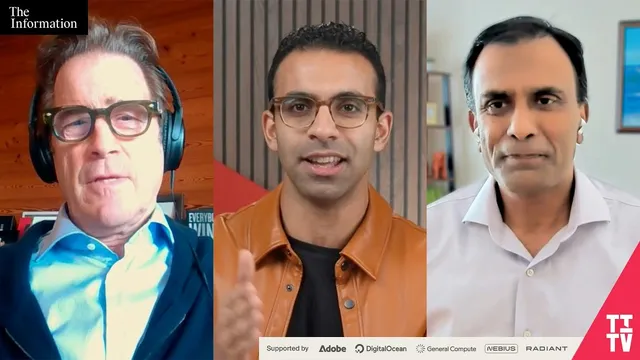
The Information's TITV, hosted by Akash Pasricha, with Martin Piers, Catherine Perloff, Rocket Drew and Adarsh Kulkarni.
Transcribed by machine (Whisper) from the episode’s audio, so a word may be off here and there.
Welcome, everyone, to The Information's TI-TV. My name is Akash Pasricha. It is Tuesday, November 17th. A reminder before we get started, we have our Anthropic IPO Day Live Video Summit on Thursday, starting at 11.30 a.m. Pacific, 2.30 p.m. Eastern. It is available for all subscribers to the information. We're going to talk through the market's reaction in real time as the stock starts trading. We'll talk about what it means for the IPO market, how Anthropics Tech currently stacks up. If you are a subscriber, you can register at theinformation.com slash events. If you are not yet a subscriber, I encourage you to check out our website.
Today on the show, Jensen Huang issued his first statement since stepping down as CEO of NVIDIA, saying he would be honored to return as CEO of the company if the board makes that decision. We're going to unpack that statement. We are also going to talk through our exclusive reporting on the extent to which customers are looking to diversify their chips away from NVIDIA. We also have new reporting on OpenAI's interest in the AI startup Goodfire and the latest craze in AI research, mechanistic interpretability. We're going to break down that term for you. And we are going to close out the show with a conversation with the CEO of Foundry Robotics.
It's going to be a good one, so let's get right on into it. Former NVIDIA CEO Jensen Huang issued a statement this morning saying that he would be open to returning as CEO of the company. I want to bring on Martin Peers, editor-at-large, for the information to break it all down. Martin, welcome back to the show. It's great to have you here. Akash, how are you? I'm good. We got the statement here from Jensen. It is really huge news, isn't it? Jensen did not want to leave. Now tells us he wants to come back. Or he's willing to come back. Well, of course he's willing to come back. He didn't want to leave.
Read the whole transcript
This is a statement of the obvious. All he's trying to do is to, you know, sort of drum up more support for his return. But the problem we have is that we don't know why the board pushed him out last week. And without knowing that, it's very hard to assess whether or not the board will be so stupid as to change its mind so fast and bring him back. Presumably, the board was aware of something that we don't know, or they're more concerned about the export stuff than they have indicated. The fact that they last night announced that they'd formed a new committee to oversee exports indicates that that is an issue.
There's been a huge amount of reporting that NVIDIA might have helped along the smuggling of chips into China. So, you know, you would imagine that is what they are concerned about. And if that's the issue, I don't see how they can bring him back. But as I said, because they never announced why he left in the first place, we just don't know. Right. So look, I mean, you have these loud voices out there. You've got these petitions from Silicon Valley elite. You have people who have stakes in NVIDIA that are leading the charge on some of this. Very small stakes. Small stakes.
“allows a group of investors who have held 15% of the stock between them for more than a year to call a special meeting of investors”
large here at The Information. With all that's happened at NVIDIA, a big question for the company is how long it can keep its clasp on customers. New reporting from my colleagues Catherine Perloff and Ryan Barwick suggests that customers may be looking elsewhere, but this actually began long before Jensen left. I want to bring on Catherine Perloff to share.
more of her reporting. Catherine, welcome back to the show. It's great to have you here. Hey, Akash. Okay, so AMD is widely seen as the closest competitor to NVIDIA. Where is their technology at? I mean, are customers telling you that they are absolutely choosing AMD over NVIDIA? I don't think it's that cut and dry, but I think AMD is definitely getting more customers. People are spending more money on uh renting amd's ai chips um and at times using uh using it instead of NVIDIA um so um some data points here uh we talked to several cloud providers who said that you know who offer amd chips who said that their the traction and the interest they've gotten from customers uh from am for amd has really increased this year um we talked about a couple of actually kind of AMD-specific neoclouds that AMD has invested in, who've really seen their revenue, you know, take off and really grow. In the past year, those are TensorFlowave and Siforium.
And, you know, we've also, you know, a couple, you know, we've also heard some startups are finding that AMD kind of gives them better margins, you know, for certain AI tasks. Because they're cheaper? They're cheaper. Yeah, they're cheaper. And they also have a lot of memory, which makes them really good for inference. So, you know, I mean, I think NVIDIA is still seen as best in class, but AMD getting better at doing more things. And if there's if there's an opportunity, you know, customers are looking to them, you know, not to mention that, you know, it's still kind of sometimes hard to find NVIDIA chips and they can be really expensive.
So customers are looking for alternatives. And it's not just AMD, right? I mean, this is also traction with the TPUs that you wrote about. Yeah. TPUs are also getting more traction. for the first time, Google has started selling them kind of very nascently, but outside their own cloud. And, you know, we talked to one of the early cloud providers that's providing TPU ships outside of Google. It's a small company called Cirascale, and they have seen like hundreds of millions of dollars in interest for TPUs. And, you know, my colleague Ryan Barwick spoke to some startups who were, at times, swapping out GPUs, say, within Google Cloud for using TPUs.
So I think it's definitely getting traction, you know, with, you know, What about Tranium? What about Tranium from Amazon? Tranium, that, you know, this year developers have also found that Tranium is easier to use and have been testing it more. So I think, you know, all of this, I think Tranium is probably a little bit behind TPUs in AMD, you know, you can only get them at AWS, which maybe is fine. AWS is the biggest cloud provider. But yeah, I think this year, especially as more companies are doing AI, more companies are running AI inference workloads, NVIDIA chips still are expensive and hard to come by, you know, it's really been the year where companies start looking at alternatives and earnestly testing them. So you talked about AMD being, having a higher
“the software is more user-friendly for their end users to just sort of plug this in themselves.”
“why would we sell our scarce compute to a competitor when we could just use it ourselves?”
of almost all of these companies that you've mentioned, Fireworks, Base10. We have had Modal on the show as well. We will link their interviews in the show notes. We haven't had Iron yet. So if their executives are watching, we would like to have you on. Kathy, I want to ask you one last question before you go. So with all your reporting here about this inference-focused segment of the sector, what questions are you trying to answer moving forward on this story?
Yeah. I mean, I think one interesting thing is like the sort of cybersecurity angle we haven't quite talked about because last week, another headline in this space was that fireworks had a big hack. And we reported one of the reasons was that they were, you know, was one of the third party cloud providers they work with was sort of a smaller cloud provider sort of initiated that. so you know what is the sort of cyber security risk of working with so many cloud providers and i think that that applies to these inference companies but i think it applies to actually like a lot of different businesses and enterprises who um are kind of maybe working with more different infrastructure partners these days because compute is scarce and then does that lead to safety issues um so i think that's one thing and yeah the other question i have is you You know, are we going to see more sort of fights between these companies?
So, you know, you mentioned sort of what we're talking about with CoreWeave and Base 10. Are we going to see more companies saying, hey, we don't really want to work together? Or maybe buy each other? You know, like, you know, how long can this sort of co-optition, like, stay? Right. Okay. Well, Catherine, it was a great pair of stories. I want to thank you for coming on. That is Catherine Perloff, our Amazon reporter here at The Information. As OpenAI continues its AI research, it at one point explored the idea of spending more than $5 billion on a startup called Goodfire that is pursuing work to figure out the way in which models think.
That is according to new reporting from my colleagues Rocket Drew, Stephanie Palazzolo, and Valida Powell. I want to bring on Rocket to help us understand what exactly this cutting-edge research is all about. Rocket, welcome back to the show. It's great to have you here. Thanks for having me, Akash. It's been a while, man. You got your own show. Now you're too busy to come on our show. I'm sorry. I'm sorry. I'm just kidding. Hey, every time you come on the show, you bring a new term for us to understand. And these are terms, you know, that you discuss very actively on your show. But, you know, I still need help understanding them.
And today's word of the day is mechanistic interpretability. What a mess. Yeah. Try saying it 10 times fast. I mean, I think our editors were going to have a heart attack when I told them that's well, we're going to have to publish that piece of jargon. So go easy on me, but help me understand what it is. Okay. All right. Let's see what we can do. Well, okay. First of all, it is a pain to say. So the cool kids just call it McInter. So that's a little easier to get out there. Okay. At a very basic level, the idea is this, right? AI models are not like traditional software. Traditional software, it's made of code, lines of code that a person wrote and a person can read and make sense of. And so if your software is doing something wrong, a human programmer can just open it up, read the lines of code, debug it, figure out what is the problem, and then fix it.
AI models are not like this because AI models are not made of software code. They're made of just numbers. Like an AI model is just one big math function. So you open it up, you don't find nicely written lines of code, you find trillions of numbers. And it's difficult to know what do the different numbers correspond to, the patterns that the model has learned, where do they live in all of this tangled mess of numbers. So mechanistic interpretability is in the business of interpreting the mechanisms inside the model. So trying to make sense of the inner workings of the model rather than just relying on its outward behavior, the text it writes down, the actions it takes to make sense of and explain what the model knows so that that's the basic uh idea here behind mechanistic so okay so i i think that kind of makes sense to me but the part where this sort of breaks down in my head is this idea of and and look i know we're in this era of recursive self-improvement and that being you know the the thing that people are um afraid of if if it's not happening already. And that is very much the fear that, well, the model can think on its own. But I guess the part where I still get confused is we made the models. And so how is it that if we made
the models, we don't know how the models think? Yeah. Yeah. It feels, it's like, it's like unfair. It's like we created it and it lives on our computer. Like we should be able to figure it out. But the way AI researchers try to get this across is they say that sometimes it feels like models are more grown than they are built. That's a phrase that you hear sometimes. It's sort of like, you know, we give them the right conditions, we give them the compute, we give them the data, and then this beautiful flower blooms, you know, but it's not like we chose how to assemble it piece by piece. Sometimes people will also describe these as an alien mind. OpenAI's chief scientist, Jakob Pachaki, had an essay recently where he talked about them as an alien mind. And that's why interpretability is so much harder. Now, because we have these affordances, we can just put it on the computer, we can look at all the numbers. It feels possible. It feels like there should be some way that we can make more progress in understanding these alien minds than we've made, than neuroscientists have made trying to unpack how human brains work. So startups like Goodfire are in the business of coming up with new techniques that can help us
figure out what the models do. Now, maybe the most basic thing you could try to do is, you know, these models they kind of look like human brains similar to how human brains have neurons and synapses these models have neurons and weights that connect them and you could try to just figure out what does every neuron in the model do what does it correspond to what does that neuron learn what's its role for a long time mechinterp researchers have thought this is totally intractable every neuron seems to do a bunch of unrelated things and it's difficult to make sense of them. So, Mechinterp has sort of settled.
for techniques that are more like let's try to untie the knot of concepts that the ai model has learned and just try to tell at any given moment is the model thinking about the golden gate bridge is the model thinking about cheating is it thinking about the colored blue just try to detect these concepts so goodfire has done some work putting these techniques into production and working with ai companies to help them detect these concepts now goodfire is returning to that original ambitious, the glorious dream of McIntyre. Can we figure out what every single neuron does and unpack this model so we understand its behavior just as well as if it were written down in code? And so I just want to make sure I understand one piece here, which is when you say neurons here, a neuron in this context, we're basically talking about, you know, like what, a package of of software that is making a decision and you when you layer these decisions on top of each other it you know it makes a prediction and that is the model output is that the idea that that's basically it the one thing i would say though is just it's even simpler than software it's just a mathematical function it just it's just a mathematical function a lot of information
gets fed in from a previous layer in the model it all gets multiplied added together rounded off and that's what the neuron does it's uh you know it just performs a little bit of math but there's billions of them and they're all processing information together and so where we are at now in the story is it we actually don't really know the some of the math that's being done because of
“cars and cats both kind of have a V shape to them. Could there be some deeper similarity between cars and cats that we hadn't appreciated before?”
“They seem to have less information in them. They're less and less legible.”
This is one of the four reviewers, that Meter, Apollo, I guess, Goodfire. Yeah, Transluse was the fourth one. Exactly. So Goodfire is collaborating with OpenAI in this way. We reported that partnership talks were also under discussion at the time, not just an outright acquisition. The last thing I'll say is that OpenAI has done interp work over the years. They absolutely have published on this topic, and they have interpretability researchers spread across multiple teams. But OpenAI's reputation has been that they've kind of been sleeping on interpretability a little bit. They might not have that many more researchers in this area than, say, Google DeepMind, but Google DeepMind, frankly, has been kind of mogging them on this research front.
They just, like, they outpublish them. They make a lot more things public. They release research tools for the interpretability community. They help organize conferences. they just like the volume of public work is much higher from deep mind and certainly from anthropic anthropic really has been championing a lot of interpretability work for a while they've created new techniques they have many researchers focused on it so open ai if any of these three companies sort of could use more interpretability researchers potentially it's open ai and we also report in our piece that there's more enthusiasm internally in open ai these days among existing open ai researchers who are who are eyeing and doing more interpretability research so i think we should expect to see a bit more of that from them great okay well rocket i want to thank you for coming on it's always a treat um i want to uh encourage everyone again to listen to ai deep dive because that's exactly the forum where we get much more in-depth about these types of topics.
Well, thanks for having me, Josh. Thank you for coming on. That is Raka Drew, our AI and robotics reporter, here at The Information. Foundry Robotics is building autonomous factories that use robots to assemble everything from drones to satellites. The company raised $100 million in a Series A round, and CEO Adarsh Kulkarni joins us now. Adarsh, welcome to the show. It's great to have you here. Absolutely. Thanks, Kosh. Great to be here. All right. So Foundry Robotics, give us the 30 seconds here. Yeah, absolutely. I mean, you said it. We build autonomous factories from the ground up. So we actually are equal parts robotics applied research lab and manufacturing as a service.
What that means is I'm fine tuning the robotics foundation models for manufacturing. I'm building the building from the ground up. I'm rethinking what it means to run a factory in the United States in 2026. And on the flip side to my customers, I'm a manufacturing as a service provider or bluntly a contract manufacturer. That's really, really exciting because historically we've had companies that sell trinkets to factories. We've had companies that are able to train models that fold laundry, but to like really combine these two powerful forces of robotics foundation models on the technological side and then re-industrialization of the United States as the most critical application, you really need to build the factory from the ground up to really take advantage.
of it. So, okay. So, and remind me, you guys have a factory that's built yet? That is correct. We just moved into our new facility in Emeryville, California. It's 130,000 square feet. And so if you walk into a foundry facility, it doesn't look anything like traditional factories, right? It is some strange mix between a warehouse and a data center. And so what you end up seeing is this grid of robotic work cells. They're typically two arms. They typically have a couple of different kinds of end effectors or end of arm tooling, like grippers or fasteners or whatever. And you have technicians as well. And you have little UGVs or unmanned ground vehicles moving parts between them. And so assembly and manufacturing becomes a scheduling problem across all of these stations. And so I can build drones on Monday, batteries on Tuesday, and satellites on Thursday.
How many people do you have at the factory, given that it's autonomous? us? Quite a few. So we are hiring left, right and center. So it is not the case that we are 100% robotics and 0% human skill. We are somewhere in the middle and it changes depending on the product, right? The whole point is I can build anything. So what the robots can do, I use the robots to do and humans supervise. What they can't do, I have the human technicians work on. And trust me, we have as many technicians at Foundry as we do salaried folks doing research. So we hire a lot of people, and we expect to hire many, many, many more.
Just this week, we had another 10 technicians start at Foundry, and that's going to continue scaling up through 2027. And who are your customers? So we focus on a ton of different critical industries. So we do defense, we do energy, we do telecom. So we have five or six paying customers today where we do robot dog manufacturing, we do autonomous submarines, we do different 5G antenna payloads, compute boxes. We have customers across all the major sort of strategic industries. Got it.
“the critical unlock is the amount of deployment you need to do and the deployment data you get”
mean then i wonder if we're gonna get to this point where we then you know we just over engineer the robots and we don't even know how the robots are thinking and then that's when you get into sort of the crazy future anyway um hey i gotta let you go um but i want to thank you so much for coming on adarsh it was a great conversation that is adarsh kolkarni the ceo of foundry robotics here on ti tv that does it for today's show a reminder we are on the stream monday through friday at 10 a.m pacific 1 p.m eastern if you can't make it then episodes are available
on the information.com on our youtube channel or wherever you get your podcasts make sure to follow us on social media, on X, on Instagram, on TikTok, and on LinkedIn. I am already excited for our next show tomorrow. Have a great rest of your Tuesday. Bye-bye for now.